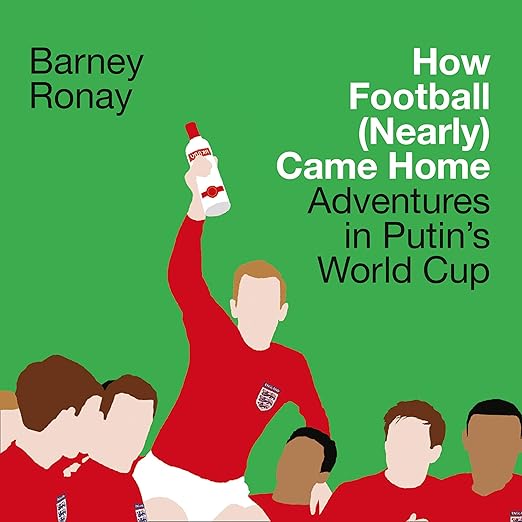
- Read by: Rupert Farley matches Ronay's literary register without ironing out the wit, giving the Russian landscapes and chaotic match-day scenes equal atmospheric weight.
- At its heart: National identity and sport, Putin's Russia as spectacle, collective hope and its fragility
- Vibe: Warm, elegiac, and unexpectedly funny
- Short version: Ronay writes football in the register of serious literature, and this audiobook captures an unlikely summer that still haunts English football fans in the best possible way.
Barney Ronay's account of England at the 2018 World Cup does something specific to football writing: it refuses to be merely about football. How Football (Nearly) Came Home arrives as a portrait of a strange summer in a stranger place, and Rupert Farley's narration gives Ronay's prose the literary weight it demands from the first chapter. This is not a match report compendium. It is something closer to a cultural diary from someone who watched England not screw it up for the first time in a generation and found that experience genuinely disorienting. The audiobook runs to 7 hours and 50 minutes, which is the right length for a book that wants to take its time with both the matches and the country hosting them.
The context Ronay establishes is important. England flew to Russia for the 2018 World Cup still reeling from the humiliation of the Iceland defeat at Euro 2016. Expectations were not merely low; they had been surgically removed. The squad had no real stars in the traditional sense, no overblown egos, no players who arrived trailing the kind of mythology that had previously crushed English hopes. Gareth Southgate wore a waistcoat and managed with a calm, fatherly manner that seemed almost deliberately anti-heroic. The nation, somehow, became invested in the waistcoat. Ronay was there to document all of it in person.
The Review
Ronay is one of the few football writers working today who can make a tactical observation and an observation about geopolitical theater share the same sentence without either element feeling out of place. His account of Russia as a host nation is not detached analysis. He was there, criss-crossing a country that was performing serenity and glamour over something considerably darker, and his notes on that dissonance are among the most interesting passages in the book. Putin and FIFA had stage-managed a tournament with extraordinary discipline, and the performance was so polished that the underlying realities were almost easy to overlook in the moment. Ronay does not let you overlook them, but he also does not let the political context swallow the genuine joy of what England were doing on the pitch.
The book's central pleasure is watching Ronay process the cognitive dissonance of allowing himself to believe. England squeaked past Tunisia, trounced Panama, and then had what he describes as a great tactical defeat to Belgium that opened up the favorable side of the draw to the final. They beat Colombia on penalties, which for English fans of a certain age felt roughly equivalent to discovering that gravity had been optional all along. Harry Maguire, dubbed Slabhead with enormous affection, became a folk hero. The waistcoat became a national symbol. It was a very specific, very English kind of madness, and Ronay captures its texture precisely.
Why How Football (Nearly) Came Home Works as an Audiobook
Farley's reading of Ronay's prose is the right casting choice for this material. Ronay writes in long, accumulating sentences that reward a narrator who understands their rhythm, and Farley does. He paces the comic deflations well and gives the more lyrical passages about Russia's landscapes and the specific loneliness of following a football team to a foreign country the space they need to breathe. One reviewer described the book as prose rather than just writing, which is a useful distinction. It reads differently than standard sports journalism, and Farley's performance honors that difference without making the book feel self-consciously literary.
Listeners who were not following the 2018 tournament closely may occasionally find the narrative assumes too much knowledge of specific matches or players. Ronay writes for a readership that lived through the summer and wants to revisit it rather than for newcomers arriving without context. But he is a skilled enough writer that the emotional logic of the story remains clear even without that background. The joy and the eventual deflation read as recognizable human experiences even for listeners who do not know a Panama from a Colombia.
The Caveats
The book earns its slight melancholy. England made the semi-final and lost to Croatia, and Ronay's account of that final act handles the deflation with an honesty that resists both dramatization and cheap consolation. The tournament did not deliver the trophy, and the title itself prepares you for that. But what Ronay argues implicitly throughout is that the summer of 2018 changed something about how English football was able to imagine itself, even if the change was ultimately incomplete. That argument is more interesting than a straightforward triumph narrative would have been, and it gives the book a durability beyond the specific result.
The passages about Russia as a setting, about the bizarre experience of attending a World Cup in a state that presented one face to visitors while maintaining a considerably different face elsewhere, have acquired additional resonance since 2018. Reading Ronay's observations now, they feel like dispatches from a moment that was more consequential than it appeared at the time, when a carefully constructed international image was still functioning as intended.
Who Barney Ronay Is Writing For
Any football fan with a connection to England's national team, particularly those who watched the 2018 tournament and want to revisit it through a finer lens, will find this audiobook absorbing. But Ronay's readership extends beyond fans who follow results. He writes for people who think sport is a lens through which a culture examines itself, and this book works at that level throughout. Skip it if you need narrative resolution, since England's near-miss is the point rather than a disappointment to be reframed. And skip it if you want tactical breakdown over cultural observation; Ronay is interested in what the football meant, not primarily in how it was played.
A Few Questions About How Football (Nearly) Came Home
Does this audiobook require deep knowledge of the 2018 World Cup to follow?
Not deeply. Ronay provides enough context for each match and player that casual followers can track the narrative. But listeners who watched the tournament will recognize details that add considerable texture to the account.
Is How Football (Nearly) Came Home an audiobook for general sports fans or primarily English football supporters?
Primarily English football supporters, though Ronay's broader observations about Russia as a host country and about sport and national identity make it interesting for readers beyond that core audience.
How does the audiobook handle the tournament's ending given that England did not win?
With honesty and a kind of earned sadness. The title signals what is coming, and Ronay's account of the semi-final defeat is one of the book's most well-crafted sections, resisting both melodrama and cheap consolation.
Is the audiobook narrated in a way that suits Ronay's literary prose style?
Yes. Rupert Farley matches the material's register well, giving the longer, more lyrical sentences room to land without losing momentum in the tighter, funnier passages.