Quick Take
- Narration: Tom Parks delivers Stanley’s philosophical arguments with appropriate gravity and clarity, handling dense academic prose without letting it become a lecture.
- Themes: Propaganda mechanics, democratic erosion, historical patterns of authoritarian rhetoric
- Mood: Dense, urgent, and intellectually demanding
- Verdict: A rigorous philosophical toolkit for understanding how democratic language can be weaponized against democracy itself, more relevant now than when it was first published.
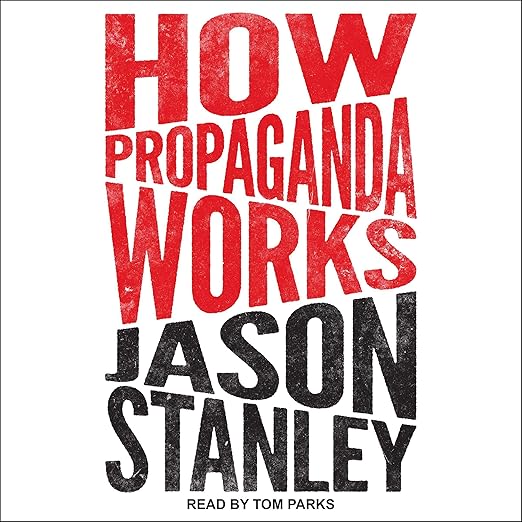
I should clarify something upfront: the audiobook listed here is Jason Stanley’s How Propaganda Works, a work of academic political philosophy published through Princeton Classics, not the more widely read How Fascism Works that Stanley published later. The metadata and synopsis describe the earlier, denser philosophical text, and that’s what this review addresses. It matters because the two books operate at very different registers and serve different audiences, and knowing which one you’re getting is important before you press play.
I came to this text during an election year, which is, I suspect, when most people find their way to Stanley. His central project in How Propaganda Works is to demonstrate that propaganda is not a relic of mid-century totalitarianism but a structural feature of democratic societies, including those that pride themselves on their resistance to manipulation. That argument is both more nuanced and more disturbing than the title suggests, and it takes real intellectual work to follow.
Our Take on How Fascism Works
Stanley’s philosophical method is to examine how democratic vocabulary, the language of freedom, equality, and civic participation, can be repurposed to undermine the very ideals it names. The example he returns to most forcefully is the restructuring of the US public school system at the turn of the 20th century, where the language of democratic education was used to replicate and reinforce racial hierarchies. This is not a case study in obvious propaganda. It’s a case study in how the manipulation of genuine ideals produces real injustice, and Stanley’s argument is that this mechanism is not historical but ongoing.
The reviewer who describes this as a work of philosophy and cautions that it “takes some effort for people who don’t have a philosophical background” is being accurate and fair. Stanley draws on concepts from analytic philosophy of language, on speech act theory and the logic of assertion and implication, in ways that he explains carefully but does not simplify into inaccessibility. This is the book’s greatest strength and its greatest challenge. The conceptual tools he provides are genuinely useful for understanding how public discourse can be manipulated, but acquiring them requires sustained attention.
Why Listen to How Fascism Works
Tom Parks is a strong narrator for this material. He handles Stanley’s sentence structure, which is precise in the way of academic philosophy, without flattening it. Parks reads at a pace that allows the arguments to land without lingering long enough to feel ponderous. For a twelve-hour philosophical text, this is a significant achievement in audio production, because the failure mode for this kind of material is narration that sounds like a very long lecture rather than a book you want to be inside.
The historical depth is one of Stanley’s particular contributions. The book doesn’t only describe contemporary propaganda; it grounds its analysis in specific instances drawn from American history, making the argument harder to dismiss as abstract or theoretical. Listeners who come in thinking that propaganda is something that happens in other countries and other eras will find that assumption systematically challenged by the time Stanley is done.
What to Watch For in How Fascism Works
The philosophical density is a genuine barrier. Reviewers who came from non-academic backgrounds and got through it describe working through the book slowly and carefully, and that’s the right approach. This is not passive listening material. You cannot engage with the argument while doing something else that requires attention, because the argument is the content, and each section builds on the previous one in ways that require you to hold earlier points in mind.
The book also works at a high level of abstraction, which is both its strength and its limitation. Stanley is interested in the structural features of propaganda, how it operates, why it works, what conditions it requires, more than in cataloguing its specific contemporary manifestations. Listeners who want a direct analysis of specific political figures or current events will find this more oblique than they hoped.
Who Should Listen to How Fascism Works
This audiobook rewards listeners who are willing to engage with it as philosophy: to slow down, to follow an argument across chapters, and to return to earlier sections when the reasoning requires it. If you came of age reading political theory or you have a background in philosophy, you will find Stanley’s analysis clarifying and genuinely illuminating about mechanisms that are otherwise hard to name.
Listeners who want a clear, accessible account of contemporary authoritarianism will be better served by Stanley’s later and more accessible How Fascism Works, which translates many of these ideas into a more readable format. This earlier text is for those willing to do the harder work of philosophical argument, and the audio format, while well-executed, doesn’t eliminate that requirement.
Frequently Asked Questions
Is the audiobook listed here How Propaganda Works or How Fascism Works?
The synopsis and content describe How Propaganda Works, Stanley’s earlier philosophical text in the Princeton Classics series. How Fascism Works is a separate, more accessible book. They cover related territory but at very different registers.
Is this audiobook accessible to listeners without a philosophy background?
It requires real effort. At least one reviewer without a philosophy background worked through it slowly and found it rewarding. Stanley explains his concepts carefully, but the argument builds cumulatively and doesn’t simplify its analytical vocabulary.
How does Tom Parks handle the philosophical prose in his narration?
Very capably. Parks maintains a deliberate pace that allows complex sentences to land without becoming ponderous. He reads the material with appropriate gravity and doesn’t let the academic register flatten into monotony.
Is this book more about historical propaganda or contemporary politics?
Both. Stanley uses historical examples, including the restructuring of the US school system in the early 20th century, to establish structural patterns that he then connects to contemporary democratic societies. The analytical framework is historical, but the implications are pointed directly at the present.