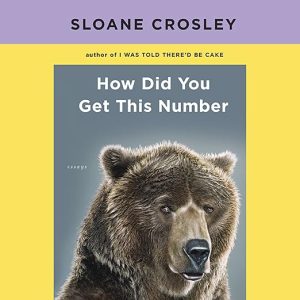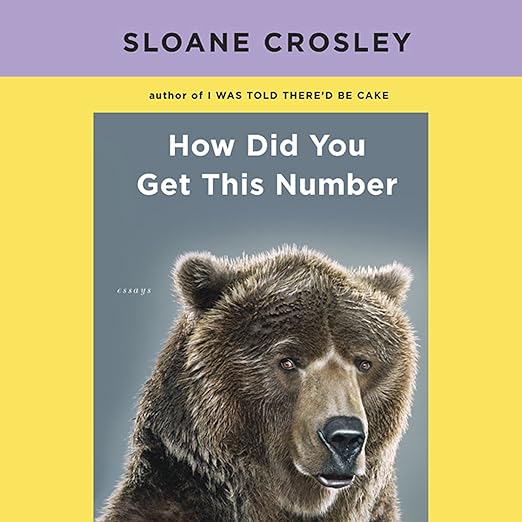
Sloane Crosley followed I Was Told There'd Be Cake, the essay collection that made her name, with a set of pieces that trade the entry-level chaos of her twenties for something a little more traveled and a little more complicated, and this audiobook is Crosley reading her own material, which for a comic essayist matters more than almost any other narration decision could. How Did You Get This Number takes her from a solo Paris wander to Portugal, chosen memorably by spinning a globe and putting a finger down, to an Alaska bridesmaid trip where the ceremonial 'bear bells' tied to everyone's ponytails stop being a joke the moment a grizzly cub actually shows up.
Self-Narration Beats a Borrowed Sedaris Impression
Self-narration is close to essential for this kind of essay collection, and Crosley earns that case immediately. Her comic timing on the page already reads as vocal, full of the kind of mid-sentence pivots and dry asides a hired narrator would have to reverse-engineer from scratch, and reviewer stjane's comment about laughing 'uncontrollably' suggests that timing survives the jump to audio intact. A real difference separates a professional narrator doing a competent David Sedaris impression from Crosley reading Crosley, and this audiobook falls squarely into the second category.
The synopsis's own comparison, Dorothy Parker mixed with David Sedaris, is doing real critical work, not just jacket-copy flattery. Crosley's essays share Parker's clipped, quotable wit and Sedaris's gift for turning a mundane travel mishap into a fully formed character study, and hearing her deliver her own punchlines confirms how deliberate the timing is on the page. The essays here also mark a shift from Cake's newcomer-in-Manhattan voice toward something more sophisticated, per the synopsis, and Crosley's narration tracks that maturity: the delivery is a shade less frantic, a shade more controlled, than a debut-collection reading might have been.
Crosley's background as a book publicist before she became a full-time writer is worth knowing, since it explains a certain professional fluency running through her prose, an insider's ease describing New York's literary and media world without ever needing to over-explain it to outsiders. That insider comfort shows up clearly in her narration too; she reads lines about book parties and publishing-world absurdities with the timing of someone who lived inside that world rather than observing it from outside.
For listeners who finish this collection wanting more, Crosley's catalog continued well past this title, including a novel, The Clasp, and a later essay collection, Look Alive Out There, both extending the same voice into new territory. How Did You Get This Number sits at a useful midpoint in her bibliography: past the least-polished debut-collection energy of Cake, not yet at the more settled, more overtly personal register of her later work, which makes it a genuinely interesting entry point for understanding how her voice developed over time.
The Alaska Bear Bells Earn Real Stakes
The travel pieces are where this audiobook is strongest, and the Alaska bridesmaid trip is the clearest example of why. What starts as a mildly absurd detail, bear bells nobody takes seriously, becomes a genuinely tense set piece once a grizzly cub actually intrudes, and Crosley's narration handles that tonal swing, from deadpan comedy to real physical stakes, without losing the humor entirely. Reviewer EJ's description, 'terrifically funny,' undersells how much control that swing actually requires from a narrator working without a script doctor to smooth the transitions.
Dash's review captures the book's other real strength: specificity. Calling out the essay 'Out of Water' by name suggests these pieces stick with listeners individually rather than blurring into a generic funny-woman-in-New-York memoir, a real risk for this subgenre given how crowded it has become since Cake's success. Crosley's growing comfort with genuine vulnerability alongside the comedy gives the book range that pure comedy audiobooks in this category often lack.
Audio Removes the Silent Reader's Translation Gap
Essay collections are a format that audio serves particularly well, arguably better than the printed page for comic material specifically, since a reader's internal voice while silently reading rarely matches a skilled comic writer's actual intended cadence. Crosley reading her own work removes that translation gap entirely; every pause for effect and every dry aside lands exactly where she meant it to, rather than where a silent reader's eye might have skimmed past it.
A Solid 4.2 Average from Just 365 Ratings
This is an essay collection, not a memoir with a single narrative arc, so listeners expecting one continuous story building toward a resolution should adjust expectations. Each piece stands alone, which makes the audiobook easy to dip into for a single essay during a commute but also means the emotional momentum resets between chapters rather than building cumulatively the way a structured memoir would.
At 4.2 stars from 365 ratings, reception is solid but not universal, and Crosley's specific, New York-inflected brand of humor is not going to land for every listener the way a broader comic voice might. The synopsis itself acknowledges she remains 'the unfailingly hilarious young Everywoman,' a real strength for readers who already love her voice from Cake, but listeners who found that first book's persona grating rather than charming are unlikely to be won over by more of the same sensibility, even with the added maturity.
One more calibration point: this collection sits between two very different modes, straightforward comic memoir and something closer to literary travel writing, and listeners drawn in purely by the promise of nonstop jokes may find some later essays slower and more reflective than the opening material suggests. That range is a genuine strength for readers wanting more than a joke delivery system, but it is a real shift in pace worth expecting.
Short-Burst Listening for Existing Crosley Fans
This audiobook is close to ideal for existing Crosley fans and for listeners who enjoy personal-essay humor in the David Sedaris or Samantha Irby tradition, especially anyone who prefers hearing comic essays performed by the person who actually lived them. It also suits short-burst listening: a single essay fits neatly into a workout or a commute without requiring the listener to track ongoing plot threads across the whole 6-hour-and-30-minute runtime.
Skip it if you have not read or listened to I Was Told There'd Be Cake and want to start with Crosley's strongest, freshest material; that earlier collection is still the better entry point for new listeners. It is also not the right pick for anyone allergic to a specifically Manhattan-centric, upper-middle-class version of comic memoir, since Crosley's world of book parties, apartment hunts, and international vacations is a real limitation on how universal the material feels.
Good to Know
Do I need to have read I Was Told There'd Be Cake before this audiobook?
No, the essays stand alone, but Crosley's earlier collection established the persona and comic voice this book builds on, so new listeners may get more context from starting there first.
Does Sloane Crosley narrate this audiobook herself?
Yes, and it matters. Her own comic timing, the pauses and pivots that make her prose funny on the page, comes through directly rather than being reinterpreted by a hired narrator.
Is this audiobook more travel writing or more personal memoir?
Both, blended. Essays move between international trips to Paris, Portugal, and Alaska, and closer-to-home material about New York apartments, friendships, and family, without committing fully to either genre.
How does the humor in this audiobook compare to Crosley's first collection?
The synopsis and reviewers both suggest it is more emotionally layered while staying just as funny, trading some of Cake's newcomer chaos for sharper, more controlled essays.