Quick Take
- Narration: Jeremy Bobb delivers Dalio’s layered economic arguments with clarity and appropriate gravitas, a demanding narration job handled with professional precision.
- Themes: The Big Debt Cycle, sovereign debt crisis, the political economy of financial collapse
- Mood: Urgent and sobering, with an underlying conviction that clarity is itself a form of hope
- Verdict: Dalio’s most alarming and arguably most necessary book arrives with the weight of a man who has been right before and is not enjoying being right again.
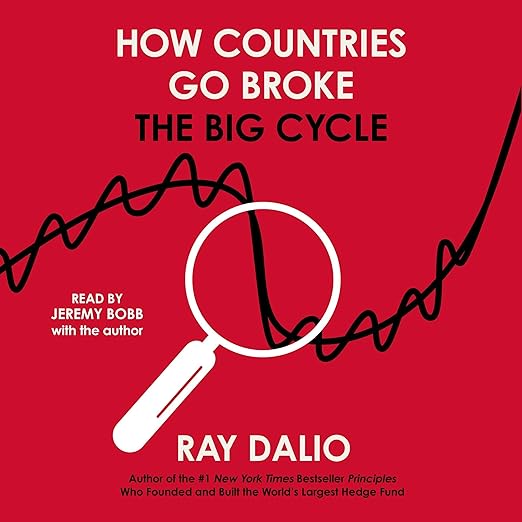
I started listening to How Countries Go Broke on a Sunday morning when the financial news had been particularly difficult for a week, and I spent the following three days finishing it on every available commute and lunch break. That is not entirely a comfortable experience. But it is an informative one, and discomfort in service of understanding is part of what serious nonfiction audio is for.
Ray Dalio needs no introduction in financial circles. His 2021 Principles for Dealing with the Changing World Order was already a substantial work on the rise and fall of empires and reserve currencies. How Countries Go Broke is his follow-up, and it is both more specific and more urgent. One reviewer compared Dalio to Hari Seldon from Asimov’s Foundation series, an economist who has unlocked the mathematical logic behind the rise and fall of nations. The same reviewer then wondered whether Dalio had become less Seldon and more Cassandra, warning of what is already underway. That shift in register is visible in the text itself.
The Big Debt Cycle Explained
The central intellectual contribution of How Countries Go Broke is Dalio’s detailed articulation of what he calls the Big Debt Cycle, a long-term pattern in which nations accumulate debt, reach a point where that debt becomes impossible to service through normal means, and then face a limited set of painful options: inflation, austerity, restructuring, or some combination. Dalio traces this cycle through historical examples and then applies the model to the United States, Europe, Japan, and China.
What distinguishes this from other macro-economic works is the layering Dalio builds into the text. One reviewer praised his writing for functioning like a tiered economics course, the overarching points are accessible to any attentive listener, while deeper dives into specific mechanisms are available for those who want them. Jeremy Bobb’s narration handles these tonal shifts well. He reads the accessible summary sections with appropriate directness and the more technical passages with a careful precision that keeps the listener from getting lost.
The case studies are where the theory gains its force. Dalio’s treatment of the 2010 to 2012 European debt crisis, which he correctly anticipated, grounds his model in recent, verifiable history before he applies it to the present moment. His analysis of Japan’s debt trajectory, and why Japan has managed to sustain debt levels that would have broken other economies, is one of the more illuminating sections for listeners who have followed the conventional wisdom on Japanese fiscal policy.
The American Situation
Dalio is careful, throughout, to frame his analysis as diagnostic rather than partisan. He is not arguing for any particular political solution. But the implications of his Big Debt Cycle model for the United States are not ambiguous: by his analysis, the country is in a late stage of a debt accumulation process that historically resolves badly for the reserve currency holder.
A reviewer described the book as complementary to The Fourth Turning, the generational cycle theory of Strauss and Howe. That parallel is instructive. Both frameworks share a commitment to historical pattern-recognition as a predictive tool, and both have been criticized for forcing complex contingent events into overly clean cycles. Dalio is aware of this criticism and addresses it with more nuance than The Fourth Turning typically does, he is careful to note where the model is probabilistic rather than deterministic.
The connection between debt problems and the other forces Dalio identifies, political polarization within nations, geopolitical competition between great powers, climate events, and the disruptions of AI, gives the book a scope that extends beyond financial analysis. Whether you find that scope illuminating or overwhelming may depend on your prior familiarity with Dalio’s framework from his earlier work. Readers coming to this without that context may find the final sections dense.
Solutions and Their Limits
The book’s framing promises that Dalio’s model points toward surprisingly straightforward solutions for dealing with debt problems in the US, Europe, Japan, and China. I would describe the solutions less as straightforward than as clear in their logic and politically improbable in their execution. The distance between knowing what would work and having the political will and institutional capacity to do it is, in Dalio’s telling, where most countries’ debt crises actually originate.
That gap, between analytical clarity and political reality, is both the book’s most honest moment and its most frustrating one. Dalio is too sophisticated a thinker to pretend the solutions are easy. But the framing sets up an expectation that the text does not fully satisfy. The closing sections feel somewhat rushed relative to the depth of the diagnostic sections that precede them.
At ten hours and available as a free audiobook, How Countries Go Broke is an essential listen for anyone trying to understand the macro-economic forces shaping the current moment. It will not make you feel better. It will make you better informed, which is the more valuable outcome. Start it on a morning when you have commuting time ahead of you and no urgent reason to feel optimistic about sovereign debt trajectories.
Henry Paulson’s blurb, that the book is a gift to humanity, is the kind of endorsement that can seem hyperbolic until you sit with what Dalio is actually arguing. He is making the case that the tools to understand and address sovereign debt crises exist, that the historical precedents are legible, and that the primary obstacle to better outcomes is not ignorance but political will. Whether that framing is hopeful or despairing depends on your prior confidence in political institutions. Dalio seems to hold both possibilities simultaneously, which is probably the most honest position available.
Frequently Asked Questions
Is How Countries Go Broke accessible to listeners without an economics background?
Yes. Dalio structures the book to function at multiple levels simultaneously. The core argument, what the Big Debt Cycle is and where various countries stand within it, is explained in terms accessible to any attentive listener. More technical sections are layered in as optional depth rather than prerequisites for following the main argument.
Do I need to have read Principles for Dealing with the Changing World Order first?
Prior reading helps but is not required. Dalio provides sufficient context for the broader framework within How Countries Go Broke itself. Listeners who have read the earlier book will have a richer foundation for the debt cycle analysis, but newcomers to Dalio’s framework will not be lost.
How does Jeremy Bobb’s narration handle the technical economic material?
Bobb is a capable narrator for demanding nonfiction. He navigates the layered structure of Dalio’s writing, shifting between accessible summary and technical depth, with professional clarity. He does not attempt to dramatize the material but reads it with a steady authority that suits the subject.
Does the book address the role of AI in the current economic situation?
Yes. Dalio includes AI among the forces he identifies as contributing to what he calls the Overall Big Cycle, the larger pattern of world order change within which the debt crisis is occurring. The AI discussion is not the book’s primary focus, but Dalio treats it as one of the significant variables in the economic and geopolitical transformation currently underway.