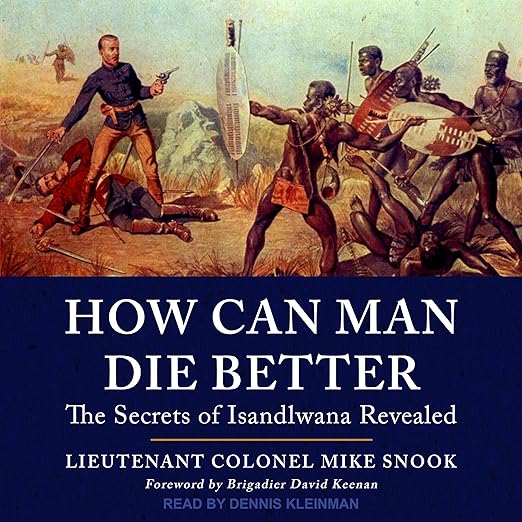
Quick Take
- Narration: Dennis Kleinman brings a soldierly directness to Snook’s military analysis, maintaining steady pace through the tactical detail without losing the underlying human stakes.
- Themes: The myth of instant British collapse at Isandlwana, Zulu military professionalism, the weight of command decisions under fire
- Mood: Methodical and intensifying, like a military briefing that gradually becomes something much heavier
- Verdict: The definitive audio treatment of Isandlwana for serious military history listeners, Snook’s insider authority reshapes what the documentary record actually shows.
I came to this one having seen the film Zulu Dawn twice and read one mainstream account of Isandlwana, which is to say I arrived with a serviceable mythology and very little actual understanding. By the time Lieutenant Colonel Mike Snook had finished dismantling the conventional account of January 22, 1879, I realized I had been carrying a comfortable falsehood for years. That process of replacement, of having something you thought you understood rebuilt from the ground up by someone who has both the scholarship and the professional military experience to do it properly, is exactly what the best military history sounds like when it is working.
Snook’s central revision is significant: the standard account of the Battle of Isandlwana holds that the British collapse was sudden and total, that the 24th Regiment was overrun quickly before it could mount an organized defense. Snook argues from tactical analysis and a re-reading of the surviving accounts that this is wrong. What actually happened, he contends, was a prolonged and disciplined defensive engagement against a Zulu force that was itself conducting a sophisticated and determined attack. Both sides, in his reconstruction, were performing at a high level. The collapse, when it came, came late and hard.
The Methodology of a Soldier-Historian
What separates this book from most popular accounts of colonial-era battles is the rigor with which Snook applies a serving officer’s professional knowledge to the physical and tactical evidence. He spent time at Isandlwana. He walked the ground. He applied what he knows about the behavior of infantry units under pressure to the question of what the available evidence can actually tell us about the battle’s timeline. This is not armchair reconstruction. When he argues that the British line held for longer than the conventional narrative allows, he is drawing on his understanding of how ammunition consumption works, how lines of communication break down under fire, and what the terrain would have dictated about unit positioning.
Dennis Kleinman’s narration serves this method well. He reads the tactical detail steadily and without the kind of performative drama that can undermine military analysis by making it feel like adventure fiction. When the argument becomes genuinely thrilling, which it does in the final defensive phases, Kleinman trusts the content to carry the weight rather than reaching for theatrical effect. That restraint is the right call for this material.
The Zulu as Professional Military Force
One of Snook’s most important contributions is his sustained attention to the Zulu army not as a savage horde but as a highly organized military institution with doctrine, discipline, and experienced command. The standard chest-and-horns formation, the coordination between impi groups, the Zulu commanders’ ability to manage a force of several thousand men across broken ground without modern communication: Snook treats all of this as the product of a sophisticated military culture. This framing is not merely politically appropriate; it is historically accurate, and it makes the battle more intelligible. The British were not defeated by chaos. They were defeated by an army that outmaneuvered them.
Some listeners have noted that the book’s level of tactical detail can be demanding without accompanying maps, and that is a fair observation. Snook references terrain features, unit positions, and directional movements frequently, and a listener who cannot visualize the ground will lose some of the precision in the argument. I would recommend finding a good battlefield map before starting. The core argument survives even without perfect geographical orientation, but the full satisfaction of following Snook’s reconstruction requires knowing roughly where the nek is relative to the donga.
The Companion Volume and What It Means for This One
How Can Man Die Better is the companion to Snook’s Like Wolves on the Fold, which covers the Battle of Rorke’s Drift. The two books were published separately and can be listened to in either order, but the logic runs from Isandlwana to Rorke’s Drift, since the latter engagement took place in the hours following the former. Together they form the most rigorous audio treatment of the opening of the Anglo-Zulu War currently available, and listeners who are drawn into Snook’s method here will find Like Wolves on the Fold covers the adjacent events with the same forensic care.
Who Should Listen, Who Should Look for Something Briefer
This is the audiobook for committed military history listeners who want more than narrative and want someone willing to argue a revisionist case from evidence. Those who prefer sweeping narrative over tactical reconstruction may find the pace demanding. For the audience it is written for, which includes anyone who has ever felt that the standard account of a colonial battle was too comfortable, Snook’s book is a rare thing: a work that changes what you thought you knew and shows you how it did so.
Frequently Asked Questions
Do I need to know the history of the Anglo-Zulu War before listening to How Can Man Die Better?
Basic familiarity helps considerably. Snook provides context but moves quickly into tactical analysis. Listeners who have seen the films Zulu or Zulu Dawn, or who have read even a brief account of the battle, will follow the argument much more easily than those coming in cold.
Is this book accessible to listeners without military training, or does it assume knowledge of tactics and unit organization?
Snook writes for an informed general reader rather than a specialist audience. He defines tactical concepts when they are introduced, and the core argument is followable without military background. That said, listeners with some understanding of Victorian British infantry formations will get more from the detailed reconstruction sections.
How does Snook’s account of Isandlwana differ from the version presented in the film Zulu Dawn?
Substantially. The film, like most popular accounts, presents the British collapse as rapid and disorganized. Snook argues from tactical and documentary evidence that the regiment fought a prolonged defensive engagement and that the collapse came much later in the battle than the conventional account suggests.
Should I listen to How Can Man Die Better before or after Like Wolves on the Fold?
Isandlwana preceded Rorke’s Drift chronologically, so How Can Man Die Better comes first. Most reviewers recommend this order, and the companion volume explicitly assumes familiarity with the earlier battle.