Quick Take
- Narration: Peter Berkrot delivers the academic argument with measured clarity, keeping the data-dense passages accessible without dumbing them down.
- Themes: Household debt and financial crises, systemic risk-sharing reform, policy bias toward creditors
- Mood: Urgent and analytical, like sitting in a lecture that keeps rewriting what you thought you knew
- Verdict: A lean, rigorously argued case for rethinking how debt works that holds up long after the crisis it was written about.
I came to this one during a stretch when I was trying to make sense of financial crisis literature as a genre. I had already spent weeks with Hank Paulson’s memoir and Michael Lewis’s big-picture narratives, and I was starting to feel like I understood what happened in 2008. Then I listened to Atif Mian and Amir Sufi dismantle that understanding in under seven hours, and I had to sit with it for a few days before I felt ready to write anything about it.
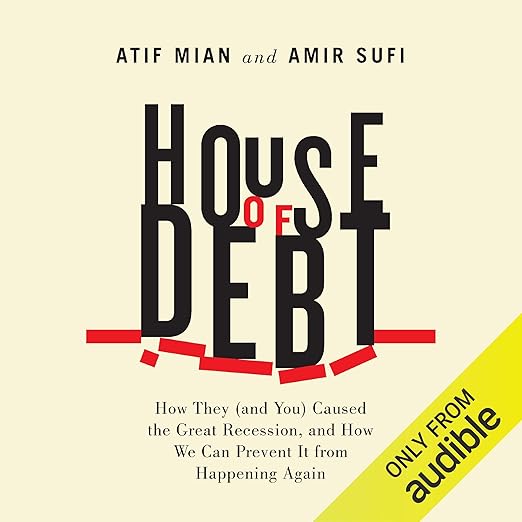
House of Debt is not a crisis narrative. It does not follow bankers through sleepless nights or reconstruct the moment Lehman collapsed. What it does instead is more uncomfortable: it argues, with careful and damning empirical evidence, that the popular understanding of the Great Recession is wrong. The banking crisis was real, but it was not the cause. The cause was household debt, and what made the recession so deep and so slow to recover from was the collapse in spending by over-leveraged homeowners. That argument sounds obvious once stated, but Mian and Sufi do the work of proving it, and the proof changes how you read everything else about that period.
The Argument That Rewrites the Narrative
The core insight is this: when households take on too much debt secured against assets that can fall in value, any significant drop in asset prices creates a catastrophic and asymmetric loss. Creditors hold fixed claims; debtors absorb the entire downside. A homeowner who borrowed $200,000 against a house worth $250,000 and now sees that house worth $150,000 is not just underwater on paper. She is cut off from the spending she would otherwise do, and multiplied across millions of households, that pullback in consumption destroys jobs and demand throughout the economy. The banks suffer, but they suffer because the real economy collapsed, not the other way around. This reversal of causality is the book’s central provocation, and the authors build it methodically using zip-code-level data that tracks debt, spending, and job losses with unusual precision.
One reviewer from the United Kingdom described it as packing enormous amounts of economics into 187 pages without ever talking over the listener’s head. That is accurate. The writing is unpretentious to a degree that is almost surprising given the pedigree involved. Mian was at Princeton, Sufi at Chicago, ideologically opposing institutions in economic research, and yet their collaboration here produces something unified and clear-eyed. A reviewer coming from the Austrian tradition noted that despite significant political disagreements with the authors, he found this the best book written on the subject. That kind of cross-ideological respect says something about the quality of the underlying work.
Where the Book Divides Its Readers
The first half of the audiobook, which delivers the diagnosis, earns near-universal praise. The second half, which proposes solutions, is where listeners start to diverge. The authors advocate for a fundamental restructuring of mortgage contracts away from fixed debt obligations toward shared-appreciation mortgages, where lenders absorb some of the downside when home values fall. One reviewer called the analysis brilliant and the solutions obviously impractical. That split is real. The policy prescriptions require coordination across a financial system that has every incentive to preserve its current structure, and the authors acknowledge this without fully resolving it.
What the second half does accomplish, even if you find the specific proposals unpersuasive, is clarify what a solution would need to look like at a structural level. The problem is not that banks lent recklessly, though they did. The problem is that the instrument they used, the fixed mortgage contract, is a tool that transfers all volatility onto the party least able to absorb it. Reforming that instrument is not a political preference; it is a mathematical necessity if the goal is preventing future crashes of similar severity.
Peter Berkrot’s Narration in a Data-Heavy Text
Peter Berkrot does what this kind of audiobook demands: he stays out of the way. The writing is precise and the argument is sequential, and what it needs is a voice that treats the listener as capable of following along without constant signposting. Berkrot provides that. He does not editorialize, does not punch for emphasis at moments that should carry their own weight, and handles the transition between empirical sections and policy argument without losing the thread. For a book that relies heavily on the cumulative force of evidence, that restraint is the right call.
At six hours and forty-two minutes, the runtime is short for the ambition of the subject. This is not a book that meanders. If you find yourself losing the thread of the argument at any point, the answer is usually to back up ten minutes rather than push forward. The sequencing is careful enough that a missed step early can make the later sections feel less grounded than they are.
Who Should Listen and Who Should Skip
This audiobook rewards listeners who want to understand financial crises at a structural level rather than through personalities and drama. It is particularly valuable for anyone who found mainstream crisis narratives satisfying but is now ready to interrogate their assumptions. Listeners who already follow academic economics debates will find the core argument familiar but will appreciate the clarity with which it is presented for a general audience.
Skip this if you are hoping for narrative tension or character-driven storytelling. The book is entirely argumentative in structure, and if you need a story to hold your interest through economic analysis, you will struggle with the middle sections. Also be aware that the policy proposals in the second half require some tolerance for institutional friction and long-horizon thinking. The solutions are structural, not individual, and the book does not pretend otherwise.
Frequently Asked Questions
Do Mian and Sufi argue that banks played no role in causing the Great Recession?
No. They acknowledge that reckless bank lending was part of the picture. Their argument is that the severity and duration of the recession was driven primarily by the collapse in household spending that followed the debt overhang, not by the banking crisis itself. Banks suffered, but as a consequence rather than the root cause.
Is the audiobook accessible to listeners without an economics background?
Yes. Multiple reviewers across different political and professional backgrounds describe the writing as clear and unpretentious. The authors present their empirical data in plain English, and Peter Berkrot’s narration maintains that accessibility throughout. Familiarity with basic economic concepts helps but is not required.
What is the shared-appreciation mortgage the authors propose, and does it seem realistic?
A shared-appreciation mortgage would allow lenders to participate in home-value gains in exchange for absorbing some of the downside when values fall. The authors present it as a structural solution to the asymmetric risk built into fixed mortgage contracts. Reviewers are divided on whether it is politically and practically achievable, with some finding it brilliant in theory and unworkable in practice.
How does this book compare to other 2008 crisis accounts like Michael Lewis’s The Big Short?
House of Debt is fundamentally different in approach. Lewis builds narrative and character; Mian and Sufi build argument and evidence. The two books are not competing but complementary. If Lewis gives you the human drama of the crisis, House of Debt gives you the structural explanation for why it hit ordinary households so hard and for so long.