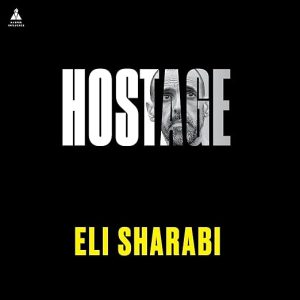
Eli Sharabi's Hostage arrives with a specific and verifiable weight: it is the first memoir published by a released Israeli hostage from the October 7th attacks, and it was reportedly the fastest-selling book in Israel's history. Those facts do not themselves make it a good audiobook, but Geoffrey Cantor's narration earns the comparison reviewers have drawn to Elie Wiesel's Night and Laura Hillenbrand's Unbroken. The craft here is the craft of witness, and Cantor treats the material with precisely the restraint that witness requires.
Sharabi was dragged barefoot from his home in Kibbutz Be'eri on the morning of October 7, 2023, while his wife Lianne and their teenage daughters Noiya and Yahel watched. He spent 491 days in Hamas captivity. His wife and daughters did not survive. The audiobook is a first-person account of those days, narrated in a voice that alternates between present-tense captivity and memory, and Cantor's ability to hold both registers simultaneously without collapsing into sentimentality is one of the central achievements of this production.
Why It Works in Audio
The question of craft in a memoir like this is not incidental. The review from H. G. Heren IV describes the book as joining "the lineage of first person accounts that have shaped humanity's understanding of suffering and resilience," placing it alongside Night and Escape from Camp 14. That is a high claim, but it reflects something real about what Sharabi has accomplished structurally. He does not write as a victim cataloguing grievances. He writes as a man who made repeated, deliberate choices to remain alive and to remain himself, and the interior monologue that runs through the captivity narrative gives the book its philosophical spine.
The passage quoted in the synopsis captures the quality of that voice: "I refuse to let myself drown in pain. I am surviving. I am a hostage. In the heart of Gaza. A stranger in a strange land." The staccato rhythm is not accidental. Sharabi writes in short declarative sentences during the captivity sections, and Cantor delivers them with measured spacing that makes each sentence carry its own weight. This is exactly the right interpretive choice: the fragmentation of the sentences mirrors the psychological fragmentation of prolonged captivity while refusing to collapse into incoherence.
Reviewer Lynn Rutman's observation that the book does not merely rehash what was already reported in the news is important for potential listeners who may feel they already know the story. Sharabi's account moves into territory no news report reached: the specific textures of starvation, the complicated dynamics with captors and fellow hostages, the way hope and despair alternated in patterns he learned to read and manage. The reviewer Mommzy identifies the recurring theme of choice as the book's moral center: even in conditions designed to eliminate agency, Sharabi locates agency in the internal refusal to accept that he is already lost. That insistence on choice, repeated across 491 days, is what gives the memoir its ethical weight alongside its emotional one.
The camaraderie forged in captivity, mentioned in the synopsis, deserves more attention than the brief synopsis suggests. Sharabi writes about the relationships formed with other hostages as a form of survival technology: the shared knowledge of who can be leaned on, who is crumbling, who has reserves of humor or steadiness that others can borrow. Cantor renders these relationships with the same restraint he applies to the darker material, which keeps them from tipping into sentimentality while preserving their genuine importance to Sharabi's survival.
What to Watch For in Hostage
This audiobook should be approached with the awareness that it contains material of genuine psychological weight. The accounts of starvation, physical beatings, isolation, and the eventual revelation of what happened to Sharabi's family are not softened for the listener's comfort. Cantor does not dramatize the violence, but he does not diminish it either. The five-hour-and-twenty-four-minute runtime is condensed but not rushed; the brevity reflects Sharabi's writing style rather than any editorial decision to spare the listener.
The book's political context will be inescapable for some listeners, and it is worth being clear about what kind of document this is. Hostage is a personal memoir, not a geopolitical analysis. Sharabi is writing about what happened to him and his family. He is not adjudicating the broader conflict or arguing a political position. The genre framing calling for analytical balance is less applicable here than to a policy book; this is testimony, and its terms are human rather than analytical.
The audiobook's relatively low rating count of three reviews reflects early rather than settled reception; all three reviews rate it five stars, and the synopsis indicates the book's significance in the broader culture. This is a title that will accumulate reviews over time as its readership grows. The production quality and Cantor's performance are commensurate with the gravity of the subject.
Who Will Get the Most From It
This audiobook belongs in the company of the twentieth and twenty-first century's most important firsthand survival narratives. Listeners who have been moved by Night, Unbroken, or Viktor Frankl's Man's Search for Meaning will recognize the tradition Sharabi is working within and will find this a worthy addition to it. The audio format, with Cantor's performance, adds a dimension of emotional immediacy that makes an already powerful text feel direct and present.
Listeners who need distance from the October 7th subject matter for their own wellbeing should approach carefully. This is not a book that offers resolution or consolation in any easy sense; it offers the harder and more durable thing, which is evidence that a human being can survive the unsurvivable and come back with language adequate to what happened. That is not a small offering, and the audiobook delivers it with full seriousness.
Before You Listen
Is the audiobook of Hostage suitable for listeners who do not follow Middle Eastern politics closely?
Yes. Sharabi writes from the position of a survivor telling his personal story rather than a political commentator analyzing the conflict. Some basic awareness of the October 7th attacks is helpful context, but the book's power comes from its intimate human scale rather than from geopolitical argument.
How long is the Hostage audiobook and does the runtime feel adequate given the scope of the events described?
At five hours and twenty-four minutes it is briefer than many survival memoirs, but the brevity reflects Sharabi's writing style rather than any shortage of material. The narrative is dense with detail and does not feel compressed or rushed.
Does Geoffrey Cantor's narration add meaningfully to the audiobook experience of Hostage?
Very much so. Cantor's award-winning theatrical background informs a performance that is controlled and serious without becoming detached. His delivery of the staccato captivity passages is particularly strong, allowing the fragmented rhythm to land as it was intended.
How does the audiobook of Hostage compare to other recent first-person survival memoirs in the format?
Reviewers have placed it alongside Elie Wiesel's Night and Laura Hillenbrand's Unbroken, both of which are strong audiobook titles in their own right. Hostage is more compressed than Unbroken and more immediate than Night, occupying a space closer to live testimony than literary recollection.