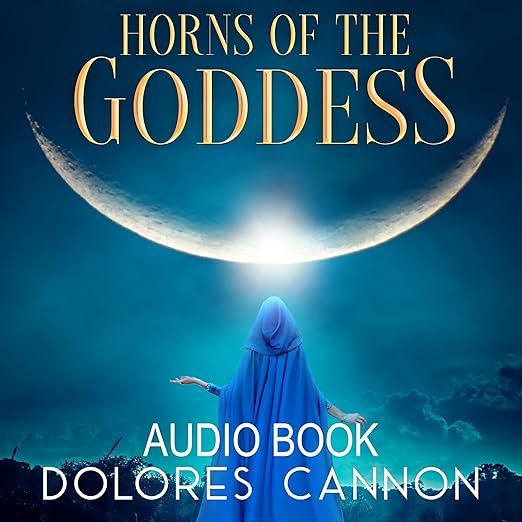
Quick Take
- Narration: Moe Egan delivers a measured, grounded performance that keeps the hypnotic regression sessions from veering into the theatrical, a steady voice for extraordinary material.
- Themes: Past life regression, Druidic persecution, the Inquisition’s suppression of earth-based faiths
- Mood: Quietly absorbing and contemplative, with stretches that read almost like oral history
- Verdict: A rewarding listen for those already sympathetic to past life research; newcomers may find the lack of editorial skepticism a barrier.
I started listening to Horns of the Goddess on a Sunday afternoon in October, when the light was going amber and there was nothing pressing to do. I had been curious about Dolores Cannon for a while but had always reached for something else first. This time I let it run, and before I knew it two hours had passed without my noticing. That is not a small thing for a book of this kind, which asks its listeners to accept a set of premises, past life regression, deep hypnotic trance states, literal memory carried across incarnations, that mainstream critical culture tends to dismiss out of hand.
Published posthumously, Horns of the Goddess draws on sessions Cannon conducted in 1983, early in the development of what she called her own method of hypnotic induction. Three volunteers regressed to lives lived during the time of the Druids, offering accounts of what it meant to practice a faith rooted in Mother Earth while the Inquisition hunted precisely such communities. The book is framed as a transcript of those sessions, with Cannon guiding and occasionally marveling at what surfaces. That structure, conversational, unpolished in places, shaped more by the logic of a session than by conventional narrative, is central to understanding what this audiobook is and is not.
The Method at the Center of Everything
Cannon’s technique is the real subject of this book, even more than the Druids themselves. She developed a form of induction that brought clients into what she described as a very deep state of trance, deep enough that they would respond to the past-life context as if physically present in it. She notes in the framing material that if a subject traveled to a period before electricity, asking about lightbulbs would draw a blank, the subject simply would not have the referent. Whether one reads this as evidence of genuine past life access or as the logic of a highly suggestible trance state, the consistency across three separate volunteers is one of the book’s most compelling details. The listener has to decide what to do with that consistency, and the book offers no guidance. Cannon records; she does not adjudicate.
One reviewer noted that the book captures something she especially valued: Cannon’s newness as a researcher. The sessions have a quality of discovery that her later, more systematic work sometimes loses. She is figuring out the edges of her own method in real time, and that uncertainty gives the transcripts a texture that feels more honest than polished.
Living Among the Druids, According to the Trance
The content of the regressions is detailed and, taken on its own terms, immersive. Life in a Druidic community is presented as both spiritually rich and materially precarious, with the constant threat of the Inquisition shaping the community’s behavior in ways that resonate uncomfortably with any history of religious persecution. The three volunteers describe practices, social structures, and a relationship to the natural world that align broadly with what historians have reconstructed, though the Inquisition’s documented reach into areas of Celtic tradition is historically contested, and the book makes no attempt to situate its accounts within that scholarly debate.
Several listeners reported a sensation of recognition while listening, a feeling that the material was surfacing something they already knew. That is a difficult response to evaluate critically, but it is worth noting as a data point about the emotional experience the audiobook produces. Whatever one believes about its metaphysical claims, it clearly functions as a kind of resonance chamber for certain types of listeners.
Moe Egan in the Narrator’s Chair
Moe Egan reads with a composure that suits the material well. This is not a narration that reaches for drama; it is one that trusts the content to carry its own weight. The hypnotic regression transcripts could easily tip into unintentional parody in less careful hands, imagine a narrator who overemphasizes every revelation, leaning into the spiritual theater of it all. Egan does the opposite. His pacing is measured, occasionally unhurried to a fault in the quieter expository passages, but that restraint pays dividends when the regression accounts themselves begin to build. His voice does not differentiate sharply between the three volunteers, which can create mild confusion about who is speaking, but the sessions are sufficiently distinct in content that listeners rarely lose the thread for long.
Who This Is for and What It Will Cost You
The honest answer is that this audiobook belongs to a specific readership, and it knows it. Cannon herself would have had no interest in writing for skeptics, and Horns of the Goddess does not make any concessions in that direction. There is no scientific framing, no acknowledgment of alternative explanations for what the sessions produce, and no engagement with the critical literature on hypnotic confabulation. If that is a dealbreaker, the book will frustrate you from the first chapter.
But if you come to this already interested in past life research, or in the history of earth-based spiritualities and their suppression, or simply in the way that Cannon’s method creates a particular kind of intimate oral history, you will find nearly fourteen hours that pass more quickly than expected. The sessions centered on Druidic life carry a quiet authority, and the book’s final note, Cannon’s characteristic assertion that those who were silenced by the burning times are back, lands with a kind of defiant warmth that her longtime readers will recognize immediately. For those new to her work, this earlier, rougher-edged volume is actually a better introduction than her more systematized later titles.
Frequently Asked Questions
Is Horns of the Goddess the right starting point for someone new to Dolores Cannon?
It is a surprisingly good entry point because it captures Cannon early in her research, when she was still discovering the edges of her own method. The sessions feel less scripted than some of her later work, and the framing is simpler. That said, listeners who want a more fully developed system should try Conversations with Nostradamus first.
Do the three past-life accounts in this book overlap or contradict each other?
They are complementary rather than contradictory. All three place their subjects in a Druidic community under threat from the Inquisition, but each account focuses on different aspects, social life, spiritual practice, and individual experience respectively. Cannon presents them as mutually reinforcing rather than as independent corroboration.
How does Moe Egan handle the distinction between Cannon’s narration and the regression transcripts?
Egan uses a subtle shift in tone and pacing to mark the transition between Cannon’s framing text and the session transcripts, but the differentiation is modest. Listeners who prefer clearly differentiated voices for different speakers may find the experience blurs slightly, though the content itself keeps the two registers distinct.
Is Horns of the Goddess available as a free audiobook through Audible membership?
Yes, Horns of the Goddess is currently available as a free audiobook for Audible members, making it an accessible way to explore Dolores Cannon’s earlier research without a separate purchase.