In Brief
- Narration: James Naughton's narration is calibrated and authoritative without being ponderous; he handles Lopez's layered, essayistic prose with the respect it demands and never rushes the quiet passages.
- Themes: The long history of human exploration and its costs, ecological grief and resilience, the search for meaning in a broken world
- Mood: Slow, monumental, and quietly devastating in the way that only the best nature writing can be
- Verdict: Lopez's final major work is among the most ambitious pieces of American nonfiction in recent memory, and it rewards listeners willing to move at its pace.
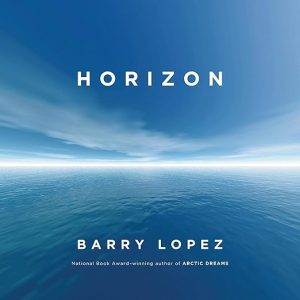
Barry Lopez died in December 2020, on Christmas Day, in Oregon, not far from the landscape he opens Horizon with. He had been diagnosed with prostate cancer while finishing the book, and knowing that gives the final chapters, set in Antarctica, an additional weight that is hard to separate from the text itself. I started listening to Horizon in late autumn, driving north through a stretch of highway where the trees had given up their leaves and the light was doing what it always does at that time of year, going somewhere else. It felt like the right season for a book about the edge of things.
Horizon is not a travel memoir in any conventional sense. It is, as one reviewer described it, a 500-plus page epic compilation of a lifetime of essays, observations, and scientific research. Lopez spent nearly five decades traveling to the places covered here: the coast of Western Oregon, the High Arctic, the Galapagos, the Kenyan desert, Botany Bay in Australia, and finally the ice shelves of Antarctica. What he has produced is not a record of journeys so much as a sustained meditation on what it means to travel through a world that human beings have already damaged nearly beyond recovery, and still find in it something worth the attention.
The Review
The six geographic sections of Horizon are not chapters in the usual sense. Each is an essay of enormous scope, ranging from ancient geology and archaeological record to contemporary ecological crisis to the specific, closely observed detail of a bird's behavior or a fossil's texture. Lopez moves freely across time scales in a way that is simultaneously dizzying and orienting: a single page might move from prehistoric peoples crossing Skraeling Island to a colonialist expedition to his own observations in the present, and the effect is not confusion but depth. He is building a picture of human presence on Earth that extends well beyond individual lives.
Reviewer Dennis Corrigan described the book as being about resilience: the resilience of things, species, cultures, and environments against harsh conditions, exploitation, and irresponsibility, and that framing holds. Lopez does not write from hope in the conventional, encouraging sense. He writes from something more austere: a commitment to witness, to look clearly at what has been done and what remains, and to refuse the consolation of turning away. Reviewer Tardigrade compared him to David Quammen and noted that Lopez's message is more grave and fundamental, that he is one of the best elders a society struggling with ecological crisis could have. That comparison is apt. This is wisdom writing in the oldest sense of the term.
Why Horizon Works as an Audiobook
At almost twenty-three hours, Horizon is a significant commitment, and James Naughton's narration is one of the reasons it holds together across that length. Naughton does not perform Lopez's prose; he renders it, which is the right instinct. Lopez's sentences require a narrator who trusts them, who can move through a long, syntactically intricate passage without forcing pace or emphasis, and who can sit with the quiet the writing earns. Naughton does this consistently, and the effect over many hours is a kind of sustained attention that mirrors the attention Lopez himself brings to the places he describes.
The essayistic nature of Lopez's prose, full of long digressions, subordinate clauses, and moments where he pauses to think on the page, is something that the audiobook format handles differently than the printed book. In audio, you cannot skim or page back easily, which means the density of each section is experienced more linearly than a reader might approach it. Reviewer ALJ noted that the thematic threads are layered and nuanced, and that this is a book that demands a slow read and a second read. In audio, that second-read function may be served by returning to individual sections rather than the whole, particularly the High Arctic and Antarctica chapters.
The Caveats
The reviews of Horizon tend to cluster around superlatives: monumental, masterpiece, enlightening, 2019 book of the year. What they do not always convey is how quietly unsettling the book is to sit with over time. Lopez is not writing a crisis document with a call to action. He is writing something closer to a reckoning: a full accounting of what the human species has been, what it has cost the world it moved through, and what, if anything, might be salvageable in the relationship between people and the places they inhabit. The Antarctica section is the most exposed. Lopez writes about the ice with the attention of someone who knows that what he is describing is disappearing, and who chooses to describe it anyway, precisely and slowly.
The New York Times, NPR, and the Guardian all named Horizon among the best books of its year, and those recommendations are not overstatements. This is a major piece of American nonfiction by a writer who spent a lifetime earning the authority to write it. Listen if you are willing to give twenty-three hours to a book that will not reward speed. Skip if you need narrative momentum and clear forward drive; this is an essay collection with a unified sensibility rather than a story with a destination.
Who Should Pick Up Horizon
The reviews of Horizon tend to cluster around superlatives: monumental, masterpiece, enlightening, 2019 book of the year. What they do not always convey is how quietly unsettling the book is to sit with over time. Lopez is not writing a crisis document with a call to action. He is writing something closer to a reckoning: a full accounting of what the human species has been, what it has cost the world it moved through, and what, if anything, might be salvageable in the relationship between people and the places they inhabit.
The Antarctica section, which is the book's final movement, is the most exposed. Lopez writes about the ice with the attention of someone who knows that what he is describing is disappearing, and who chooses to describe it anyway, precisely and slowly. The New York Times, NPR, and the Guardian all named Horizon among the best books of its year, and those recommendations are not overstatements. Listen if you are willing to give twenty-three hours to a book that will not reward speed. Skip if you need narrative momentum and clear forward drive; this is an essay collection with a unified sensibility rather than a story with a destination.
Before You Listen
Is Horizon a single narrative or more of an essay collection? How does that affect the audiobook experience?
It is six long, interconnected essays organized by geography, each of which spans decades and scales of history. In audiobook form, this means the listening experience is more meditative than propulsive. Listeners who expect a linear journey narrative will need to adjust their expectations; those comfortable with the essay form will find it rewarding.
How does James Naughton's narration handle Lopez's very long, syntactically complex sentences?
Naughton handles them with patience and without forcing pace or artificial emphasis. His approach is to render rather than perform, which is the correct instinct for prose this carefully made. The narration never feels rushed or over-interpreted.
Horizon was praised by major outlets before Lopez's death in 2020. Does knowing about his illness and death change how the book reads?
For many listeners, yes. The Antarctic section, which is the book's final movement, carries a particular weight when you know Lopez was finishing it while facing a terminal diagnosis. This does not make the book a different work, but it adds a layer of biographical context that many readers find deepens the experience rather than changing it.