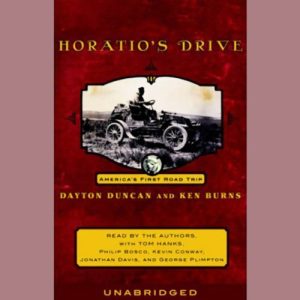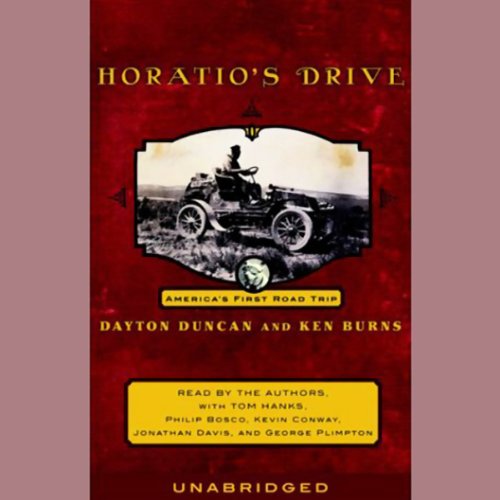
Dayton Duncan's authorial voice has a quality that is difficult to manufacture: he sounds like someone who genuinely cannot believe how good this story is and wants to make sure you understand why. Horatio's Drive, his companion audiobook to the PBS documentary about Horatio Nelson Jackson's 1903 cross-country automobile journey, is that rarity: a history narrated by its author with the infectious pleasure of someone who discovered something wonderful in the archive and never fully got over it.
The Verdict, Briefly
The facts of Jackson's journey are almost too good to be true. In 1903, there were 150 miles of paved roads in the entire United States. Most Americans had never seen an automobile. A thirty-one-year-old Vermont doctor impulsively bet fifty dollars that he could drive a 20-horsepower car from San Francisco to New York City. He did it, eventually, over months of spectacular mechanical failure, navigational disaster, and sheer stubborn optimism. He brought his mechanic, Sewall Crocker, and partway through acquired a bulldog named Bud who wore driving goggles and became something of a national celebrity. The letters Jackson sent his wife along the route, included in the book, have the quality of dispatches from a man who is unreservedly having the time of his life even when the car is mired in a Wyoming mud hole.
Duncan tells this story with the economy of someone who has made documentaries and knows exactly which details carry the most weight. At three hours, the audio is compact and perfect for the material. This is not a story that needs stretching; it needs the right images in the right order, and Duncan provides them.
What Makes Horatio's Drive Worth Hearing
The audiobook captures what is fundamentally a kinetic story: the sensation of moving through a landscape that has never seen a vehicle like this, through small towns where Jackson's open-air Winton drew 'delirious excitement,' in Duncan's phrase. The letters to Jackson's wife are among the best primary source material in any popular American history, and hearing Duncan read them gives the journey an immediacy that bridges 120 years without effort. Jackson was, in his own words and by consistent evidence, a man possessed of 'a deep thirst for adventure,' and that quality comes through in every dispatch he wrote from the road.
One reviewer who came to the audiobook after watching the Ken Burns documentary by the same title found the book a complementary experience. The audio version cannot deliver the 146 photographs and the map that the print edition contains, and listeners should know this going in. The photographs, nearly one hundred of them taken by Jackson himself, showing a country still built around the horse-drawn carriage, are a significant part of the book's appeal in print. In audio, Duncan describes some images verbally, but this is a meaningful difference between the two formats. Listeners who want the full visual documentation should prioritize the print edition or watch the documentary alongside the listen.
Points to Consider
The three-hour runtime means this is a companion volume in scale as well as name. It is a thorough account of the journey but not an exhaustive one. One reviewer noted they 'would have liked more text and details,' which is a real observation about a volume that presents a story worthy of deeper treatment while keeping its scope deliberately manageable. The companion documentary covers the same material visually and will enhance the listening experience for those who access both.
The historical context Duncan builds around Jackson's journey, the state of American roads in 1903, the cultural novelty of the automobile, the towns and landscapes the journey passed through, gives the trip its proper meaning. This was not just an adventure; it was the first chapter of a story that would reshape the physical structure of the entire country within two generations. Duncan is aware of this, and while he does not belabor the symbolism, he gives it enough weight that the journey feels significant rather than merely amusing. One reviewer called it the 'origin story for road tripping in the USA' and lamented that more people don't know it, a sentiment that explains why this book found its audience through both the documentary and the written word.
Who Should Listen to Horatio's Drive
Listeners who love American history with genuine characters and a propulsive narrative line will find this three hours of pleasure rather than work. Road trip enthusiasts, car history buffs, and anyone who has ever felt the specific American pull of an open road will find this the right origin story. Ken Burns fans who have seen the documentary will find the book a natural companion that deepens the experience with Jackson's own words. Listeners who primarily want the visual documentation of Jackson's photographs should prioritize the print edition; the audio version holds up on its own but the absence of the imagery is real. Those looking for a substantial, multi-hour history of early American motoring will want to supplement this with longer works, but as an introduction to one of the great American adventure stories, this is the right place to start.
The self-narrated audiobook has a quality that general-interest history listeners will appreciate: Duncan reads as if he is telling this story to someone who hasn't heard it yet and is visibly delighted to be the one doing the telling. That quality is rarer than it should be in historical audio, and it makes three hours feel like the right length rather than a frustrating constraint.
Frequently Asked Questions
Does this audiobook work without access to the photographs in the print edition?
It works, but the photographs are a notable absence. Jackson took nearly 100 photographs of his journey, and they are integral to the book's appeal in print. The audio version relies on Duncan's verbal descriptions, which are vivid but cannot fully replace seeing a roofless 1903 automobile navigate frontier roads through small-town America.
How does Dayton Duncan narrating his own audiobook compare to a professional narrator for this kind of historical material?
The self-narration is an asset here. Duncan has spent years with this story and reads with genuine enthusiasm rather than professional neutrality. For material built partly on the author's own delight in discovering a remarkable piece of American history, that personal voice matters significantly to the experience.