Home With a Permanently Disabled Body
Hope Heals succeeds at something most survival memoirs do not attempt: Katherine Wolf narrates her own audiobook after relearning, quite literally, how to form words again following a massive brain stem stroke. She was twenty-six, six months into motherhood with her son James, when she collapsed at home in April 2008 while her husband Jay was nearby. The surgery that followed removed part of her brain, and her odds of survival, let alone recovery, were slim enough that the family had already begun preparing for the worst.
What the book documents is not a tidy recovery arc. Katherine spent forty days on life support in the ICU and nearly two years in full-time rehab relearning to talk, eat, and walk, and she returns home afterward with a permanently, visibly disabled body rather than a fully restored one. The memoir's honesty about that permanence, rather than framing recovery as a finish line she eventually crossed, is what separates it from more conventional inspiration-memoir structure.
Katherine and Jay's decision to keep building a full life together after the stroke, rather than treating survival itself as the whole story, gives the book its actual shape. Blurbs from David Platt and Lysa TerKeurst, both significant names in evangelical publishing, point to where this book has found its core audience: readers looking for a faith-centered account of suffering that does not rush toward easy resolution.
Katherine was pursuing a modeling career in Los Angeles when the stroke happened, a detail the book does not treat as incidental; the gap between the life she and Jay had actively built toward and the one they had to construct afterward is part of what gives their story its weight, rather than framing catastrophic illness as an interruption of an otherwise undefined life.
Marketing Copy That Refuses Restoration Language
The synopsis's own description of Katherine returning home with a severely disabled body, rather than a softer phrase implying full recovery, signals an unusually candid marketing choice for this genre. A lot of survival-memoir marketing leans toward triumphant restoration language even when the reality is more complicated; this listing does not make that substitution.
Catastrophe Reshaped Into Hope Heals Camp
The self-narration here carries a specific weight print simply cannot replicate. This is a memoir substantially about the mechanics of relearning speech, and hearing Katherine Wolf deliver that story in her own voice, years past the point where forming sentences was a genuine daily struggle, adds a layer of testimony that a hired narrator reading the same words could not fully reproduce.
Reviewers respond to the book's emotional honesty specifically. One calls it a book that becomes like a good friend that is hard to say goodbye to, and another highlights the couple's joint telling, noting the marriage itself, not just Katherine's individual recovery, as one of the more affecting threads running through the full 8 hour and 16 minute runtime.
Katherine and Jay later founded Hope Heals Camp, a real camp built specifically for families affected by disability and brain injury, which the memoir's closing chapters gesture toward. That trajectory, personal catastrophe reshaped into a structure meant to help other families facing similar loss, gives the book's hopeful framing a concrete, verifiable outcome rather than an abstract promise.
Specificity Instead of Platitude Inside Faith
This is explicitly faith-centered material, framed throughout around finding God's presence inside suffering rather than a secular resilience narrative. Listeners should know that going in: the book's central argument is theological as much as personal, built around welcoming what it calls God's miracles into ordinary life, and those looking for a purely secular medical-recovery memoir will find the framework here consistently, deliberately religious.
Within that faith framework, the book earns its position through specificity rather than platitude. Katherine and Jay engage honestly with genuinely dark material, the forty days in the ICU, the uncertainty about whether she would survive at all, rather than skipping past the hardest parts toward a comfortable resolution, which keeps the memoir grounded even for listeners who do not share its theological premises.
Compared to more clinically focused stroke-recovery memoirs, this one spends less time on medical procedure detail and more on the emotional and spiritual experience of the family around the patient; listeners wanting a granular account of brain-stem stroke treatment specifically should treat this as a personal and theological account first, a medical one second.
One Voice, Carrying Both Halves of It
That candor extends to the tag attached to this listing, People with Disabilities, which frames the book accurately as ongoing disability memoir rather than a temporary-setback-to-full-recovery story, a distinction worth knowing before starting the audiobook.
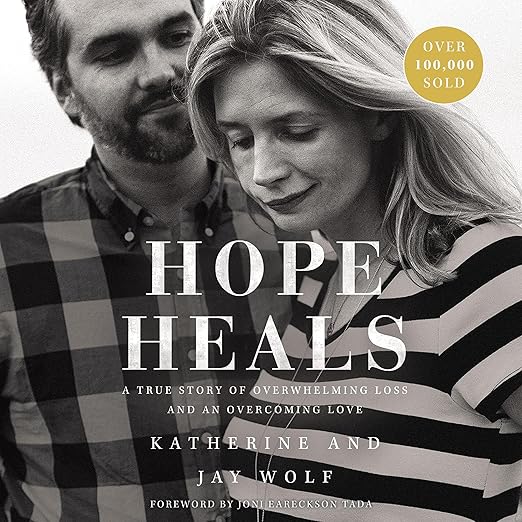
Though Jay's perspective is woven throughout the synopsis and the couple co-wrote the book, Katherine is the sole credited narrator on this audio edition. Listeners should expect her voice carrying both halves of the story rather than a true dual-narrator structure, worth knowing if you were expecting to hear Jay's sections in his own voice.
Jay's Caregiving Gets a Full Narrative Thread
This fits listeners drawn to faith-based memoir specifically, readers of Lysa TerKeurst or David Platt's broader catalog, and anyone interested in disability and recovery narratives that resist a tidy inspirational arc. The self-narration makes this a particularly strong pick for listeners who value hearing survivors tell their own stories directly.
Skip it if a secular framing is a requirement for you, since the theological lens here is consistent and central rather than incidental. Everyone else looking for an honest, faith-grounded account of catastrophic illness, and the marriage that survived it alongside the patient, gets real substance in this one.
Caregivers and family members of stroke or brain-injury survivors specifically may find Jay's side of the story, documented alongside Katherine's, as valuable as the survivor's account itself, since the memoir treats his caregiving experience as a full narrative thread rather than a supporting footnote.
The 4.8 rating across a small sample of reviews is consistent in tone throughout: every review attached to this listing describes the book in terms of comfort and encouragement rather than raising any specific critique worth flagging.
- Read by: Katherine Wolf narrates her own memoir, and hearing her deliver a story literally about relearning speech gives the audiobook a testimony no hired narrator could replicate.
- At its heart: catastrophic illness and disability, faith under extreme pressure, marriage as a shared survival story
- Vibe: Raw, faith-centered, quietly devastating
- Short version: A genuinely moving self-narrated memoir for faith-focused listeners; know going in that the framework is consistently theological.
Questions Listeners Ask
Does Katherine Wolf narrate the entire Hope Heals audiobook herself?
Yes, she self-narrates the full memoir, which carries extra weight given the book's own subject matter, her relearning basic speech after a brain stem stroke.
Is this audiobook secular or faith-based?
It is explicitly faith-based throughout, framed around finding God's presence within suffering rather than a purely secular resilience narrative, so listeners should expect a consistently religious lens.