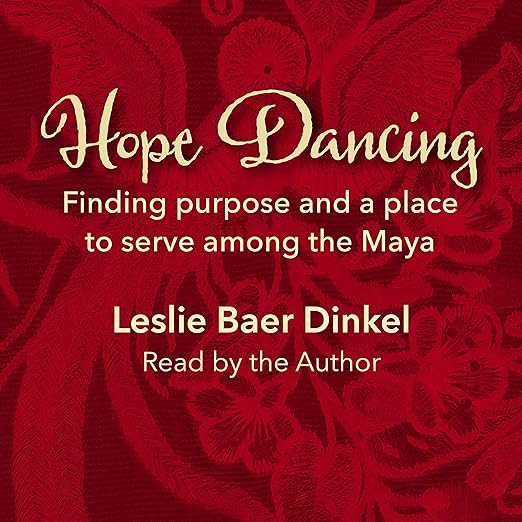
Quick Take
- Narration: Leslie Baer Dinkel narrates her own memoir, and the self-narration adds a layer of intimacy and authority that a professional narrator could not replicate, despite the inevitable rough edges.
- Themes: Humanitarian service and self-determination, Guatemala’s civil war and its aftermath, the transformation of the giver as much as the helped
- Mood: Urgent and emotionally full, with stretches of dark history and stretches of genuine levity
- Verdict: A memoir that earns its inspirational framing through specificity and honesty, particularly for listeners interested in Central American history alongside the personal narrative.
I had a long Sunday ahead of me and a list of things I was supposed to be doing when I started Leslie Baer Dinkel's memoir. Thirteen hours later, having done approximately none of those things, I understood why reviewers keep using words like "riveting" and phrases like "won't stop reading." Dinkel begins from the first sentence with an urgency that does not let up, and the material itself provides enough genuine dramatic weight to carry that urgency without the author having to manufacture it. She was kidnapped. She was extorted. She navigated a brutal civil war. And she built an organization, Xela Aid, that changed the course of tens of thousands of lives in rural Guatemala. Any one of those threads would sustain a book. Together they produce something close to overwhelming.
The memoir covers Dinkel's encounters with the Maya of Guatemala's highlands, beginning with what sounds like coincidence, the curious accidents of travel and connection that led her there, and developing into a life-organizing commitment that reshaped her entirely. She is honest about that reshaping. This is not a book where the protagonist arrives with answers and distributes them generously. Dinkel arrives uncertain, makes significant mistakes, faces genuine danger, and learns what it means to serve people who are fully capable of determining the course of their own lives if given the structural support to do so.
Our Take on Dinkel’s Guatemala
The historical context the memoir provides is genuinely valuable and often overlooked in English-language accounts of Central America. Guatemala's civil war, which killed an estimated 200,000 people and displaced over a million more, with the Mayan indigenous population bearing the overwhelming weight of that violence, is not well-documented in popular literature. Dinkel writes from inside that history rather than around it, and the specific incidents she recounts, the encounters with military personnel, the extortion attempts, the kidnapping and its resolution, carry the texture of lived experience rather than research.
The figure of Mother Teresa appears briefly but meaningfully. Dinkel's encounter with her is not name-dropped for credibility; it arrives at a moment where Dinkel is questioning the purpose of her own work, and what she describes of the meeting has the quality of a genuinely formative experience rendered honestly rather than hagiographically. That kind of restraint runs through the memoir and is what distinguishes it from the genre's more self-congratulatory examples.
Why Listen to Hope Dancing
Dinkel's self-narration is the right choice for this material, whatever its technical limitations. She is also a composer and performer, and her musical sensibility comes through in the pacing and rhythm of her spoken delivery. Several reviewers noted links to her songs embedded throughout, which adds a dimension to the audio experience that the print version cannot replicate. When she describes musical moments in the narrative, the listening experience has a direct relationship to those descriptions that print readers must imagine.
The thirteen-hour runtime earns every minute. This is not a memoir that mistakes length for significance. Dinkel has lived through enough material to sustain it, and the organizational story, how Xela Aid developed from a small group of committed friends into a thriving institution supporting rural Mayan self-reliance, provides structural momentum alongside the personal narrative. One reviewer called it "a narrative of self-discovery embedded in a story of learning about the history of a country," which is precisely accurate.
What to Watch For in This Memoir
Self-narrated memoirs carry the narrator's strengths and vulnerabilities simultaneously. Dinkel's delivery is occasionally uneven in the technical sense: some passages have the rhythm of someone reading aloud rather than performing for audio, and the production does not always smooth those moments. Listeners who are accustomed to the polished consistency of professional narrators may notice these stretches. They are not a significant obstacle for this memoir, but they are present.
The book's inspirational framing in its marketing slightly misrepresents the darker material the memoir contains. Guatemala's civil war is not a backdrop. It is a present reality in these pages, and the violence Dinkel witnessed and navigated is described with honesty that the inspirational genre framing might lead listeners to underestimate. Those who want uplift without difficulty will find this book more demanding than the cover suggests. That is a feature, not a limitation.
Who Should Listen to Hope Dancing
Essential for anyone interested in Guatemala, in Central American history, or in the practical and ethical complexities of humanitarian work. Also well-suited for listeners who find most humanitarian memoirs too polished and self-exculpatory and want one that maintains genuine complexity about what it means to arrive in another community and try to help. Those who prefer memoirs with tight narrative structure over expansive chronological accounts should know this book follows the latter approach. It is worth the investment for listeners prepared for its full scope.
Frequently Asked Questions
How much of the book deals with Guatemala’s civil war versus the Xela Aid organization’s growth?
Both threads are intertwined throughout. The civil war and its postwar aftermath provide the context in which Xela Aid operates, and Dinkel does not separate the humanitarian work from the political reality that necessitates it. Listeners interested in either thread will find both developed substantially.
Does Dinkel’s self-narration affect the listening experience significantly?
It adds intimacy and authority that professional narration would lack, particularly in the most dangerous and emotionally difficult sections. The technical consistency is slightly lower than a studio narrator, but most listeners find the personal voice more than compensates. The musical sections in particular benefit from Dinkel narrating her own material.
Is this book appropriate for listeners who know little about Guatemala or Mayan culture?
Yes. Dinkel is writing for a general audience and provides the historical and cultural context necessary to follow the narrative. She does not assume prior knowledge, and the learning embedded in the memoir is part of its purpose.
How does Hope Dancing handle the ethical complexities of a North American building an organization to help an indigenous community?
This is where the book distinguishes itself from the genre average. Dinkel is explicit about her mistakes, about the dynamics of power and dependency that humanitarian work can reproduce, and about the principle of self-reliance that shaped Xela Aid’s model. The memoir is not self-exculpatory about these questions.