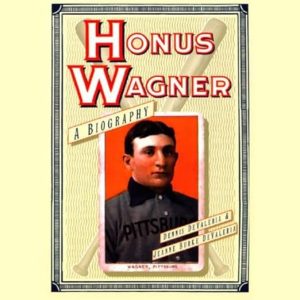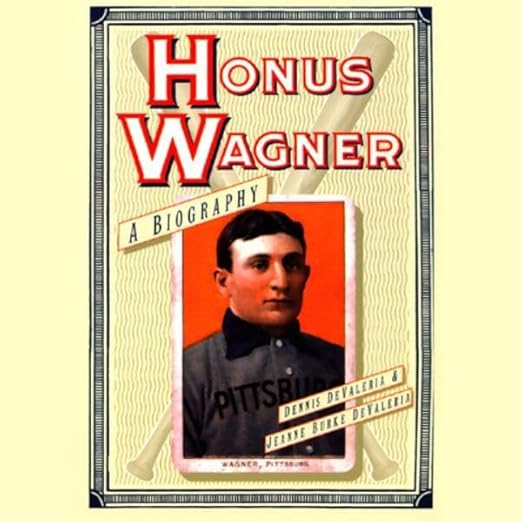
How does a rectangle of cardboard, roughly one and a half inches by two and a half, sell for $640,500? That question opens the copy on this audiobook, and it is the door rather than the room. Dennis DeValeria's biography spends thirteen hours and fifty-nine minutes on the man printed on the card, and by the end the card is comfortably the least interesting object in the story. Blackstone put the recording out in 2006, and it has aged better than the listing around it.
Not the Ruffian, Not the Teetotal Saint
Setting Wagner against Carnegie, Rockefeller and Hearst is the description's first move, and it announces the book's real ambition. This is a life used to open an era: a country thinking on a grand scale, barriers of communication and transportation coming down, and a national game acquiring its first genuine giant. Sports biography usually shrinks to the field and the clubhouse. Here the field is a way into a nation turning itself into the world's industrial leader, which is a much larger claim and one the running time actually supports.
Neither available myth survives the treatment, and the copy says so in a single clause: not the rowdy-ball ruffian, not the teetotal saint assembled by legend. What replaces them is duller and far more useful. Wagner's slow climb out of the pack rather than an overnight arrival. The minor league years. The values. The business ventures that failed during the Depression and the long later life after the playing stopped. Biography of that kind takes patience to write and rewards patience to hear.
oldtimebaseball's July 2010 five-star supplies the best endorsement on the page, because it records a change of mind. Decades of reading and studying early baseball had left the writer thinking Wagner was a very good player; the research prompted by this book produced the conclusion that he was without doubt among the top players in the history of the game, able to fill any position competently and to run and steal at will. Conversion testimony from somebody already deep in the subject beats enthusiasm from a newcomer every time.
Esmo Must Phrase Numbers for a Single Pass
August 2020 supplies a four-star naming the secondary payoff, which may be the primary one for a general listener: the book explains where certain baseball terms and traditions came from, not merely what Wagner did, and does it in a way the entry calls interesting and readable. For a look at early baseball, that response concludes, you will not go wrong here. A biography that doubles as an origin story for the vocabulary of a sport is a rarer thing than the shelf suggests.
Ian Esmo works without a second voice, and the specific demand this material makes is arithmetic. A life reconstructed from the era before broadcast runs on numbers: batting figures, season totals, positions filled, salaries, the $640,500 that started the whole conversation. On a page those sit in rows you can scan and re-scan. Read aloud they arrive in a single pass, in sequence, and have to be phrased so a listener retains them without rewinding. Sample a stretch from the middle of a playing career rather than the opening, because the opening runs narrative and the figures pile up in the middle.
Thirteen hours and fifty-nine minutes is long for a single-subject sports biography, and the copy is honest about where the time goes. Local, regional and national context, offered so that a reader ends up with a thorough understanding of Wagner's times rather than merely his statistics. That is a deliberate wager: depth over pace. Whether it pays depends entirely on whether you came for a player or for a period, and the description gives you enough to decide.
A Fairness Problem Behind a Search Problem
Byline and description disagree about how many people wrote this. The record credits Dennis DeValeria alone, while the copy says the DeValerias tell the story and that they present the context, plural in both clauses. So a co-author exists and this page does not name them. For a buyer that is a search problem before it is a fairness problem: looking up the second writer, finding their other work, or citing the book properly is impossible from this listing alone.
November 2019 brings the only real dissent, a three-star arguing that the book does very well on its subject but carries a great deal of superfluous information about regular season play, while still judging it worthwhile. Set that beside the copy's promise of rich detail and full regional context and you have one editorial decision described twice, once as thoroughness and once as padding. At fourteen hours the cost of that decision falls on a listener, who cannot skim the way a reader can.
Text on this page has decayed in two visible places. A control character sits where an opening quotation mark belongs, in the phrase about the rowdy-ball ruffian, and the word league is misspelled a few lines above it. Nobody checked the copy after it was pasted across. More consequential still are the things the description never supplies: Wagner's dates, his club, and the years he played appear nowhere at all. You are told he was the giant of the nation's game at the turn of a century and left to reconstruct the rest yourself.
Any Age Is Generous for Fourteen Hours
Tracy Asbury's January 2020 five-star recommends it for any baseball fan of any age, admiring the standard of players in that period, the game-winning hits, a legacy worth emulating, and the statistics. Any age is generous for a fourteen-hour biography, but the constituency it identifies is right. Baseball history readers are the core audience here, and the era material widens it to anybody interested in how American celebrity worked before radio and film arrived to manufacture it.
Numbers are the honest warning. A biography this thorough about a player from the era before broadcast runs on statistics, seasons and positions, and read aloud those arrive in order with no table to glance at. Baseball history readers will not mind and will probably relish it. Whoever came for the story of the card should know it is settled early, and that almost all of the remaining fourteen hours belong to the man on it.