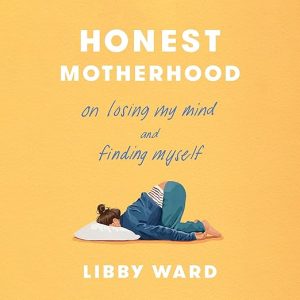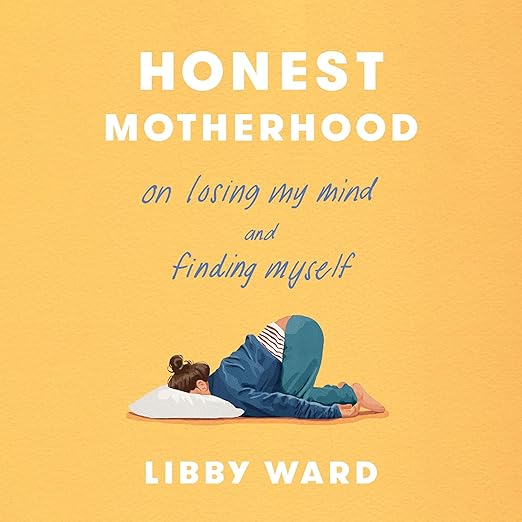
Chicken nuggets carry a surprising amount of weight in the description of this book, which promises a mother who stopped trying to do everything and learned to serve the dang chicken nuggets. Honest Motherhood runs eight hours and thirteen minutes, published by Random House Audio in April 2026, and Libby Ward reads it herself. The audiobook arrives with no ratings and no written responses attached, which shapes what can honestly be said here.
Twenty-Six, a Toddler, and Silent Rage
Twenty-six is the age at which Ward became a mother, and the copy is precise about what she brought with her: a determination to give her kids a childhood different from her own, and a grip on the world's shoulds so tight that she treated them as load-bearing. A couple of years later, with a toddler around her ankle and a needy baby in her arms, silent rage was running through her and she started to come apart.
Shoulds Turn into Inherited Instructions
Shoulds is the word the description keeps returning to, and it does real work. The argument underneath is that the unrelenting and often unspoken expectations of mothering are inherited instructions rather than personal failures, and that an overfunctioning people-pleaser meets them by wallowing in shame and then simply trying harder. That sequence, repeated until the body objects, is the engine of the memoir.
Silent rage is the phrase that decides whether this book is for you. The copy does not soften it and does not frame the collapse as a temporary bad patch. Ward's body and mind push back until she has to ask why motherhood stays so impossibly hard when advice is available in unlimited quantities at any hour. The question is genuine rather than rhetorical, and the book spends itself answering it.
Ward Reads All Eight Hours Herself
Manifesto is the other half of what is on offer, and the description says so outright, calling the book equal parts memoir and manifesto. The claims concern support that never arrives, guilt, invisibility, the cycles a generation is trying to break, and the fantasy of a hospital stay purely as a way of getting a rest. Eve Rodsky's endorsement, printed in the copy, calls it truth-telling and rebellion and a rallying cry for women to stop carrying what was never theirs to hold.
Self-care, boundaries and sleeping when the baby sleeps appear in the copy with exclamation marks attached, which tells you the register. The book is partly a comedy about advice, and that joke depends entirely on delivery: three phrases like those read as a list on the page and land as an impersonation when somebody says them out loud. A self-narrated recording is exactly where the difference shows.
Ward reads all eight hours herself, and the material argues for that more strongly than most memoirs do. A book about being unheard, about invisibility, and about the distance between what mothers say and what they are thinking loses something when the confession is voiced by a hired reader. Random House Audio kept the author in the chair, which is the most consequential production decision visible anywhere on this page.
Filed as Sociology, Written as Memoir
Nobody has rated it and nobody has written about it. Four months after publication by a major imprint, the page carries no stars, no responses and no trade quotation beyond the one the publisher chose to print. That absence costs one specific thing rather than the whole judgment. The copy sells the book as disarmingly funny, and humor is precisely the quality a description cannot establish, because a joke on a page and a joke in a voice are not the same event.
Sociology is the tag and politics and social sciences is the shelf, which is a strange filing for a book its own copy calls a memoir twice inside three sentences. The practical consequence is discoverability. A listener searching parenting memoirs may never meet it, while somebody browsing social science meets one household's story told from the inside instead of the research they came for.
Funny and devastating in the same book is a hard balance to hold, and the description asks a buyer to accept both on trust. What it does supply is specificity: chicken nuggets, a toddler around an ankle, a fantasy about being admitted to hospital for the rest. Detail at that grain usually indicates an author who has stopped performing, and it is the best available evidence that the comedy is earned rather than applied afterward.
Also for the Partners Standing Nearby
Mothers currently in the middle of it are the obvious audience, particularly anyone who recognizes the overfunctioning people-pleaser the copy describes, and anyone raising children while working hard not to repeat their own upbringing. The full runtime is a great deal to find, though the format helps more than usual here, since this is a book that can be taken in fragments during the exact conditions it describes.
Partners, relatives and friends of a mother who is not coping are the second audience and arguably the more useful one. The copy identifies the missing support and the invisibility as structural rather than personal, and that argument travels better in a stranger's voice than in the voice of somebody who lives in the house. Hearing it from Ward takes the accusation out of the conversation.
Data-minded listeners should look elsewhere. Nothing here promises studies, statistics or a survey of maternal mental health, whatever the social sciences shelf implies, and the method is one woman separating social conditioning from learned trauma responses in her own life. Anyone who wants the argument without the memoir, or who cannot presently take eight hours of another parent's exhaustion, should leave it for later.
- Read by: Libby Ward takes her own eight hours at the microphone, a first-person breakdown voiced by the person who went through it.
- At its heart: The myth of the ideal mother, invisible labor and unspoken expectation, breaking inherited patterns
- Vibe: Raw, funny and openly furious
- Short version: A memoir and a manifesto in one file, arriving with nothing on the page yet to test the humor it promises.
Does Libby Ward narrate the audiobook herself?
She does. Random House Audio gives her the full eight hours and thirteen minutes. What that guarantees is authenticity of register rather than technical polish, and with no listener responses on the page yet, a sample is the only way to work out which side of that trade you land on.
Is this audiobook a memoir or a parenting guide?
The copy calls it equal parts memoir and manifesto, and neither half is a guide. Ward describes her own unraveling after becoming a mother at twenty-six, then argues that the expectations behind it are inherited rather than personal. Expect an account and an argument, not routines, schedules or techniques to apply.
Why are no ratings showing for an April 2026 release?
It simply has none, four months on. New titles often take a while to gather votes, particularly when the intended buyers are the people with the least time to sit down and write one. The only outside verdict printed anywhere is Eve Rodsky's endorsement, chosen by the publisher.