At a Glance
- Read by: Collins reads his own decade of research, which lands differently because the copy says this is the first time he has put his own story inside one of these books.
- At its heart: Fracture points and reinvention, purpose after the goal is met, momentum built decade upon decade.
- Vibe: Measured and analytical, closer to a documentary series than to a pep talk.
- Short version: Worth the long run if you are standing at one of the cliffs it maps; less so if you want a system to execute on Monday.
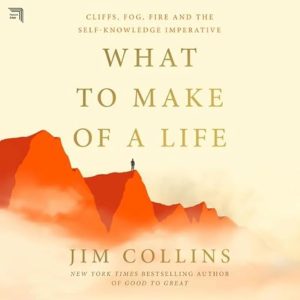
A decade went into this audiobook, and the shape that decade produced needs explaining before anything else. Jim Collins, whose Good to Great sold internationally, spent ten years studying what he calls cliffs: the fracture points that flip a life from clarity into confusion and force a choice about what comes next. Rather than build a framework and then illustrate it, he constructed the whole book out of matched pairs, two people meeting the same cliff and going different ways. Thirteen and a half hours of that.
Eight Lives, All of Them Left Anonymous
Those pairs are both the method and the pleasure. Two rock musicians facing a future without the group that made them. Two public figures wrecked by scandal, each deciding separately how to rebuild. Two suffragists who achieved the epic goal and then had to work out what a life looks like on the other side of it. Two figure skaters whose Olympic careers simply stop. Writers, actors, scientists and leaders fill in around them.
Here is what deserves flagging: the description names not one of those people. Eight lives get invoked and all eight stay anonymous, in copy whose entire selling proposition is the specificity of its cases. That is presumably a choice to protect the reveals rather than an oversight, but it leaves a buyer unable to judge whether these are figures worth spending an evening with before committing to the full run.
Cliffs, Fog, and the Inner Fire, Defined
Collins writes in coined terms, and you should work out early whether that helps you or grates. Cliffs, the fog, the inner fire, being naturally encoded for a role, personal momentum built decade upon decade. Anyone who knows his business work will recognize the technique, which is to hand an abstract state a concrete handle so it can be argued about. Applied to a life rather than a company, those handles carry most of the analytical load.
Collins Chronicles His Own Story for the First Time
Two facts about this credit belong together. Collins reads it himself, and the copy says that for the first time he chronicles his own story, describing how undertaking the project transformed his thinking and reshaped his emotions in fundamental ways. A researcher who becomes one of his own cases, reading that admission aloud, is a different proposition from an author performing settled conclusions. The confession and the voice making it belong to the same person.
Turning the question from organizations toward individuals is the actual news. His earlier work asked why some companies sustain performance across decades; this asks the same of a person, and the questions the copy lists are unusually concrete for the genre. How do you make your personal economics work so you can focus on the one thing feeding the inner fire? How do you build confidence step by step while genuinely lost in the fog?
At better than thirteen hours this runs long for a life-design book, and the length is doing real work. Paired biographies need room. You cannot run two musicians, two scandals, two suffragists and two skaters through a single framework in four hours and have any of them register as a person rather than a data point. The trade is patience. Anyone who wants the framework alone will experience the case material as delay.
Retrieve the PDF Before You Press Play
A supplemental enhancement PDF accompanies the recording, according to the copy, and on a book this structured that document is not decorative. Frameworks with named stages, side-by-side comparisons and a checklist of life questions are precisely the material that lives in a diagram. Retrieve it before you press play rather than afterward, because listening to a framework described in words while its picture sits unopened is the classic way to lose half a book.
Nothing else on this listing gives you anything to lean on. Published in April 2026, the page shows an empty rating slot and an empty counter, which means nobody has yet reported how the paired lives hold up across a long sitting. For a title from a name this established, an empty page usually reflects timing rather than reception, but it does leave the description as the only evidence available before purchase.
Both remaining cautions are smaller. The shelving reads politics and social sciences, which will bewilder anyone arriving for policy; this is personal development with research methodology bolted on. And the promise that a richly fulfilled life is within reach of us all sits awkwardly beside case material drawn from Olympians, bestselling writers and public figures. The cliffs described really are universal. The lives chosen to illustrate them are conspicuously not.
Closer to a Documentary Series Than Self-Help
Two groups will get their money's worth. First, anyone standing at a cliff right now: a career ending, a public failure, a goal achieved that left a hole behind it. Collins built the entire structure around that exact moment, and the paired design hands you two responses to your situation instead of one prescription. Second, the reader who has worked through his business titles and wondered what the same method looks like turned inward.
Long-form listeners should also do well here. The rhythm of the thing, a cliff, two lives, a divergence, a lesson, repeated across writers, actors, scientists and leaders, sits closer to a documentary series than to a self-help program, and it rewards being taken in order rather than sampled. Anyone who reads biography for its own sake can ignore the framework entirely and still come away with eight lives worth the hours.
Leave it alone if you want a system you can apply this week. The book is built to be thought about rather than executed; its questions are the deliverable and its answers arrive as examples, not instructions. Anybody allergic to invented vocabulary should sample first, since cliffs, fog and inner fire recur constantly and are load-bearing rather than ornamental. My own reservation is smaller and sits with the marketing: it asks for trust on cases it will not name.
Does the audiobook come with the supplemental PDF, and do you need it?
The copy states a supplemental enhancement PDF accompanies the recording. On a book organized around named stages, paired comparisons and a checklist of life questions, that document holds the diagrams the prose can only describe. Retrieve it before you start rather than discovering it later, or a good half of the structure stays abstract.
Is thirteen and a half hours long for an audiobook of this kind?
Considerably, and the paired structure accounts for it. Running two musicians, two scandals, two suffragists and two skaters through one framework needs room for each life to register as a person rather than an example. If you want the framework stripped of biography, that length reads as delay; if the lives are the draw, it is proportionate.