Before You Press Play
- Big ideas: Aging out of the care system, the limits of a two-week placement, a secret carried alone
- Atmosphere: Quiet, domestic, and steadily heavier as it goes
- Worth it?: A stronger premise than most fostering memoirs manage, sold on a page that names no reader and carries no votes at all.
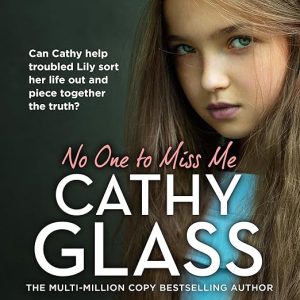
Boxing Day night gives Cathy Glass the opening image she needs and the whole book in miniature. A noise outside. A window with nobody under it. A front door opened carefully onto a teenager huddled in the porch, teeth chattering, saying she stayed there ten years ago for two weeks. The audiobook runs eight hours and fifty-seven minutes, and everything in it grows out of that one sentence spoken on a cold step by somebody who had nowhere better to be at that hour.
Thirty Years of Fostering, Then One Doorstep
Thirty years of fostering and more than a hundred and fifty children stand behind this one, and the description puts those numbers in capital letters before it gets anywhere near the story. Glass has been publishing these accounts since Damaged, a Sunday Times and New York Times bestseller, and the promotional copy leans on that history hard. What the copy never does is tell you anything about the recording itself, which is the one question a listener has to answer before committing to it.
What follows the doorstep is where the title earns itself. Lily has fallen through the cracks in the social care system, and that phrase is doing real work here: she is not in trouble because of one bad decision on one bad night but because a sequence of adults and agencies stopped keeping track of her at all. Glass, by her own account in the copy, has no idea what to do with her. Then Lily shares a secret, and the book turns on it.
Nothing has been written about this one yet. The page carries no stars, no rating counter, no responses of any kind, which is what a title still weeks away from release looks like. That leaves the title itself doing all the persuading, and it is a good one. No One to Miss Me is not a description of how Lily feels. It is an administrative fact about a young woman nobody was assigned to notice had gone missing.
The Narrator Slot Nobody Has Filled Yet
Immediacy is the selling point. The description narrates in the present tense, a noise, a window, a door, a girl, and if the book keeps that register then this is material built for speech rather than for the page. Fostering accounts live on small domestic detail: what gets said in a hallway, what a child will and will not eat, which sentence finally arrives after three days of nothing. Detail at that scale tends to land harder in a voice than in print.
Advocacy runs underneath the story without ever taking the microphone. A former placement coming back ten years later, as an adult with nowhere to sleep, is an argument about what a two-week stay can and cannot do, and about what happens to a young person who ages out of a system that was only ever holding her temporarily. Glass does not have to editorialize for any of that to register with a listener. The doorstep does the work on its own.
Just under nine hours puts this at long-weekend length rather than project length, with HarperElement handling the September release. The narrator slot on the listing is empty. For a first-person account told by the woman who lived it, that gap is not a small detail: whether you hear Glass herself, an actor cast to sound like her, or a voice with no connection to the household changes the entire proposition, and the page currently refuses to say which it will be.
Proofreading Slips and a Genre That Hides It
Proofreading is the first thing anybody will notice. The description reaches this page with at least two errors in it, a sentence that opens the front door onto a teenage with the noun missing, and Lily saying she stayed her ten years ago where the word should plainly be here. Neither error touches the book itself. Both suggest the copy went live without a read-through, which is worth knowing before taking anything else on the listing at face value.
Content is the second. Glass writes about real children and does not sand down what happened to them, and this one turns on a secret a teenager has been carrying by herself for some time. Listeners who found earlier titles in this run heavy should expect at least the same weight again. It is never misery assembled for its own sake, but it is not a comfort listen either, and the book runs long enough for the accumulation to be felt.
Classification is the third. This sits on the listing under social sciences and politics rather than under memoir or biography, which will send it to browsers looking for policy analysis and hide it from the readers most likely to want it. The frame is British throughout, starting with Boxing Day itself, so American listeners should expect the vocabulary of a care system that does not map cleanly onto their own.
A Bet on the Author, Not the Voice
Readers who already own a shelf of Cathy Glass will not need talking into this, and the premise is stronger than most: not a placement beginning, but a placement coming back a decade later to ask what it was actually worth. Anyone drawn to accounts that sit on the join between one household's improvised kindness and one system's documented failure will find this squarely inside their territory, told from the kitchen rather than from the committee room.
It is the wrong purchase for anyone who needs to know the reader before committing, because that name is simply not on the page yet and may not be until release week. It is equally wrong for listeners who want fostering stories with the hard parts smoothed off. Lily arrives cold, at night, with nothing, and the book begins from the assumption that you can sit with that.
Until the reader is named, this stays a title you buy on the author's record rather than on the recording's, which for Glass is a reasonably safe bet and still a bet. Nine hours, one doorstep, and a decade of institutional neglect turning up in a porch in the middle of the night, asking to be let back in.