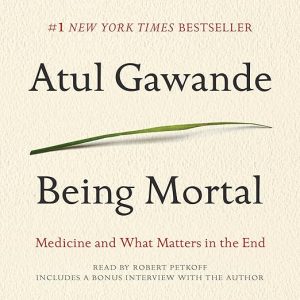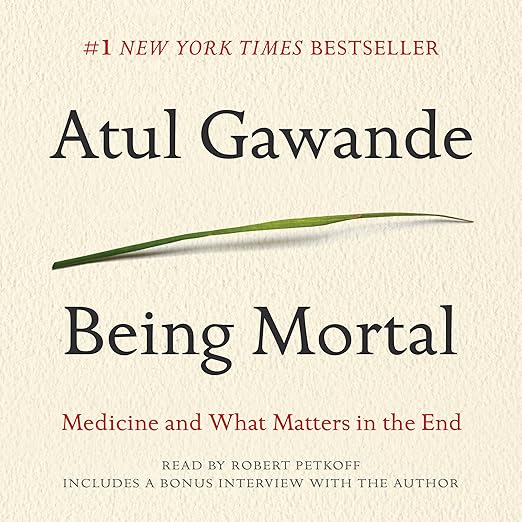
Medicine got very good at postponing death and never worked out what to do next. Atul Gawande's argument about that gap runs nine hours and three minutes for Macmillan Audio, read by Robert Petkoff, and it sits here under health and wellness with a tag for aging and longevity. Treat the shelving loosely. This audiobook is not a guide to living well into old age, it is a practicing surgeon's account of what his own profession does to people at the end of theirs.
Safety Culture Traps Patients in Railed Beds
Nursing homes pin patients into railed beds and wheelchairs out of a preoccupation with safety. Hospitals isolate the dying and go on checking vital signs long after any hope of cure has gone. Doctors, committed to extending life, carry out procedures that extend suffering instead. Those three claims are the description's own summary of the problem, and the reason the book hit as hard as it did is that none of them are presented as scandals. They are presented as the system working as designed.
Gawande Writes as a Surgeon Seeking Solutions
Quality of living set against safety and medical intervention is what the March 2024 account, graded five stars, says it had never properly thought through. That reader came away with the wheels turning about their own and their husband's likely decline, and recommends the book to anyone of any age who wants their views on aging formed before the decisions arrive. Doing that thinking early rather than in a hospital corridor is the whole case for picking it up at all.
Gawande writes as a practicing surgeon rather than as a critic standing outside, which is what keeps the book from reading as a complaint. He puts his profession's ultimate limitation on the table, argues that quality of life is the goal patients and families actually hold, and then goes looking for arrangements that deliver it, the freer and more socially fulfilling models for assisting the infirm and dependent elderly that the description promises.
Petkoff Carries Nine Hours of Case Histories
February 2015 produced the response that states the thesis most plainly: the limits of medicine, and the claim that the profession has been wrong about what its job is, health and safety and survival. That five-star account puts the real aim as enabling well-being, and the reason a person wishes to be alive when serious injury or sickness comes. It also opens with what looks like a pasted review header carrying a misspelling of the author's surname, which is worth registering before you weigh it.
Hospice is where the book turns constructive rather than diagnostic. The description promises a look at its varieties, aimed at showing that a person's last weeks or months can be rich and dignified instead of merely prolonged, and it ends on the formulation people quote back: the goal is not a good death but a good life, all the way to the very end. That sentence carries more freight than it first appears to.
Nine hours is the right length for what this is. Research alternates with individual case histories, and the case histories are what stay with you, which means the listening depends on hearing a story through without a page number to skip back to. Petkoff carries all of it alone on a 2014 Macmillan Audio production, at a pace that has to serve the data and the deathbeds equally.
Nobody Mentions Petkoff's Actual Reading Voice
Religion and the right-to-die debate are the two subjects a January 2015 dissent wanted more of. That four-star account calls the book a fast read it could hardly put down, then withholds the fifth star because the dying-with-dignity argument in America gets less depth than it might have, and because the way belief systems shape a person's death is touched rather than developed. It also credits Gawande for staying above the surrounding controversy, which is a fair reading of a deliberate choice.
Two of the five accounts here describe the experience in print terms, one calling it easy to read and another a fast read overall. The others praise the book without saying how they took it in. The 4.7 average across forty-eight votes is a verdict on Gawande's argument, gathered over more than a decade and across every edition of it, and none of that isolates the nine hours in this particular file.
Petkoff's reading is the one thing the page will not tell you about. Forty-eight ratings, five written accounts, and not a line among them about the voice, which matters more here than on most nonfiction. This book asks a listener to sit with failing bodies and dying parents at length, and the gap between a reading that respects that and one that performs it decides whether you finish. The credit is all you get.
Caregivers Recognize These Situations Before Gawande Finishes
Caregivers are the first audience, and the September 2025 account filed from the South Africa store puts the reason simply, calling the book brilliant and written with compassion and deep understanding. Anyone currently making decisions for a parent will recognize the situations before Gawande has finished describing them. The practical value is the vocabulary it hands you for conversations most families postpone until they have to happen in a hallway.
Doctors, nurses, students and anyone working near the end of life are the other clear group, since the argument aims at professional habit rather than at patient behavior. It also works as the single serious title on aging for a reader who wants one rather than a shelf, and the length is a manageable commitment for a subject most people approach once and then avoid for another ten years.
Wellness shoppers should know what they are buying. The health and wellness shelf and the aging and longevity tag suggest routines, tips and mindfulness, and this book contains none of those. It is an argument about institutions, written by a surgeon, with sustained descriptions of decline and dying in it. Come to it when you have room for it, not as something to keep playing while you do other things.
Before You Press Play
- Narrator: Robert Petkoff alone for nine hours on a 2014 Macmillan Audio production, one voice across research and case histories alike.
- Subjects: The limits of medicine, autonomy against safety in eldercare, hospice and what a good last year looks like
- Tone: Calm, clinical and quietly devastating
- Bottom line: Take it on before you need it, and expect an argument about institutions rather than advice about aging.