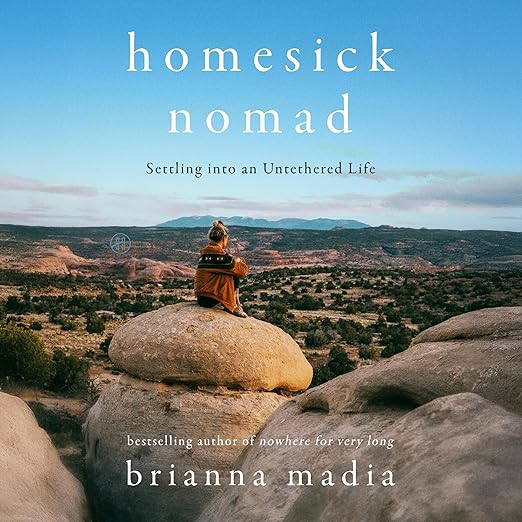
Brianna Madia narrates her own audiobook Homesick Nomad, and that choice is not incidental. Her previous books, including the New York Times bestseller Nowhere for Very Long and Never Leave the Dogs Behind, established a devoted readership drawn to her honesty about life outside conventional structures. This memoir picks up a version of that thread but the territory here is more interior and more uncertain: the question of what happens when someone who has built an identity around radical independence falls in love with someone who offers her the thing she has long refused to need. At 6 hours and 13 minutes, it is a single sustained reflection on some of the largest questions a person in their thirties can sit with, and Madia's voice, both written and spoken, is the instrument doing all of the work.
Keeping the Trailer Without Running Water on Purpose
The structural premise is specific: Madia is splitting her time between her beloved wild desert in Utah and her boyfriend's cozy suburban home in the Pacific Northwest, and the contrast between those two environments is used to externalize the internal conflict she is working through. The desert is where her sense of self lives, where she feels most undiluted and most capable. The suburban home represents something she genuinely wants but cannot accept on terms that would require her to diminish herself. The tension between those poles is the book's engine, and Madia runs it without pretending she has it resolved.
What makes this more than a familiar "I refused to settle down" memoir is Madia's willingness to sit with the motherhood question directly and honestly. She does not resolve it neatly or perform the kind of enlightenment that memoir sometimes uses to give the narrative a tidy forward momentum. The Source describes her tales as "transcending their rugged terrain, telling, at the crux of it all, very human stories," and that is accurate here: the Utah desert and the Pacific Northwest suburbs are the terrain, but the human story underneath is about how to commit to another person without surrendering the version of yourself that gives your life meaning. That is a question most people encounter in some form, regardless of whether they live in a trailer or a suburb.
The decision to keep the trailer without running water, resisting what the synopsis calls "upgrades," reads in the memoir as something more than personal preference. It is a statement about what kind of life Madia is willing to accept and what that choice costs in a relationship with someone who values different things. She writes about this without performing enlightenment or arriving at a conclusion that makes the complexity disappear. The result is a memoir that sits with its tensions rather than resolving them into a lesson, which is harder to write and more honest to read.
Audiobooks That Live or Die on Authenticity
The self-narration is the most significant argument for the audio format here. Madia's voice is the one that holds all of these reflections, and hearing her read her own ambivalence about motherhood, her own stubbornness about the trailer, her own slow recognition that the comforts of the suburban home are actually giving her something she did not expect to want, adds a layer of credibility that is impossible to reproduce with a hired narrator. The pauses in her delivery, the places where the prose has more weight than the spoken sentence suggests, are earned by the fact that she is the person who actually lived this and is reporting back. Memoir audiobooks narrated by their authors live or die on this authenticity, and Madia has a distinct enough voice both on the page and in audio to make the choice pay off across the full runtime.
At just over six hours, the runtime is well-matched to the reflective rather than event-driven nature of the material. This is not a book with dramatic external plot; it is a book that asks the listener to stay company with a person working through genuinely difficult questions in real time. That pacing works in audio as a kind of extended, intimate conversation, and Madia's narration never loses the specificity that her written voice has always carried.
No Listener Reviews Yet to Triangulate Against
Readers who come to this book expecting the adventure-forward, landscape-saturated writing of Nowhere for Very Long may need to adjust their expectations. Homesick Nomad is quieter, more inward, and more uncertain. The desert chapters deliver the sensory richness that Madia's readership associates with her work, but the suburban Pacific Northwest chapters have a different texture: more domestic, more interpersonal, more focused on the small negotiations of shared life. That contrast is the book's design, not a failure of ambition. It means this is a different kind of reading experience than her earlier books, and listeners who want wilderness memoir specifically should know the split is approximately even.
The absence of listener reviews at the time of this writing means the community response cannot be triangulated, but the advance praise confirms that readers who know Madia's previous work are recognizing this as consistent with her standards. The memoir's willingness to not tie things up neatly will appeal to readers who distrust memoir that arrives at convenient wisdom; it may frustrate readers who want resolution as the payoff for a personal story.
Read Nowhere for Very Long First, Then This
Readers of Madia's previous books who want to follow her into the more interior territory of this one are the natural audience. Women in their thirties or forties grappling with the relationship between independence and commitment, with or without the wilderness-living backstory, will find the core questions immediately recognizable and honestly handled. Listeners drawn specifically to self-narrated memoirs where the author's voice is inseparable from the material will find this a well-suited example of that form. Those wanting adventure-forward, landscape-driven memoir should start with Nowhere for Very Long and then decide whether to follow Madia into this quieter, more personally uncertain territory.
Key Details
- Performance: Brianna Madia narrates her own memoir, and the self-narration gives the more intimate passages a quality that hired actors cannot replicate - her voice carries the specific weight of someone who has actually reckoned with these decisions.
- What it covers: independence versus commitment, the question of motherhood, belonging without surrendering self
- Feel: Reflective, honest, and grounded
- Our call: A memoir that earns its intimacy by taking Madia's familiar wilderness voice into more uncertain personal territory, made richer by her own narration.