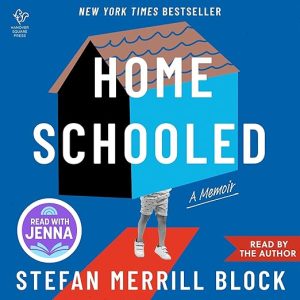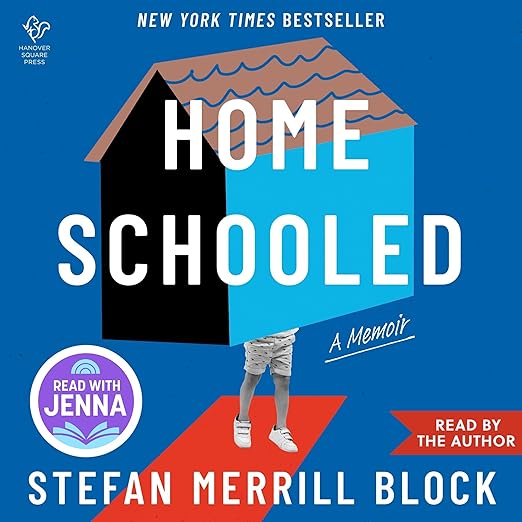
Stefan Merrill Block sits at his own kitchen table, narrating his own childhood, and the dissonance is the point. Homeschooled, this audiobook delivered in Block's own voice across 7 hours and 9 minutes, is the memoir of a child who was pulled from public school at nine by a mother convinced that his teachers were "stifling his creativity." What followed was five years in which the living room became the classroom, the mother became the sole authority, and the curriculum drifted from education into something considerably more alarming. Block's debut memoir carries the 4.1 rating of a book that generates strong, divergent responses, and that divergence is itself part of the argument.
Block is careful to position this memoir neither as an attack on homeschooling broadly nor as a simple abuse narrative. The subtitle signals both dimensions: "a mother's all-consuming love" holds the ambivalence in its syntax. His mother's project was not indifferent or hostile, she believed she was protecting and developing her son's gifts. The problem was that her methods were untethered from any external accountability: she forced Block to bleach his hair, required him to crawl on all fours in a regressive attempt to recreate his early childhood development, and designed a curriculum shaped more by her own psychological needs than by any coherent educational philosophy. The isolation was total. For five years, Block had no peers, no outside validators, and no framework for determining whether his experience was ordinary or extraordinary.
The book's secondary argument, about the legal and regulatory vacuum surrounding homeschooling in the United States, is where Homeschooled becomes something beyond personal memoir. Block's experience began in Texas just as homeschooling became legal in his home state, in a regulatory environment where no one was required to verify that children were being educated rather than merely kept at home. The absence of oversight that allowed his mother's increasingly eccentric project to continue for five years is, Block argues, not an edge case but a structural feature of an unregulated system that now encompasses millions of American children. Reviewer PennyJarBooks found the book "fascinating and deeply tragic" while noting that it is more about mental health failures and child abuse than about homeschooling specifically, which is both a fair reading and a somewhat incomplete one. Block is arguing that the homeschool system's lack of regulation made the abuse possible and invisible simultaneously.
Block's Measured Voice Reconstructs His Own Childhood
The self-narration is the audiobook's defining feature and its most complex element. Block reading his own childhood places the listener in the same position he occupied as an adult reconstructing these events: close enough to feel them, distant enough to analyze them. His voice is measured throughout, which is not the same as emotionally flat. The measured quality is that of a memoirist who has spent years processing this material and arrived at something more nuanced than rage or grief, something like a complicated, hard-won understanding. Reviewer Rien called it "bravely written" while noting that memoir must be viewed through the author's own perceptions, a caveat Block himself acknowledges by being explicit about the limits of his own perspective on his mother's state of mind and motivations.
At seven hours and nine minutes, the audiobook is compact for a memoir of this scope. Block moves efficiently through the childhood years, the reenrollment in public school as a freshman in Plano, and the jarring social recalibration that required, the discovery that he had developed in certain ways and failed to develop in others, and the work of figuring out which was which. The book's humor is not incidental. Block is funny about the absurdity of his own formation in a way that makes the darkness more rather than less precise. The humor is the instrument of a writer who knows that the most unsettling truths often land hardest when they arrive without melodrama.
Block Voices Both Child and Difficult Parent
Block's portrait of his mother is the audiobook's most demanding achievement. She is neither a monster nor a saint. She is a person whose love for her son expressed itself through methods that caused harm she could not recognize as harm, because there was no external voice in a position to name it as such. Block holds this complexity without collapsing it into either villainization or excuse, and the self-narration gives that complexity an additional layer: he is literally speaking his mother's words as the narrator, performing her in his own voice. This is not a comfortable device, but it is the right one for a memoir about a boy who had no language or model for evaluating what was happening to him outside his mother's frame. Hearing Block give voice to both child and parent with the same instrument is the closest the audiobook comes to a formal argument about how formation works.
The Plano public school reentry chapters are the memoir's most surprising and in some ways most revealing section. Block arrives as a freshman with gaps in his socialization that are immediately visible to his peers but invisible to himself, having had no comparison group. His account of learning what normal looks like by studying the people around him, a form of improvised anthropology conducted under the social pressure of high school, is both funny and genuinely moving in equal measure. This section of the audiobook contains some of Block's best prose and most of his wit.
Homeschooling Families Will Find This the Hardest
This audiobook belongs in the reading of anyone with a policy interest in American education, child welfare, or parental rights frameworks. It also works for readers interested in mother-son memoir in the tradition of writers who have grappled with inherited damage without making their parents simply evil. Listeners who are themselves involved in homeschooling, either as parents or as former students, will find Block's argument the most challenging, he is specifically not arguing that all homeschooling is harmful, but his examples are difficult and his policy critique is real and documented. Anyone who comes to this audiobook looking for comfortable resolution should know the ending is harder-won than easy catharsis allows.