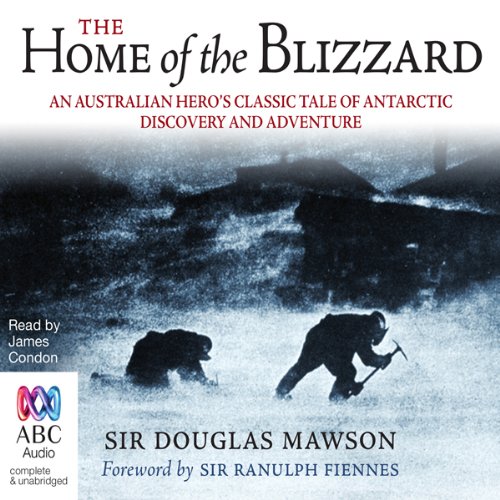
Quick Take
- Narration: James Condon reads Mawson’s laconic prose with appropriate restraint, letting the understatement do its work without dramatizing what is already extraordinary enough on its own terms.
- Themes: Survival and endurance, scientific obsession, the indifference of nature
- Mood: Austere and absorbing, with stretches of genuine horror delivered in the calmest possible voice
- Verdict: A first-person polar exploration account that earns its reputation as one of the great survival narratives, rendered faithfully in audio form.
I came to this one through a rabbit hole that started somewhere around Shackleton and kept pulling me further south. I had read secondary accounts of the Australasian Antarctic Expedition before picking up Sir Douglas Mawson’s own version, and I want to be clear about what the primary source offers that the histories do not: the texture of understatement. Mawson was primarily a scientist, and he writes like one even when describing circumstances that would reduce most people to incoherence. That quality is both the book’s central strength and its primary challenge as a listening experience.
Home of the Blizzard was first published in 1918, covering the expedition years of 1911 to 1914. Its most famous sequence involves the solo return journey of 1912 to 1913, during which both of Mawson’s companions perished. Without describing what happens in detail, I will say only that the physiological reality of what Mawson survived is among the more disturbing things I have encountered in the exploration genre, and he describes it with the calm of a man filing a field report. That gap between the horror of events and the register of their telling is where the book lives.
Our Take on Home of the Blizzard
Reviewer Michael Lauducci describes it as difficult to conceive how these men survived over 100 years ago with primitive technology and equipment, and that sense of inconceivability is exactly what Mawson’s prose generates through accumulation rather than drama. He does not tell you this was terrible. He tells you the wind speed, the temperature, what equipment failed, what decisions were made, and lets the numbers do the work. For readers who appreciate that kind of restraint, it is devastating. For readers who need a narrative guide to tell them how to feel, it may require patience.
James Condon’s narration suits the material well. He does not reach for emotion that the text withholds; he trusts Mawson’s voice. This is the right call. A narrator who pushed the drama would have worked against the book’s fundamental character. Condon’s measured, clear delivery allows the listener to absorb the scientific detail without fatigue, which matters for a 17-hour listen that contains genuine stretches of technical observation about Antarctic geology and meteorology.
Why Listen to Home of the Blizzard
The audio format has a specific advantage here that the print edition lacks: Mawson’s writing is dense with proper names, geographical detail, and expedition logistics that benefit from a human voice pacing the delivery. Reading the text on the page requires constant re-orientation; listening, you can follow the expedition’s movements with more fluidity because Condon provides natural pauses and vocal emphasis that a page of 1918 prose does not.
Reviewer HOW notes that the original illustrated edition had sketches, photographs, and maps that are absent from the Kindle edition and recommends having a good map of Antarctica nearby. This applies equally to the audio. If you have access to a map showing the expedition’s routes, pulling it up at the start will enrich the listening considerably. The narrative geography of where camps were established, where parties split, where men died, becomes much more visceral when you can picture the actual terrain.
What to Watch For in Home of the Blizzard
One reviewer’s complaint about the physical print edition mentions formatting issues, but that does not apply to the audiobook. What does apply is the scope of the text. This is not only the survival narrative that its reputation foregrounds. Mawson was conducting scientific research across the full expedition, and the book covers magnetic observation, biological collection, geological surveying, and meteorological study at a level of detail that serves the historical record more than it serves the contemporary listener looking for sustained narrative tension. The most gripping sections alternate with passages of scientific documentation. That rhythm is true to what the expedition actually was, but it means the pacing is uneven if survival narrative is your primary expectation.
The laconic style that makes the survival sequence so powerful can also make the earlier expedition sections feel slow to readers conditioned by contemporary nonfiction’s tendency toward continuous dramatic momentum. Approach this as a period document written by a scientist, not as a modern adventure narrative shaped for a general audience, and the tone becomes part of the experience rather than an obstacle to it.
Who Should Listen to Home of the Blizzard
Essential for anyone serious about polar exploration history, and a natural companion to other first-person accounts from the heroic age of Antarctic discovery. Listeners who have read or listened to works about Shackleton or Scott will find Mawson’s perspective both complementary and distinct: he is less the charismatic leader and more the methodical scientist, and his account carries a different emotional frequency as a result. General readers who want sustained narrative drama may want to supplement with a secondary history. For those who can sit with the material on its own terms, it is quietly unforgettable.
Frequently Asked Questions
Does this audiobook cover the full Australasian Antarctic Expedition or focus only on the famous solo survival journey?
It covers the full expedition from 1911 to 1914, including the scientific work and logistical operations. The solo survival journey of 1912 to 1913 is the emotional centerpiece, but it occupies only a portion of the total 17-hour runtime.
Is Home of the Blizzard accessible to listeners who know little about Antarctic exploration history?
Yes, though Mawson assumes no prior knowledge of the region and explains his scientific goals as he goes. Having a map of Antarctica nearby helps considerably when following the geographical narrative.
How does James Condon’s narration handle the scientific and technical passages?
Condon reads them clearly and without affectation, which suits Mawson’s factual style. He does not try to dramatize passages that the author deliberately kept neutral, and that restraint is the right approach for this material.
Is this the same text as the original 1918 publication, or has it been abridged?
Based on the 17-hour runtime and reviewer comments, this appears to be the complete text. One reviewer notes that the original was illustrated, and those visual elements are obviously absent in audio, so having supplementary maps is recommended.