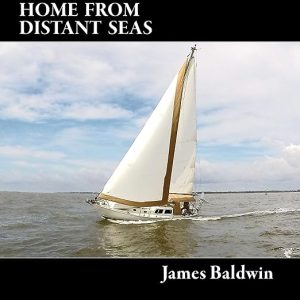
Twenty-five years of live-aboard cruising end here, and the ending is the least dramatic part. James Baldwin closes a trilogy about a life spent on small voyaging sailboats with a passage that runs from South Africa back to the United States, and this audiobook gives Ross Pipkin fourteen hours and fifty-five minutes to get there. The storm off the Cape of Good Hope arrives early. Most of what follows is weather, ports, repairs, and other people's stories.
An Eighty-Year-Old Who Built His Own Leeboarder
Geography supplies the structure. Baldwin leaves South Africa, is tested badly by a gale rounding the Cape, crosses the South Atlantic to Brazil, works north through the Caribbean islands, marries along the way, and finally settles on a home port on the United States East coast. Homeward is the operative word, and the book is honest that the journey is at times a reluctant one, which is a strange and interesting note to end a circumnavigation on. Nothing about it is presented as a stunt. The boat is small, the budget is smaller, and the ocean is exactly the size it has always been.
Strongest of all is not Baldwin's own voyage but the people he stops to interview. A family of treasure hunters and island traders working the Indian Ocean from a Polynesian-style catamaran. A married couple who sailed around the world together while each single-handed a separate boat. A man who spent a winter alone aboard his sailboat in Antarctica. An eighty-year-old who had just crossed the Atlantic in a leeboarder he built himself.
Writing in March 2021, a five-star account identifies the highlight accurately: the detailed account of the passage to Brazil aboard a friend's boat, with Mei, which that reader calls the real treat of the book. The same response describes Baldwin's minimalist philosophy of sailing as extremely compelling, notes that the narrative runs right up to the pandemic, and admits that anyone who follows his work closely will meet some familiar stories along the way.
A Self-Published Book in the Fullest Sense
September 2024 brought a five-star making the comparative case: somebody who has worked through many sailing books and rates this series above them, drawn less by the seamanship than by Baldwin's approach to life. That is the right emphasis. The description states outright that this is less a treatise on how to sail than a description and an endorsement of a way of living, and the book keeps that promise from the first chapter.
Matter-of-fact prose turns out to be the correct decision at this length. A book this long could not survive heightened language about the majesty of the sea, and it does not attempt any. What it sustains instead is a competent person describing what broke, what it cost, who helped and what the anchorage looked like, and the accumulation is oddly hypnotic. Danger arrives in the same register as provisioning, and the flatness of the telling makes the genuinely frightening passages land without any assistance.
Minimalism is the actual argument, and a quietly radical one. Baldwin's case is that a small boat, few possessions and no fixed address buy a kind of freedom that the conventional version of a successful life cannot, and he makes it by demonstration rather than by advocacy: a quarter century of accumulated evidence, presented with very little comment attached. Listeners with no interest in boats will still recognize the question being asked.
This is a self-published production in the fullest sense. The author is also the publisher of record, so every decision about what to keep was made by the person who wrote it, with no imprint standing between the manuscript and the buyer. In practice that shows up as generosity with detail: repairs, prices, routes and conversations that a commercial editor would have trimmed. Whether that reads as richness or as clutter depends entirely on how much you want to know about small boats.
Dated Months Before This Recording Existed
Series information is missing altogether, which is a genuine problem for a book the description itself calls the completion of a trilogy. Bound for Distant Seas and The Next Distant Sea are named in the copy and nowhere in the catalog entry, so the page gives a browsing buyer no indication that two earlier volumes exist, let alone that this one begins in the middle of a circumnavigation already underway.
Dates on the reviews need reading carefully as well. Two of the accounts here are dated December 2020, roughly two months before this recording was released in February 2021, so they cannot be about the audio at all; they belong to an earlier edition whose ratings have been pooled with this one. Three describe reading it, and one of those recommends it specifically as a gift for a sailing friend.
Bring a map. A narrative that crosses the South Atlantic, works up through the Caribbean and finishes on the American East coast assumes you can picture the route, and a printed sailing memoir would normally settle that with a chart in the back. Nothing on this page points to accompanying material of any kind, so an atlas or a map application beside you converts a lot of vague geography into an actual voyage.
Sailors Who Never Got to Make the Voyage
Sailors are the obvious audience, and specifically the ones drawn to the simpler end of long-distance cruising rather than to well-funded bluewater programs. A four-star from February 2022 shows the secondary audience clearly: somebody who never got to make the voyage, regrets it, and reads this instead. Anybody who has stood on a dock doing the arithmetic on a life change will find a long book's worth of that arithmetic already done for them.
Newcomers wanting instruction should start elsewhere, because this is a memoir and not a manual, and nobody will learn to navigate from it. Listeners who need narrative momentum should also think twice: the structure is a passage plan, not a plot, and the pace is the pace of a boat crossing an ocean. Anyone allergic to detail about equipment, weather and provisioning will find a great deal of all three here, since those are the materials the life is actually made of.
One last practical note: start with the earlier two volumes if you can find them, since this one was written to close a story rather than to open it. Taken on its own it still works, but it works the way the final act of anything works, which is to say better if you were there for the rest.