Quick Take
- Narration: Dr. Theon Hill brings scholarly warmth and oratorical presence to the NLT text, 92 hours of consistent, respectful delivery.
- Themes: Accessibility of Scripture, translation philosophy and faithfulness, contemporary spiritual engagement
- Mood: Reverent and unhurried
- Verdict: The NLT audio edition with Dr. Theon Hill is a serious commitment of listening time, but for those wanting the full Bible in contemporary English, the narration matches the translation’s clarity.
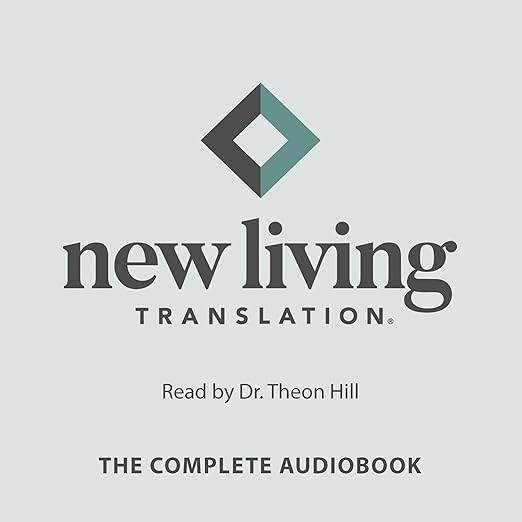
There are audiobooks you finish in an afternoon and ones that become part of the rhythm of months. The complete Holy Bible in audio format is categorically the latter. I came to this particular edition, the New Living Translation narrated by Dr. Theon Hill for Oasis Audio, after recommending a handful of audio Bible editions to AudiobookDaily readers who had asked specifically about accessibility. The NLT’s reputation in that regard is well-established, and Dr. Hill’s name attached to a 92-hour project warranted a serious listen.
It would be dishonest to review this as I would a standard audiobook. The NLT is the product of ninety leading Bible scholars working to render ancient Hebrew and Greek texts into natural contemporary English, not word-for-word translation but what the publishers describe as thought-for-thought equivalence. The result is a text that reads the way people actually speak, without sacrificing fidelity to the source material’s meaning. Whether that is the right approach to Scripture is a conversation that has occupied theologians for centuries, and this is not the place to settle it. What I can evaluate is how the audio edition executes on those goals.
Our Take on the Holy Bible: New Living Translation
The NLT occupies a specific niche in the translation landscape: it is significantly more readable than the King James or even the New International Version, and it has been designed explicitly so that every family member, from children to adults, can access the same text without hitting archaic language barriers. Reviewers who use it for youth ministry or church groups consistently highlight this feature. One reviewer who purchased a stack for a teenage group noted that after real-world handling, the majority held up; the ones that did not had absorbed significant physical abuse. That durability detail is not irrelevant, this is a text meant to be used, not archived.
For the audiobook specifically, the dynamic equivalence approach works particularly well. Passages that clunk in more literal translations flow naturally here. The poetic books retain their rhythm. The Pauline epistles, notoriously dense in word-for-word translation, become more immediately comprehensible. The translators note they aimed to be both exegetically accurate and idiomatically powerful, and across the 92-hour runtime that balance holds more often than it falters.
Why Listen to the Holy Bible: New Living Translation
Dr. Theon Hill is a scholar and preacher, and that background is audible throughout the recording. His voice carries ecclesiastical authority without tipping into performance. He does not dramatize the text, he reads it with care and consistency, treating both genealogical passages and the Psalms with equal intentionality. For a project of this length, consistency matters enormously. Some multi-cast Bible productions gain energy from varied voices but sacrifice cohesion; Hill’s single-voice approach maintains a unified atmosphere from Genesis through Revelation.
The 92-hour runtime is the single most significant commitment a prospective listener faces. Many people approach audio Bibles in sections rather than sequentially, reading plans, devotional practices, or targeted study passages. The NLT edition lends itself well to this approach, and individual books can be returned to without losing thread.
What to Watch For in the Holy Bible: New Living Translation
The NLT’s dynamic equivalence method occasionally draws criticism from readers who prefer strictly literal translation and want to parse original-language nuance. Footnotes in the print edition address some of these points, and the audio companion PDF (accessible as a download) supplements the listening experience with additional resources including a glossary, though the audio itself does not pause for footnotes. Listeners who use audio Bibles for intensive academic study should be aware of this limitation. For devotional listening, personal reflection, or broad comprehension, it is largely a non-issue.
One thing worth noting: some reader reviews on record are clearly for print editions of the NLT rather than this audio production specifically. The audio is its own distinct experience, shaped substantially by Dr. Hill’s interpretive choices. The print edition’s note-taking appeal, underlined passages, margin notes, does not translate directly, though the companion PDF provides a structural anchor.
Who Should Listen to the Holy Bible: New Living Translation
This edition is well-suited for new Christians or those returning to faith after a gap, people exploring the Bible with no prior background, families wanting a shared text accessible across age ranges, and commuters who want to integrate Scripture into daily listening routines. Those who require a strictly literal translation, are using the audio for academic translation comparison, or prefer a multi-voice dramatized production may want to explore other editions alongside this one.
Frequently Asked Questions
Is this the complete Bible or a selected highlights edition?
This is the complete Holy Bible in the New Living Translation, all 66 books of the Old and New Testaments, clocking in at 92 hours and 29 minutes.
How does Dr. Theon Hill’s narration compare to the more dramatized Bible audio productions?
Hill’s is a single-narrator reading rather than a dramatized cast production. It prioritizes clarity and consistency over theatrical performance, which suits the NLT’s emphasis on accessible, natural language.
Is the NLT considered a reliable translation for serious Bible study?
The NLT was produced by 90 Bible scholars and is widely used in churches and seminaries. It uses dynamic equivalence rather than word-for-word translation, which some scholars prefer for comprehension and others find less suitable for detailed textual study.
Does the audiobook include any supplementary resources like commentary or reading guides?
The audio itself is the text only, but a companion PDF download includes a glossary, an infographic of biblical holidays, and a Hebrew alphanumeric chart.