Quick Take
- Narration: A Virtual Voice AI narrator handles the material cleanly, though the comedic timing that makes Steve Ebling’s annotated style land best on the page translates imperfectly to synthesized delivery.
- Themes: biblical skepticism, satirical commentary, Old Testament absurdity
- Mood: Deliberately irreverent and blunt, with flashes of genuine argumentative sharpness
- Verdict: For secular readers and curious agnostics already interested in critical readings of the Pentateuch, this is entertainingly pointed; for everyone else, the title is warning enough.
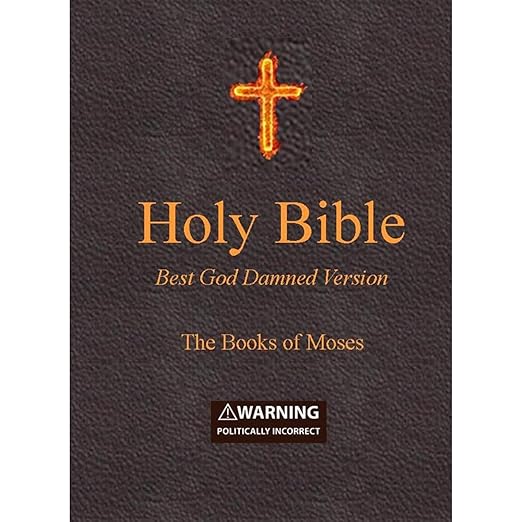
I picked this one up on a Sunday evening, which felt like a small act of defiance even though I was just sitting at my kitchen table. Steve Ebling’s retelling of the Books of Moses, Genesis, Exodus, Leviticus, Numbers, and Deuteronomy, comes with a premise so compressed it barely qualifies as a synopsis: “Because you know it’s nonsense, but were never sure why.” That single line either tells you everything you need to know about whether this is for you, or it tells you to stop reading here.
What Ebling has done, across multiple volumes of the Best God Damned Version series, is annotate the Pentateuch with running commentary that strips out the theological framing and confronts the text on its own literal terms. The murders. The incest. The genocides commanded by a deity whose temperament, when read without apologetics, resembles a volatile Bronze Age warlord far more than any modern conception of the divine. The first book in this series carries a 4.6 average across nearly six hundred Audible ratings, which suggests there is a real audience for this kind of critical engagement delivered with humor rather than academic detachment.
What Satire Actually Requires of a Text
To be clear about what this is and what it is not: Ebling is not writing comedy in the traditional sense. He is writing annotated parody, which is a different discipline. The humor arises almost entirely from juxtaposition, the gap between what the text claims to be and what it demonstrably is when read without deferential framing. One reviewer put it precisely: what the book demonstrates with sparkling clarity is that the Pentateuch does not stand the test of time. That is both the thesis and the method. Ebling identifies the specific moments of contradiction, cruelty, and narrative incoherence and holds them up without attempting to explain them away.
The best sections are the ones where Ebling lets the text incriminate itself through selective emphasis and dry observation. Leviticus, which devout readers tend to quietly skip, gets particularly sharp treatment. The legal codes governing ancient Israelite life, who can touch whom, what can be eaten, which bodily states render a person ritually unclean, read very differently when annotated by someone with no professional commitment to finding theological meaning in them.
The AI Narrator Question
This is a Virtual Voice title, which means an AI narrator handles the audio. For most audiobook content, this is a meaningful limitation. For this particular book, the impact is more complicated. Ebling’s comedic style relies heavily on timing and deadpan delivery, the kind of reading where a slight pause before a punchline does all the work. The Virtual Voice narrator reproduces the words correctly but cannot replicate the comedic rhythm that a skilled human reader would bring. Several listeners who encountered this through the print version noted that the humor lands harder on the page. That said, the material is strong enough that the argument remains coherent even when the delivery is merely competent rather than inspired.
One reviewer from Canada noted that Ebling puts the main characters into sharp focus by placing them in human context rather than the pompous airs that many theologians speak with on Sunday mornings. That is an accurate description of the method, and it holds up even through synthesized narration.
Where the Approach Has Limits
A few reviewers noted that by the end of the Pentateuch, the humor begins to flatten because the source material’s absurdities are repetitive. Yahweh commands a genocide; the Israelites rebel; Yahweh punishes them; the cycle repeats. Once Ebling has established his observational framework, the later books offer fewer opportunities for genuine surprise. This is a structural problem inherited from the source text rather than a failure of Ebling’s craft, but it is worth knowing before committing to eleven-plus hours of audio.
The book works best as a companion for people who have already read or studied the Old Testament and want permission to voice their discomfort with what it actually says. As an introduction to biblical criticism, it is too polemical to be comprehensive. As a standalone comedy record, it requires too much contextual knowledge to work on its own terms. But as a particular kind of cathartic exercise for secular readers who grew up in religious households, it delivers something genuine.
Who This Will Resonate With and Who Should Skip It
Listeners who are devout believers will find this deeply offensive, and Ebling does not pretend otherwise, the series title is self-aware about its own provocation. Listeners who are casually curious about religion might find it a bit thin on actual biblical scholarship. The sweet spot is secular readers, ex-religious listeners, and anyone philosophically in the agnostic space who has spent time genuinely puzzled by why these texts retain the cultural authority they do. For that audience, this free audiobook delivers pointed, occasionally hilarious, and bracingly direct engagement with some of the most influential documents in Western civilization.
Frequently Asked Questions
Does this audiobook cover the entire Bible or just the first five books?
This first volume covers only the Books of Moses, Genesis through Deuteronomy. It is the first in Ebling’s ongoing Best God Damned Version series, with subsequent volumes covering additional biblical books.
Is the Virtual Voice narration a significant problem for this content?
It affects the comedic timing more than it affects the argument. The satirical annotations remain legible and pointed, but Ebling’s deadpan humor benefits from human pacing that the AI narrator cannot fully replicate.
Is this free audiobook appropriate as a starting point for someone with no biblical background?
Probably not the ideal entry point. The humor depends heavily on the gap between what readers expect these texts to mean and what they literally say. Some familiarity with the Old Testament makes the commentary far more effective.
How does this compare to secular critiques by Dawkins or Hitchens?
Ebling is less interested in systematic philosophy than in line-by-line comedic annotation. It is closer in spirit to a satirical close reading than to formal argument against religion, less Dawkins, more Mark Twain’s Letters from the Earth.