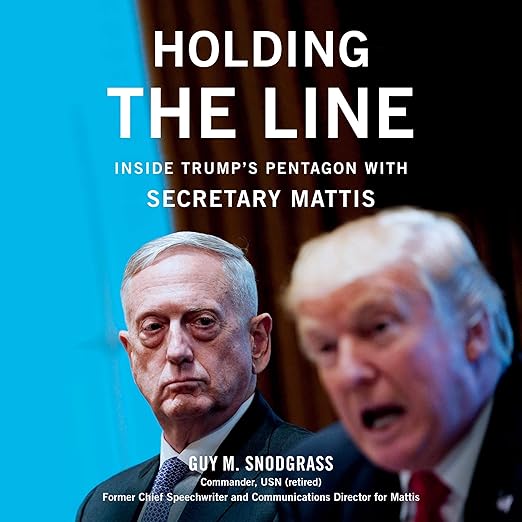
Quick Take
- Narration: Snodgrass narrating his own memoir adds documentary credibility; his delivery is measured and military rather than performative, which suits the material precisely.
- Themes: Institutional loyalty versus political pressure, the ethics of dissent within command structures, national security under chaotic civilian leadership
- Mood: Urgent and sobering, occasionally alarming, with the restraint of someone who spent years learning not to show his hand
- Verdict: An essential insider account of a period that is still being processed, with the authority that comes from genuine proximity to the events described.
I listened to Holding the Line during a week when I was reading extensively about the intersection of military institutions and political leadership, and the timing made Snodgrass’s account hit differently than it might have under other circumstances. This is not a book that benefits from distance. It is most effective when you read it, or rather listen to it, in full awareness of the specific political moment it documents: seventeen months inside the Pentagon as Jim Mattis navigated his role as Secretary of Defense under a president whose decision-making process was, by all accounts here and elsewhere, erratic and frequently communicated via Twitter rather than through official channels.
The Washington Post’s description of this as the memoir America wishes Jim Mattis had written is both accurate and slightly unfair to what Snodgrass has actually accomplished. Mattis’s own memoir, Call Sign Chaos, is a book about generalship as a philosophy. This one is a book about a specific impossible job in a specific impossible political environment. Snodgrass was Mattis’s chief speechwriter and communications director. He was in rooms. He heard things. And unlike Mattis himself, who has maintained near-total silence about his tenure, Snodgrass decided that the public record required his account.
What the Speechwriter Saw That History Missed
The granular detail is what makes Holding the Line valuable rather than merely interesting. Snodgrass describes moments that do not appear in other accounts of the period: Mattis learning about major policy decisions via Twitter before any official notification, the specific mechanics of slow-rolling presidential directives that senior DoD officials found constitutionally or strategically alarming, the delicate maintenance work required to preserve relationships with allied governments who were watching American leadership with increasing anxiety.
One reviewer, a current Army officer who served on Capitol Hill and inside the Pentagon, confirms that Snodgrass’s portrait of navigating the DC political climate rings true to lived experience. That validation matters. This is not a political operative’s account or a journalist’s reconstruction from secondary sources. It is the testimony of someone who was there, who understood the institutional culture from the inside, and who had the professional background to recognize which moments were historically significant as they were happening.
Narrating Your Own Memoir at This Level of Sensitivity
Snodgrass narrating his own memoir is the right choice here. His delivery is measured, controlled, and somewhat formal, which is what you would expect from someone who spent a career communicating on behalf of senior military leadership. He does not reach for drama or perform outrage. The alarming material in this book is more alarming for being delivered in that flat, professional register. When a man with that bearing describes something as concerning, the word carries weight it would not carry in a more theatrical reading.
This is the rare case where author narration makes the book better rather than merely more convenient. The voice and the events it describes are inseparable. A professional narrator, no matter how skilled, would be performing credibility. Snodgrass does not need to perform it.
Where the Book’s Loyalties Lie
Holding the Line is, above all else, a portrait of Mattis as a leader. Snodgrass admires his former boss without reservation, and that admiration is both the book’s strength and its primary limitation. Mattis is presented throughout as the adult in the room, the steady institutional hand, the man who absorbed enormous pressure without breaking. That portrait is probably accurate as far as it goes. But it does leave certain questions unasked. Critics of Mattis’s tenure have pointed out that slow-rolling presidential directives, however well-intentioned, raises its own questions about civilian control of the military. Snodgrass does not dwell on that tension, and his lack of self-criticism is one of the few places where the book feels less than fully honest.
Who Needs to Hear This Account
This audiobook is aimed at readers who want to understand how American defense institutions function under political pressure, and it delivers on that promise. It is particularly valuable for anyone interested in the specific question of how career military and civilian officials navigate situations in which the chain of command is generating directives that conflict with strategic judgment. If you are coming looking for a takedown, you will find evidence but not a polemic. If you are coming for a portrait of institutional resilience under stress, you will find something more textured and lasting. The free audiobook availability makes this an easy entry point for listeners interested in recent American political and military history.
Frequently Asked Questions
Does Snodgrass break any confidentialities or reveal genuinely classified information in this book?
Snodgrass was careful about what he included, and the book was presumably reviewed through appropriate channels before publication. The revelations are more operational and cultural than classified in the technical sense. He is describing atmospheres, attitudes, and decision-making processes rather than intelligence or weapons systems.
How does this book compare to Mattis’s own memoir, Call Sign Chaos?
They are complementary rather than overlapping. Mattis’s book is a memoir of generalship across a career and barely touches his time as Secretary of Defense. Snodgrass’s account is specifically about that Pentagon tenure. Together they give a more complete picture than either does alone.
Is Holding the Line fair to the Trump administration, or is it clearly partisan?
It is critical of specific decisions and behaviors but is not written in the register of partisan polemic. Snodgrass is a career military officer, and his background shapes his perspective: he is judging actions against institutional and strategic standards rather than political ones. Readers across the political spectrum have found it credible, though readers sympathetic to the administration will find the portrait uncomfortable.
How reliable is Snodgrass as a narrator given his obvious admiration for Mattis?
His loyalty to Mattis is visible and should be factored in. He is not writing a balanced assessment of his former boss’s tenure but an account filtered through genuine admiration. Reviewers with direct Pentagon experience have confirmed the accuracy of the institutional atmosphere he describes, which adds credibility to the factual record even where the interpretive framing reflects personal affection.