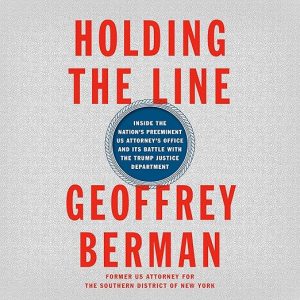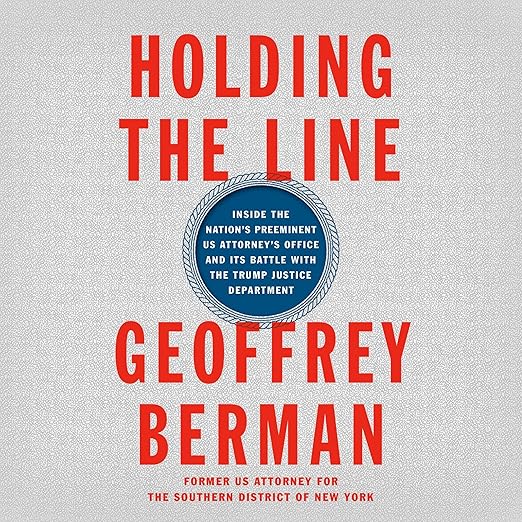
A prosecutor's memoir lives or dies on specifics, and this audiobook opens with one of the better sentences in the genre: Trump's Justice Department kept demanding that I use my office to aid them politically, and I kept declining, in ways just tactful enough to keep me from being fired. Geoffrey Berman walked that tightrope for two and a half years as US Attorney for the Southern District of New York, until, in his own phrasing, the rope snapped. Penguin Audio released the recording on September 13, 2022, with Berman reading it himself across nine and a half hours.
A Closer Look at Holding the Line
Berman's account has two engines and they run at different speeds. One is institutional: a Trump appointee discovering that the office he was handed in 2018 came with expectations attached, and that his predecessor Preet Bharara had been dismissed in a manner troubling enough to serve as a warning. The other is procedural, a working record of what the Southern District did in those years. The book's argument is that the second engine is what protected the first, since an office visibly doing serious work is harder to bend.
Linda Chase, five stars in October 2022, identifies the quality that makes it work for non-lawyers: Berman's explanations of what a US Attorney in the Southern District actually does are simple enough for anyone to follow, and the case narratives sit alongside them without turning into a legal seminar. That same response found the book hard to put down. Accessibility of that kind is not automatic in a memoir written by someone who spent a career addressing judges. It is also the quality that decides whether a general listener finishes a legal memoir or abandons it in the second hour.
Self-narration cuts both ways on a book like this. Berman is, in the end, making his own case about his own conduct, and hearing him make it removes the small distance a hired reader would have supplied. Nothing is filtered; the claims about Barr and the firing arrive in the voice of the person making them. Listeners who want an account they can weigh at arm's length should note that the format has quietly removed the arm. The compensation is considerable: a man describing his own firing has an investment in the telling that no hired reader could counterfeit.
What Makes Holding the Line Worth Hearing
John Silas Hopkins III, writing at five stars in November 2022, makes the craft argument more convincingly than the publisher's copy manages: litigation is about facts, and about making those facts speak to whoever is judging them. That response credits Berman with reciting the facts of his matters so clearly that they carry themselves, and calls that the mark of a skilled litigator. For a listener, that translates into narrative chapters that hold together without editorializing at the end of each one.
The casework is the reason to stay. Jeffrey Epstein and Lawrence Ray, pharmaceutical executives, organized criminal syndicates, and the repatriation of art looted by the Nazis: the range is extraordinary for one office over two and a half years, and each strand doubles as an illustration of what independence buys. The office's own history, which the copy dates back more than two hundred and thirty years, gives the institutional stakes some weight beyond one administration.
Barbara McQuade's line in The Washington Post, quoted on the listing, frames the book accurately as a cautionary tale about political forces undermining the quest for justice. That is a fair summary of the ambition and a fair warning about the register. Berman is not writing a neutral history of the Justice Department between 2018 and 2020. He is testifying, at length, about a period he experienced from the inside, and the value lies in the specificity of the testimony.
Things to Know Before Starting Holding the Line
The numbers on this page cannot be right. The listing shows a 4.6 average built on exactly one rating, and a single vote can only ever be one, two, three, four or five whole stars. No arrangement of one rating produces 4.6. Below that counter sit five signed written responses, each carrying its own star grade. A rating count of one under five graded reviews is the signature of a split or duplicated listing, so anyone comparing editions should look for a second entry holding the rest of the votes.
A four-star response posted on release day supplies the other warning, and it does so by accident. It describes the book as five parts, twenty-three main chapters and about 311 pages, not counting acknowledgments and index. Every one of those measures is a print measure. A listener gets none of that architecture: no visible part divisions, no index to consult when a name from chapter four resurfaces in chapter nineteen, and no page reference to note down.
Nothing in the copy pretends to detachment, and buyers should price that in. The description ends by saying Berman's defense of prosecutorial independence made him a hero to everyone who shares those values, which is publisher's language for a book that has already reached its verdict. The events described are documented and the account is detailed. It remains one participant's version of a dispute in which the other participants would tell it very differently, and the listing offers no signal that anyone has tested it.
Who Geoffrey Berman Is Writing For
P. H., five stars in October 2022, aims it squarely at the legal profession: required listening for first-year law students and practicing attorneys, with a half-joking suggestion that it ought to earn a couple of hours of continuing education credit in ethics. That is a serious recommendation dressed lightly. Anyone considering law school, or currently deciding how much institutional pressure they are willing to absorb, will find this more useful than any careers talk.
Readers who want the politics litigated will be disappointed in both directions. This is not a polemic against an administration, and it is not a balanced history either; it is a narrow account of one office under pressure, and the pressure is described rather than analyzed. Anyone hoping for courtroom theater should also adjust expectations, since the drama here happens in phone calls and meetings rather than in front of juries.
Berman has written the rare public-service memoir with enough procedural detail to teach something, read by the person who lived it, on a page that cannot count its own reviews. The mismatch between the quality of the account and the state of the listing is genuinely odd. A career built on facts deserves a page that gets its own numbers right.
- Voice: Berman reads his own defense, which removes the distance a hired performer would have put between the claims and the man making them.
- Big ideas: Prosecutorial independence, political pressure on the Justice Department, the Southern District's casework, institutional loyalty
- Atmosphere: Controlled, procedural, quietly furious
- Worth it?: A detailed insider account worth the time, on a listing whose ratings counter is demonstrably broken.
Questions Listeners Ask
Why was Geoffrey Berman fired, according to the audiobook?
The copy says Trump and Barr grew fed up with his principles and dismissed him summarily. Berman then refused to go quietly, and blocked Barr from installing a replacement who might prove more compliant. That standoff is the episode the whole book has been building toward.
How political is the audiobook?
Structurally political, and openly so. The description talks about blatant efforts to bring weak cases against political foes and to squash cases threatening allies, and names Bill Barr as the point where things worsened. Expect a participant's testimony rather than a historian's survey of the same period.
Which house produced the recording, and what does it run to?
Penguin Audio, on September 13, 2022, at nine hours and thirty-three minutes, with Berman credited on both the writing and the reading. That is a modest span for a two-and-a-half-year tenure covering the caseload described, so expect selection rather than a complete record of the office.
Is it worth listening to for the legal craft rather than the politics?
Yes, and one five-star response from May 2024 argues exactly that, calling it insight into how the federal justice system works and how easily it can be upended. The casework chapters do the teaching; the political conflict supplies the reason those chapters mattered.