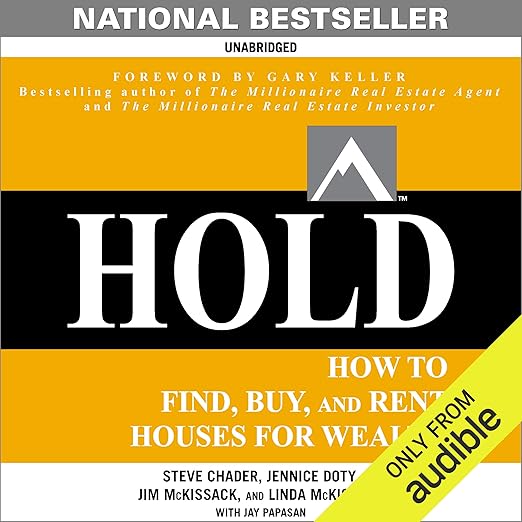
I came to HOLD at a moment when I was trying to think seriously about what financial independence actually looks like in practice rather than in theory. I had read the more famous works in the real estate investing genre, the ones that promise transformation on the first page, and I was looking for something that treated the reader as an adult capable of handling operational complexity without needing constant encouragement. HOLD delivered that, and then some.
The book is the third in Gary Keller's Millionaire Real Estate Investor trilogy, written with Steve Chader, Jennice Doty, Jim McKissack, Linda McKissack, and Jay Papasan. It follows SHIFT and The Millionaire Real Estate Investor, and while it can be read independently, it is clearly designed as the operational capstone of a larger framework. Where earlier books in the series focus on mindset and initial deal-finding, HOLD is about what comes after the acquisition: how to manage, hold, and eventually leverage the properties you own into a portfolio that generates genuine financial freedom over time rather than quick appreciation.
Our Take on HOLD
The book is organized around five stages: Find, Analyze, Buy, Manage, and Grow. That framework is simple enough to remember and detailed enough to be actionable in real situations. Reviewers consistently praise the worksheet component, downloadable forms for analyzing properties, evaluating offers, running the numbers on potential acquisitions, and those worksheets are where the book earns its reputation as the most practically useful entry in the trilogy.
One reviewer who is a working real estate professional describes gifting this book to clients at every stage of their investment journey, from first-time buyers to seasoned investors. That range of usefulness is the book's real achievement. The Analyze and Buy sections give beginning investors the language and framework to evaluate deals without guessing. The Manage and Grow sections give experienced investors a structured approach to portfolio development that most real estate books leave vague or treat as self-evident. The combination is unusual in the genre.
Why Listen to HOLD
The financing chapter is the consistent weak point across multiple reader accounts. One reviewer who otherwise praised the book highly notes that the section on financing is too brief and light on examples relative to its importance. This is not a small omission, financing decisions are arguably the most consequential choices a real estate investor makes, and the book's relatively thin treatment of leverage, creative financing structures, and debt management is a real gap for listeners who are trying to make actual purchase decisions.
Paul Keith's narration does not add to or subtract from this limitation. His performance is clear and competent: he makes the technical content accessible without editorializing, which is the right instinct for dense nonfiction. Seven hours of real estate investment methodology requires a narrator who knows when to get out of the way, and Keith mostly does. Listeners who need a more engaging performance to stay with dry material should be aware that this is a straightforward read rather than a character-driven one.
What to Watch For in HOLD
What distinguishes HOLD from much of the real estate investment genre is its genuine commitment to the long game. Most books in the category are optimized for the acquisition, how to find deals, how to structure offers, how to get to closing. HOLD is organized around the conviction that the real value in real estate investing is created over decades of holding, not at the moment of purchase. The title is the thesis: the act of holding, through market downturns, difficult tenants, unexpected maintenance costs, is where the wealth actually accumulates. That argument sounds obvious but it runs against the bias of most real estate content, which treats transactions as the interesting part and management as the unavoidable burden.
That perspective is not exciting in the way that deal-finding narratives are exciting, and the book does not try to make it exciting. The tone is methodical and occasionally stolid, and that is probably appropriate for material about behavior that requires sustained patience rather than inspired action. The people who get the most from this book are the ones who are already past the phase of needing motivation and into the phase of needing a system.
The Grow section of the book is where HOLD most clearly differentiates itself from transaction-focused real estate content. The argument is that wealth in real estate is not created primarily by buying low and selling high but by the compounding effect of long-term ownership, mortgage paydown, and rental income accumulation over years and decades. That sounds obvious once stated, but the book makes it feel obvious in a way that changes how you read the earlier sections, the emphasis on finding the right property at the right price makes more sense when you understand that the property you buy is one you may hold for twenty years rather than flip within eighteen months.
Who Should Listen to HOLD
Listen if you already own investment property or are seriously planning your first acquisition and want a rigorous framework for the full life cycle of the investment, not just the purchase. Also worth listening to if you have read the earlier books in the Keller trilogy and want the operational capstone. Skip if you are looking for motivational framing or creative financing strategies, this book assumes you are serious about the work and focuses on how to do it systematically. The financing chapter's brevity is a real limitation, so supplement with dedicated resources on real estate debt if that area is central to your planning.
At a Glance
- Voice: Paul Keith delivers a functional, clear narration that keeps the technical real estate content accessible, professional but not particularly distinctive.
- Big ideas: Long-term wealth building through property, the five-stage investment cycle, financial independence through patient holding
- Atmosphere: Practical and methodical, with the calm confidence of someone who has done the math repeatedly
- Worth it?: The final book in Gary Keller's real estate investor trilogy is its most operationally complete entry, rigorous on process, occasionally thin on financing detail, but consistently useful for listeners at any stage of their property investment journey.
Before You Listen
Can HOLD be read as a standalone, or do I need to read the earlier books in Gary Keller's trilogy first?
It works as a standalone, Keller's framework is re-established at the beginning of this volume. That said, reading The Millionaire Real Estate Investor first provides useful context for the mindset and early-stage deal-finding strategies that HOLD builds on in its later chapters.
Are the worksheets and downloadable forms accessible to audiobook listeners?
The worksheets are available through the publisher's companion resources. Audiobook listeners will need to access them separately, but they are referenced clearly enough in the narration that you can follow the logic even without the physical forms in front of you.
How does HOLD handle the question of property management, hiring managers versus self-managing?
The Manage section addresses both approaches with some specificity. The book is not dogmatic about self-management versus professional management; it treats the decision as a function of portfolio size, time availability, and geographic proximity to your properties.
Is the real estate market context in the book dated, given it was published in 2013?
The market-specific examples are dated, but the underlying principles, how to analyze a deal, how to evaluate cash flow, how to build a portfolio over time, are not particularly time-sensitive. Listeners should update the financing chapter with current market information, but the framework itself remains applicable.