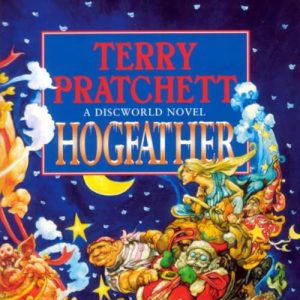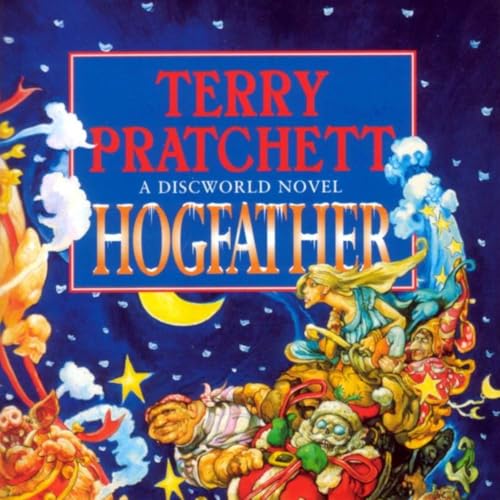
There are Discworld novels you reach for when you want comfort and there are Discworld novels that reveal themselves to be doing something considerably more ambitious than they initially let on. Hogfather is firmly in the second category, and in audio it is one of the most concentrated doses of Pratchett's particular genius available. I listened to it on a December evening, which is probably the intended context, but the content works year-round because what it is actually about has nothing to do with any specific holiday. It is about why human beings need stories, and what happens when the stories we have built to sustain us are threatened.
Sian Clifford narrates, and this is a smart choice for a book that requires navigating between broad satirical comedy and something darker and stranger. Clifford has range, and she needs it here. The Discworld requires narrators who can commit fully to the absurdism without undermining the genuine emotional intelligence underneath it. She handles Death, one of the most distinctive voices in the Pratchett canon, with a precision that honors the character without turning him into a one-note comedy bit. Death is not funny exactly. He is sincere in a way that makes the world around him funny by contrast, and Clifford understands that distinction with enough clarity to perform it consistently.
How Hogfather Holds Up
The plot, such as it is, involves the Hogfather, Discworld's equivalent of Father Christmas, going missing on the last night of the year. Death steps in to fill the role, because if the Hogfather does not deliver belief-made-real to the children of the Disc, something worse than disappointment will happen. The novel's villain, Mr. Teatime, a name that is pronounced Teh-ah-tim-eh and weaponized for comic effect throughout, has been hired by the Auditors of Reality to eliminate the Hogfather by destroying the belief that sustains him.
This is the surface plot. Underneath it, Pratchett is asking one of the questions that runs through his mature work: why do human beings need stories? Not as entertainment but as a structural necessity. Why do we create Santa Claus? Why do we create the Tooth Fairy, to which Death also attends in this novel, collecting teeth and leaving coins for reasons he is trying hard to understand? What function do these belief-constructs serve that cannot be served by accurate accounting of physical reality? The answer Pratchett gives, through Death and through his granddaughter Susan who reluctantly becomes involved in the effort to restore the Hogfather, is not comforting and not sentimental. It is, however, deeply considered and arrives as a conclusion earned rather than declared.
Why Hogfather Works as an Audiobook
Death is at his best in Hogfather. The character, across the Discworld series, is Pratchett's primary vehicle for examining human irrationality with genuine affection and without condescension. Death does not understand why humans do what they do, but he is fascinated rather than contemptuous, and that curiosity generates the series' most philosophically interesting moments. When he dresses as the Hogfather and attempts to fulfill the role with scrupulous attention to its requirements, the comedy works because his earnestness is real. He is not mocking the tradition. He is trying, with complete sincerity, to understand and sustain what it does for the people who depend on it.
Susan, Death's granddaughter, is less comfortable with irrationality than her grandfather. Her arc in the novel moves her from dismissal of what she considers childish belief to a grudging understanding of why the childish beliefs matter, and why dismissing them is itself a form of failure. Clifford handles this character with real intelligence. Susan's skepticism reads as genuine intelligence rather than mere coldness, and her eventual concession has weight because it has been earned through experience rather than engineered by the plot.
Weak Spots in Hogfather
The duration listed for this edition is unusually short for a full Discworld novel, and listeners should verify the edition details before purchasing to ensure they are getting the complete unabridged text. Full unabridged versions of Hogfather typically run considerably longer than an hour. This may be an abridged version, which would substantially change the experience of the philosophical sections that give the book its depth. If the complete text is important to you, checking the edition before purchase is recommended.
Whether full or abridged, the twentieth Discworld novel does not require extensive prior series knowledge. Death and Susan are recurring characters, and their relationship has history that deepens if you know the earlier books, but the novel establishes what you need to know. The pleasure is in the comedy and the ideas, both of which are largely self-contained.
The Right Listener for Hogfather
Any listener with tolerance for intelligent comedy and a taste for philosophy delivered through the medium of a world where Death personally delivers presents on a flying sleigh will find this richly rewarding. Sian Clifford is a genuine asset. Listeners who have never encountered Discworld and prefer to start at the series beginning may want to orient themselves first, but Hogfather's self-sufficiency makes it a viable first entry for anyone drawn specifically to the premise. One important note: verify whether the edition is the complete unabridged text before purchasing if the full philosophical depth of the book matters to you. The 4.8 rating across over 1,000 listeners is Pratchett's characteristic ceiling for his strongest work, earned by the combination of genuine wit and genuine seriousness that marks his best Discworld novels. This is one of them, and Clifford's performance is one reason the audio format works so well for it.
In Brief
- Performance: Sian Clifford brings sharp comic timing to Pratchett's layered satire, her voice well-suited to the material's combination of absurdism and genuine philosophical provocation
- What it covers: Belief and narrative necessity, the function of myth in human societies, Death as an unlikely hero
- Feel: Darkly funny with genuine intellectual bite, the way only the best Discworld entries manage
- Our call: One of Pratchett's most thematically rich Discworld novels in a compact listen that rewards both newcomers and long-term series followers.
Frequently Asked Questions
Is Hogfather accessible to listeners who have never read any Discworld before?
Yes, with the caveat that Death and Susan's relationship has history in earlier books. The novel establishes everything a new listener needs, and the central comedy and philosophical argument are self-contained.
How does Sian Clifford differentiate Death's voice from the novel's other characters?
Clifford plays Death as deeply sincere and unhurried, using his literal-mindedness as a comic and philosophical tool rather than playing him as spooky or melodramatic. The contrast between his manner and the absurdity of his situation generates the comedy.
The duration listed is just over an hour. Is this the complete novel or an abridgement?
The duration listed is unusually short for this novel. Full unabridged versions of Hogfather typically run considerably longer. Check the specific edition details before purchasing if unabridged text is important to you.