Before You Press Play
- Narration: Alex Magaña narrates the Spanish-language edition fluidly, handling Derek Thompson's analytical prose with clarity and appropriate energy for a book about cultural contagion.
- Themes: Psychology of popularity, cultural economics, hidden power networks
- Mood: Sharp and revelatory
- Verdict: Thompson's rigorous deconstruction of how products become cultural phenomena is essential reading in any language, and this Spanish edition delivers the full argument with strong narration.
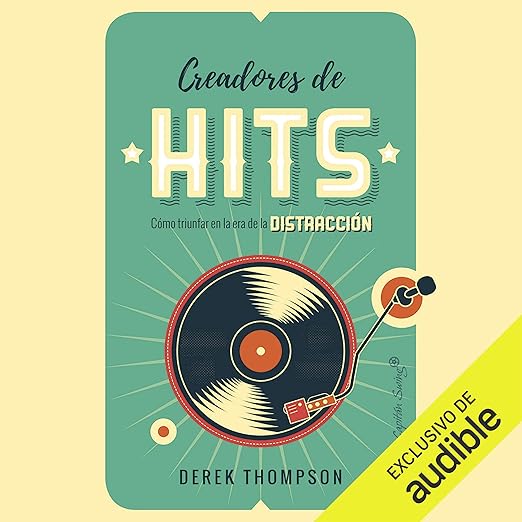
Derek Thompson's Hit Makers has earned its reputation as one of the more rigorously argued books about cultural popularity in recent decades, and this audiobook edition, narrated by Alex Magaña, delivers the full argument in Spanish. Buyers should be aware before purchasing: this is the Spanish-language edition, titled Creadores de hits in print, and the entire audiobook is produced and narrated in Spanish. It is not a bilingual edition or a partial translation. English-language listeners looking for Thompson's original text should seek the English audiobook separately. For Spanish-speaking listeners, this edition offers Thompson's analysis at full length with narration that handles the material's intellectual demands well.
Is Hit Makers Worth Your Time?
Thompson, an editor at The Atlantic, built this book around a central and counterintuitive argument: nothing goes viral. The popular understanding of cultural success as a spontaneous, democratic process where quality rises organically through word-of-mouth sharing is, Thompson argues, a myth that flatters both creators and audiences. Every significant hit has an infrastructure behind it: a set of networks, gatekeepers, distribution systems, and amplification mechanisms that most people never see. Understanding that infrastructure is what separates strategic creators from talented ones who remain obscure. This is not a cynical argument about manufactured culture; it is a structural one about how attention actually moves through the systems we've built to carry it.
The book's historical scope is one of its most distinctive features. Thompson begins not with Spotify playlists or social media algorithms but with the Impressionists and the role of the Paris Salon in shaping which art the public encountered. He traces the mechanics of popularity from Greek antiquity through the twentieth century's radio and film industries and into the current era of platforms and algorithmic recommendation. This historical breadth prevents the book from being a narrow case study collection and gives its arguments genuine durability. The specific platforms and companies Thompson references will continue to evolve, but the underlying dynamics he identifies have operated across centuries.
The concept Thompson develops around psychological familiarity and the principle he borrows and adapts from industrial designer Raymond Loewy, described as "most advanced yet acceptable," is among the book's most transferable insights. Loewy argued that consumers want something simultaneously new enough to feel progressive and familiar enough not to be threatening. Thompson extends this principle from product design into the broader mechanics of cultural hit-making: the most successful products are not the most innovative but the ones that deliver novelty within a frame of recognition. This is a framework that reorganizes a substantial amount of what appears accidental about cultural success, and it holds up under examination.
Alex Magaña's narration suits the material's combination of intellectual argument and narrative illustration. Thompson's prose moves between data-heavy analytical passages and specific story-driven examples, and Magaña tracks these shifts without losing the thread of the larger argument. Spanish-language business and cultural criticism narration often tends toward either flat recitation or theatrical overcorrection; Magaña finds a middle register that serves Thompson's accessible but rigorous style effectively. The arguments about how Star Wars was actually distributed and marketed, about the hidden networks that made certain Etsy sellers visible while others remained invisible, and about the economic structure of radio programming are all rendered clearly in this narration.
Reviewers in Spanish note specifically the quality of Thompson's case studies as teaching tools. Thompson uses specific examples not merely as illustrations but as evidence for structural claims. The distinction matters because it keeps the book from sliding into the business-book failure mode of treating anecdote as proof. Magaña's pacing makes this argumentative structure clear, giving listeners time to absorb the specific case before Thompson draws the structural inference from it.
Before You Commit to Hit Makers
The book was published in 2017, and some of its specific data points about social media platforms and streaming economics have been overtaken by subsequent developments. This is inevitable in any book about digital culture and does not undermine Thompson's core structural arguments, but listeners who notice dated platform-specific details should understand them as illustrations of principles rather than as current industry descriptions. The arguments about human psychology and the mechanics of attention distribution are as relevant now as when Thompson wrote them, because they are grounded in patterns of human behavior that predate any particular platform by centuries. The analysis of how the radio industry concentrated cultural gatekeeping power in the 1920s and 1930s, for instance, maps directly onto how streaming platforms operate today, which is precisely the kind of structural continuity that gives the historical framing its value beyond mere context-setting.
The Spanish edition is a complete translation of Thompson's original text, not an adaptation or abridgment. The translation handles Thompson's prose idioms capably, maintaining the analytical tone without the stiffness that can affect business book translations done primarily for speed rather than precision. Listeners who have already read the English print edition will find no structural gaps or omissions in this version.
Should You Listen to Hit Makers?
Spanish-speaking professionals in marketing, media, entertainment, and technology will find this audiobook a rigorous account of how the attention economy actually functions, grounded in both history and current practice. Artists and creators who want to understand the structural forces that determine whether work reaches an audience will find Thompson's analysis actionable in ways that most business books are not. Listeners who prefer their cultural criticism narrative-driven and example-rich over theory-heavy will appreciate Thompson's balance of case studies and argument. English-language listeners who want Thompson's original text should look for the English audiobook edition, as this is a Spanish-language production throughout, from the first chapter to the last.
A Few Questions About Hit Makers
Is this audiobook narrated entirely in Spanish?
Yes. This is the Spanish-language edition of Derek Thompson's book, narrated by Alex Magaña throughout. English-speaking listeners who want Thompson's text should search specifically for the English audiobook edition, as this production is not bilingual and contains no English-language content.
Does this audiobook require any prior knowledge of marketing or media theory?
No. Thompson writes for a general intelligent audience rather than for specialists, and the Spanish translation maintains that accessibility. The book uses specific case studies to build its arguments from the ground up, from Impressionist painting to Star Wars distribution, and no prior knowledge of marketing theory is required to follow the full analysis.
How does the audiobook handle Thompson's data-heavy analytical sections?
Alex Magaña's narration paces the analytical sections carefully, which makes the argument easier to follow in audio than silent reading might suggest. The balance between data-driven sections and story-based illustrations means the listening experience doesn't become uniformly dense, and Magaña's clarity helps listeners track the thread across the book's longer structural arguments.