Quick Take
- Narration: Desmond Manny delivers a steady, clear performance suited to survey history, authoritative without being academic.
- Themes: Russian imperial history, the Soviet formation, Cold War espionage
- Mood: Brisk and informative, a confident overview rather than a deep investigation
- Verdict: Captivating History delivers exactly what the brand promises, a well-organized gateway into Russian history that rewards listeners looking for orientation rather than depth.
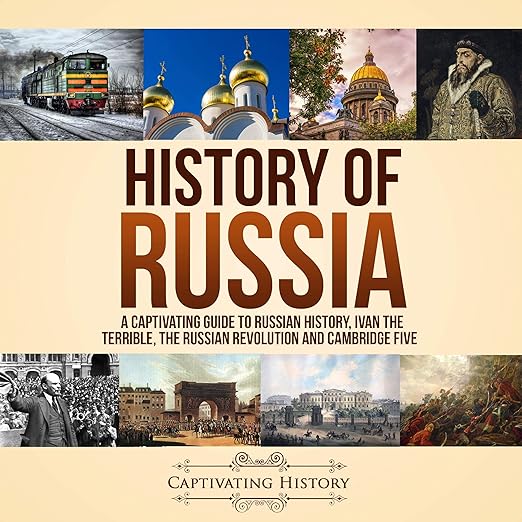
I spent a couple of evenings with History of Russia from Captivating History during a period when I was trying to catch up on a gap in my own reading. Russia keeps appearing in everything, contemporary news, historical fiction, Cold War retrospectives, and I had the embarrassing sense that my background knowledge was thinner than it should be. This four-part compilation, covering Russian history broadly, Ivan the Terrible, the Russian Revolution, and the Cambridge Five spy ring, seemed like the right kind of structured overview.
What I found was exactly what Captivating History does well: clear synthesis of a large subject, organized sensibly, narrated cleanly, and pitched at the listener who wants to understand rather than to specialize.
Our Take on History of Russia
The four-manuscript structure is worth understanding before you start. You're not getting a single coherent narrative of Russian history from the Rus principalities to the fall of the Soviet Union. You're getting four distinct books packaged together, each with its own scope and depth. Part one is a broad sweep from the foundation of Rus through the imperial period. Part two zooms in on Ivan IV. Part three covers the 1917 revolutions and the early Soviet state. Part four pivots to Cold War intelligence, the Cambridge Five who passed secrets to the Soviets from inside British intelligence.
That structure is both the strength and the acknowledged limitation. Reviewer Ray Z. put it well: 'If you are looking for an in depth look into Russian history and other significant events in the forming of Russia you will be disappointed with this group of short overviews. However it is an excellent and concise overview.' That's an honest summary of what Captivating History produces. The model is breadth over depth, and within that model, this is a well-executed example.
Why Listen to This Over a Single-Subject Audiobook
For listeners who don't know where to start, the compilation format has real advantages. You get enough context from part one to understand why the revolutionary conditions of part three exist. The Cambridge Five section is particularly valuable as an entry point into Cold War espionage, the spy ring is one of the most consequential intelligence failures in Western history, and this summary covers the key figures and operational timeline clearly enough to orient someone unfamiliar with the story before moving on to something more detailed, like Ben Macintyre's A Spy Among Friends.
Reviewer Rdelt, who described Russia as that formidable and at times fearsome nation, found the compilation helped them understand why the October Revolution was possible as well as why it was so easy to form the soviets, and why the last Tsar had to die as he did. That's the exactly appropriate use of a survey work: building the explanatory scaffolding for events that otherwise feel inevitable in retrospect but incomprehensible in origin.
What to Watch For in Desmond Manny's Narration
Manny is a solid survey narrator. He handles the proper nouns, Russian names and place names have their own phonetic demands, without stumbling, and he maintains a consistent, forward-moving energy across eleven-plus hours. Survey history in audio can drift into textbook cadence, and Manny avoids that. He's engaged without being theatrical, which is the right calibration for material that needs to cover a lot of ground without losing the listener.
The production quality is consistent across all four manuscripts. This matters because compiled audiobooks sometimes have audible seams where the recording sessions shift, and there's none of that here.
Who Should Listen to History of Russia
This is the right listen for someone who recognizes a gap in their knowledge of Russian history and wants a structured, accessible way to fill it before going deeper. It's also well-suited to listeners who prefer breadth over depth as a primary mode, people who would rather have a coherent outline of a thousand years of history than an immersive examination of one decade. Reviewer Backpacker called it always informative, educational and interesting, provides the right amount of facts, not too little, not too much. For the listener that description resonates with, this is exactly right. For anyone wanting serious historiographical engagement with the revolutionary period or with Ivan's court, this is the starting point, not the destination.
Frequently Asked Questions
Does the four-manuscript structure feel cohesive, or does it read as four separate books stitched together?
It reads as four distinct pieces, each with its own scope. The transition between parts is audible. Listeners who expect a single integrated narrative will find the seams noticeable, but the thematic progression from foundational history to the revolutionary period to Cold War espionage does create a loose connective logic.
How does Captivating History handle politically sensitive material like Stalin and Lenin?
The Captivating History model is descriptive and relatively neutral in tone. Controversial historical figures are covered in terms of their historical role and impact rather than through deep ideological analysis. Listeners seeking interpretive depth or historiographical debate will need to supplement with more specialized works.
Is the Cambridge Five section accurate and up to date relative to recent scholarship?
For an introduction to the Cambridge Five, the coverage is solid. More recent scholarship, including Ben Macintyre's work, has added detail on specific operations and the long-term intelligence damage. Treat this as an orientation, not a complete account.
How does this compare to other Captivating History audiobooks for listeners who have used the series before?
Consistent with the brand. The approach, production quality, and scope are in line with what Captivating History delivers across its catalog. Regular users of the series will know exactly what they're getting. New listeners should approach all Captivating History titles as structured starting points rather than comprehensive treatments.