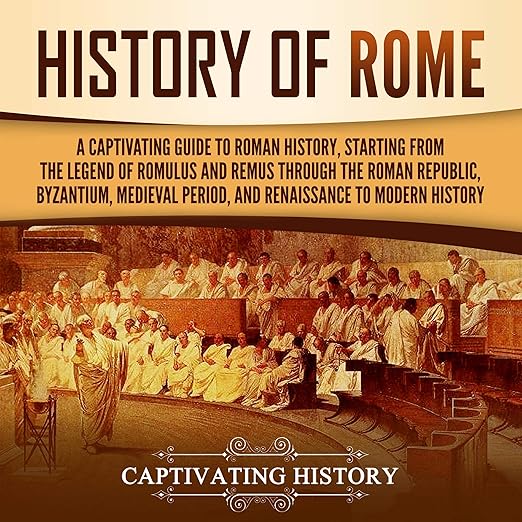
Quick Take
- Narration: Jason Zenobia reads with clean professional delivery that suits Captivating History’s accessible survey-level style without particular distinction.
- Themes: Rome from mythic founding through Medieval transformation, the city as continuous cultural protagonist, the arc from Republic to Empire to Holy City
- Mood: Brisk and informative, like a well-organized museum tour that covers a lot of ground in under seven hours
- Verdict: A capable introductory sweep through Roman history that works best as a first pass before deeper reading, not as a replacement for it.
I finished History of Rome on a Tuesday morning commute, which tells you something about its character. At just under seven hours, it is designed for exactly that kind of listening: dense enough to be informative, accessible enough to follow without notes, and brisk enough that you never feel like you’re being held in any one period longer than necessary. This is the Captivating History model applied to one of the largest subjects in Western historiography, and it delivers what it promises without overpromising.
The book covers Rome in the fullest sense of that phrase: not just the Republic and the Empire, which dominate most popular Roman histories, but the full arc from the legend of Romulus and Remus through the Kingdom, the Republic, the Empire’s height under Pax Romana, the third-century crisis, the fall of the Western Empire, the Byzantine continuation, the Medieval city under the popes, the Renaissance, and a brief treatment of modern Rome. That is an extraordinary range for a 200-page book, and the coverage reflects that ambition more than it satisfies it on every front.
What This Book Does Well and Where It Thins Out
The Republican period is handled with particular care. The progression from Romulus to the Tarquin kings to the founding of the Republic, the growth of Roman law, the Punic Wars, and the social wars that eventually broke the Republican system are narrated with enough detail to be genuinely illuminating for a listener who has not read deeply in this period. One reviewer notes that the information corresponds to and corroborates facts from other sources while including material they had not encountered elsewhere, which is a useful benchmark for introductory history writing.
The Imperial period is where the book’s constraints become most visible. As another reviewer observes, the straight-up list of emperors and popes that occupies much of the Imperial and Medieval sections is inherently tedious when presented as a catalog. The writer is working against real limitations: you cannot tell the story of Rome’s 1,200-year arc without introducing an enormous cast, and compressing that cast into sequential entries sacrifices the narrative texture that makes individual emperors memorable. Listeners who want Hadrian or Marcus Aurelius to feel like people rather than entries in a timeline will need to supplement this with more focused material.
The City as Protagonist
What distinguishes this volume from general Roman Empire histories is its focus on Rome the city rather than Rome the empire. The synopsis flags this explicitly, and reviewers confirm it: this is a history organized around the physical and cultural space of the city itself, tracing what it looked like, how it was organized, who lived there and how, rather than tracking the military and political expansion of Roman power across Britain and Asia and North Africa. That is an unusual and genuinely interesting organizing principle. It means the book has meaningful things to say about Rome in the Medieval period, when the city became a very different kind of place under the popes, that most Roman histories skip past in a paragraph or two.
Jason Zenobia’s narration is professionally clean throughout. He reads at a pace that allows the material to be absorbed without dragging, handles the Latin names and terms without stumbling, and does not impose a performance on a text that is not asking for one. Captivating History’s style is informational and relatively direct; Zenobia reads it as such.
The Right Use for This Book
The question to ask before listening is: what do I want from this? If the answer is a coherent chronological framework for Roman history that you can build on, this delivers that. It is the kind of audio that makes subsequent reading more efficient by giving you the skeleton on which deeper material hangs. If the answer is immersion in a specific period, the late Republic, the Augustan Age, the age of the Antonines, this is the wrong tool. A listener who has already read Tom Holland’s Rubicon or Adrian Goldsworthy’s Caesar biography will find much of this familiar at a summary level. But a listener who has absorbed neither and wants to get their bearings will find this worth seven hours.
Who Should Listen and Who Should Not
First-time encounters with Roman history who want a broad, accessible overview before committing to something longer will be well served. History teachers looking for a reliable survey for students or general listeners who caught a documentary on Pompeii and want context will also find this functional. Specialist listeners and anyone who has already done substantial reading in Roman history will find the coverage too compressed to be satisfying. At 273 ratings and a 4.3 average, the audience signal is consistent: this is a book that earns modest praise precisely because it does what it says it will do without claiming to do more.
Frequently Asked Questions
Does this cover the Roman Empire or specifically the city of Rome?
Both, but with an emphasis on the city itself as a physical and cultural entity rather than on the empire’s military expansion. The book traces Rome from its founding myths through the Medieval city under papal authority, the Renaissance, and into modern history. It is organized around the city’s story rather than the empire’s political and military narrative.
How does Captivating History’s Rome book compare to Will Durant’s Caesar and Christ?
They are fundamentally different in scope and ambition. Durant’s volume is 36 hours long, covers Roman civilization in extraordinary depth, and was written by a Pulitzer Prize-winning historian with decades of scholarship behind it. Captivating History’s survey is under seven hours and designed as an accessible introduction. Both have their uses, but they are not competing for the same listener.
Is the narration by Jason Zenobia consistent with other Captivating History audiobooks?
Captivating History produces a large catalog of survey histories, typically narrated by professional narrators in a clean, neutral style. Zenobia’s performance here is consistent with that house style: clear, professional, and suited to the informational register of the writing. Listeners familiar with the series will recognize the approach.
Does the book cover Byzantium and the Eastern Roman Empire in any meaningful way?
It mentions the continuity of the Eastern Empire after the fall of the West but does not give it substantial treatment. The book’s focus after the fall of Rome in the 5th century shifts to the city itself and its role as the Medieval papal capital rather than to the ongoing Byzantine state. Listeners interested in Byzantium specifically will need a dedicated resource.