Quick Take
- Narration: Alyse Thompson delivers a clear and steady performance that serves the informational content well without adding significant interpretive color.
- Themes: Colonial legacy and identity, the statehood-versus-independence debate, cultural resilience under external rule
- Mood: Thoughtful and measured, occasionally urgent
- Verdict: A genuinely useful orientation to Puerto Rico’s political history, especially for listeners approaching the subject cold.
A reviewer of this book wrote that her father grew up on a self-sufficient farm in a remote part of Puerto Rico and would say he was “a man without a country,” and that reading this book finally helped her understand what he meant. That sentence stopped me when I read it. It is the best argument I have encountered for why a book like History of Puerto Rico matters, not as academic exercise but as the kind of explanation that families owe each other across generations and across languages.
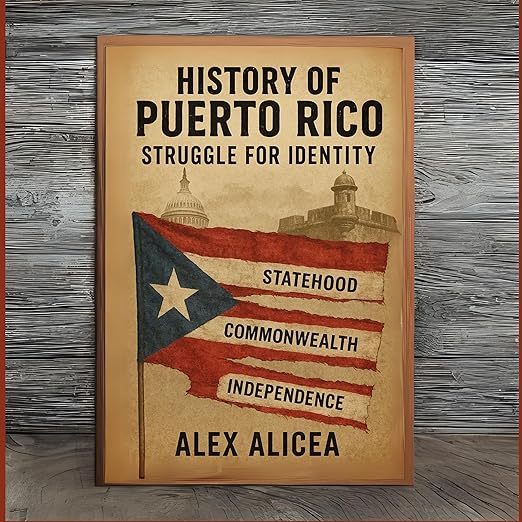
Alex Alicea’s audiobook covers over 500 years of Puerto Rico’s political evolution, from Spanish colonization in 1493 through the Grito de Lares uprising to the Spanish-American War and the island’s current status as an unincorporated US territory. At just under four hours, this is a compact treatment of genuinely complex material. The book’s strength is its clarity. Alicea is not trying to write the definitive scholarly history. He is trying to make the essential political narrative legible to listeners who may know Puerto Rico only as a travel destination, and on those terms he largely succeeds.
Our Take on History of Puerto Rico
The question this book returns to repeatedly is the identity question, which encompasses the statehood-commonwealth-independence debate but extends well beyond electoral politics. Alicea traces how Puerto Rican culture, shaped by Spanish, African, and indigenous Taino heritage, has survived and adapted through centuries of external rule. That survival is presented as active rather than passive, a series of choices and assertions and negotiations rather than simple endurance. The Grito de Lares section, which covers the 1868 independence uprising, is one of the more compelling passages because it makes clear how far back the argument goes, and how consistent the terms of the argument have remained. The book also does something quietly important in giving serious space to the period between the Spanish-American War of 1898 and the mid-twentieth century, a stretch of Puerto Rican history that is often compressed into a transition paragraph in broader Caribbean histories. The Jones Act of 1917, which conferred US citizenship while withholding full political representation, is explained with enough context that listeners unfamiliar with it can understand why it remains a source of ongoing grievance.
Why Listen to History of Puerto Rico
Several reviewers with personal or family connections to Puerto Rico described the book as clarifying in ways they had not anticipated. One noted that having grown up hearing fragments of history without context, the audiobook provided the connective tissue that made individual stories make sense. For listeners without that personal connection, the book functions as a solid primer that does not oversimplify. Alicea is honest about the complexity of the statehood question and resists the temptation to offer a clean conclusion where none exists. The Taino cultural thread, which runs from pre-colonial history through to contemporary Puerto Rican identity, is handled with appropriate care.
What to Watch For in History of Puerto Rico
At just under four hours, this is necessarily an overview. Listeners wanting deeper scholarly engagement with Puerto Rican history will need to go further. The book is part of a larger series and is identified as Volume 8, which suggests it exists within a broader framework of regional histories, though it works as a standalone. Alyse Thompson’s narration is competent and clear but does not add interpretive dimension to the material. For informational content this is generally fine, but there are passages where the political passion embedded in the history would benefit from a more emotionally invested delivery. The book also has a slightly promotional register in places, a legacy of the synopsis’s marketing language, though the actual content is more substantive than that framing suggests.
Who Should Listen to History of Puerto Rico
Listen to this if you want a clear, accessible overview of why Puerto Rico’s political status is still contested after 500 years of external governance. Listen if you have Puerto Rican family or friends and want to understand the historical stakes behind conversations you have had. Listen if you are generally curious about Caribbean political history and colonial legacy. Skip it if you are looking for deep archival scholarship or a personal narrative approach. This is an informational audiobook first, and it delivers that function reliably within its runtime.
Frequently Asked Questions
Does this book take a position on whether Puerto Rico should become a state, remain a commonwealth, or pursue independence?
It presents the debate fairly without advocating for a particular outcome. Alicea outlines the historical arguments for each position without rendering a verdict, which is the appropriate approach for this kind of historical overview.
Is this book accessible for listeners with no background in Caribbean history?
Yes. Several reviewers specifically noted that they knew Puerto Rico only as a vacation destination and found the book a useful and engaging orientation. The writing is designed for general readers rather than specialists.
How does Alyse Thompson’s narration handle the Spanish names and historical terminology?
Thompson handles the Spanish names and place terms clearly without over-pronunciation. The delivery is consistent and professional throughout, suited to informational content.
Is the Taino indigenous heritage covered in the book, or does it focus primarily on Spanish and American colonialism?
The Taino heritage is addressed as part of the cultural identity thread. Alicea covers the pre-colonial period and traces how Taino cultural elements persist in contemporary Puerto Rican identity alongside the Spanish and African influences.