Quick Take
- Narration: Jason Zenobia brings a clear, consistent delivery to the Captivating History house style – functional for a survey primer, though without the depth of character that a more idiosyncratic narrator might bring.
- Themes: Polynesian settlement and Maori society before contact, British colonization and the Treaty of Waitangi, New Zealand’s path to democratic sovereignty
- Mood: Brisk and accessible – a survey overview rather than a deep immersion
- Verdict: A useful orientation to New Zealand history for listeners who want the essentials without committing to a multi-week scholarly read.
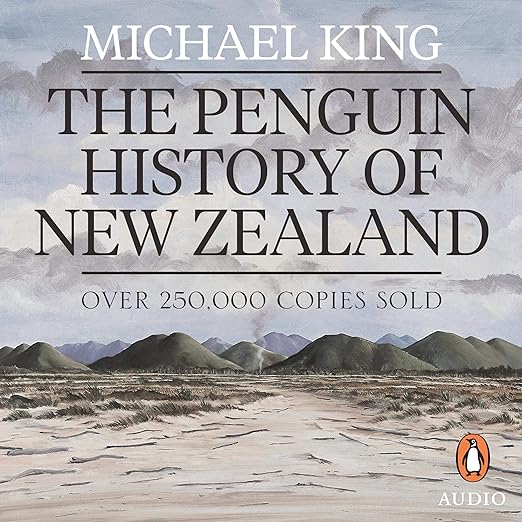
A practical note before anything else: the synopsis currently attached to this listing in some catalogs appears to have been pulled from Michael King’s Penguin History of New Zealand rather than from this Captivating History title. These are two entirely different books – King’s is the definitive 17-hour single-volume scholarly history by New Zealand’s most respected historian; this is a separate, shorter production from the Captivating History series, a publisher known for accessible, conversational surveys aimed at general readers. If you encounter this metadata confusion on your platform, the runtime is your clearest disambiguator.
I mention this because it matters enormously for calibrating expectations. If you pick up this title expecting the comprehensive sweep and scholarly depth that King’s volume delivers, you will be disappointed. If you approach it as what it actually is – a well-structured, accessible introduction to New Zealand history from a series that specializes in exactly this kind of primer – you will find it considerably more useful.
What the Captivating History Format Actually Delivers
The Captivating History series has developed a recognizable house style: clear chronological organization, accessible prose that avoids specialist jargon, a focus on the broad arc of events rather than primary source analysis or historiographical debate, and narration that favors intelligibility over characterization. Jason Zenobia’s delivery fits this template. He reads clearly and consistently, at a pace that allows the material to land without rushing the listener through unfamiliar names and geographical references.
The strength of this format for New Zealand history specifically is its treatment of the Polynesian settlement narrative. The story of how, somewhere between 1250 and 1300 CE, East Polynesian voyagers crossed one of the most remote stretches of open ocean in the world and found an uninhabited archipelago at the edge of the South Pacific is genuinely extraordinary, and it loses nothing in the telling even at an accessible register. The approach gives you the essential contours: the navigation practices, the rapid adaptation to an environment unlike anything the settlers had known, the development of the distinctly Maori political and spiritual culture that Europeans would encounter five centuries later.
The Treaty and Its Contested Legacy
The Treaty of Waitangi – signed in February 1840 between the British Crown and roughly 500 Maori chiefs – is one of the most contested documents in the Pacific, and its dual-text problem (the Maori and English versions make different claims about what sovereignty means) has generated constitutional arguments in New Zealand that remain unresolved. The Captivating History treatment gives you the essential facts and the core disagreement without attempting to resolve a debate that specialists have not resolved. For a survey introduction, this is the appropriate approach. For listeners who want to engage with the Treaty seriously, this will function as an orientation that points toward more detailed reading.
The Limits of the Survey Format
What this format cannot do – and does not attempt – is the kind of sustained argument that makes Michael King’s work distinctive. King spends thousands of words developing his revisionist case about Maori agency under colonization; the Captivating History version notes the essential facts and moves forward. That is not a failure of this book; it is the definition of the genre. The danger is that listeners who absorb the survey-level account may not realize how much interpretive complexity they have not yet encountered. A reader who finishes this title knowing that King’s book exists, and understanding how the two sit in relation to each other, will be better positioned than one who mistakes the orientation for the destination.
When This Is the Right Choice
One small but notable issue applies specifically to audio listeners rather than print readers: the Captivating History series produces books that are written for the page first, and New Zealand history in particular involves a significant number of Maori terms, place names, and personal names that require accurate pronunciation to be meaningful. A listener who arrives knowing nothing about te reo Maori will absorb the anglicized versions Zenobia uses, which are serviceable, but may be slightly surprised when they encounter the same names in other contexts where New Zealand speakers pronounce them differently. This is not a disqualifying problem, but it is worth knowing in advance.
There is a genuine audience for this kind of book, and it deserves to be served honestly rather than patronized. Someone who has booked a trip to New Zealand and wants to arrive with a working grasp of the essential historical narrative – Maori settlement, the contact period, British colonization, the development of a democratic state, the twentieth century – will find exactly what they need here. Someone preparing to engage seriously with Maori culture, Treaty politics, or New Zealand literature will need this as a first step, not a final one. Jason Zenobia’s narration makes the listen pleasant rather than effortful, which is the practical purpose of the format.
Frequently Asked Questions
Is this the same book as The Penguin History of New Zealand by Michael King?
No. These are entirely separate titles. The Penguin History of New Zealand is Michael King’s comprehensive 17-plus-hour scholarly history, the standard single-volume reference on the subject. This Captivating History edition is a shorter, accessible primer from a series that specializes in introductory surveys. Some catalog listings have incorrectly attributed King’s synopsis to this title – the runtime is your clearest way to distinguish them.
How does this compare to The Penguin History of New Zealand for a first-time reader?
This title is the more accessible entry point for casual curiosity or pre-travel preparation. King’s book is the more authoritative and comprehensive choice for anyone who wants to understand New Zealand history in depth. Many listeners will find it useful to start here and move to King afterward.
Does Jason Zenobia’s narration handle Maori place names and personal names accurately?
The Captivating History series typically engages professional narrators familiar with their material, but the pronunciation of Maori language – which has specific phonological rules quite different from English – is worth sampling before purchase, particularly if accurate pronunciation matters to you.
Is the Treaty of Waitangi covered in sufficient depth to be useful for understanding modern New Zealand politics?
It is covered at the level appropriate for an introductory survey – the essential facts, the dual-text problem, the broad significance. For the depth required to engage with modern Treaty politics or constitutional debates, you will need a dedicated source on the Treaty itself.