Quick Take
- Narration: Jason Zenobia narrates with professional clarity, bringing more warmth than the listicle-style structure strictly requires, though the format limits what any narrator can ultimately do.
- Themes: Colonial history, Indigenous dispossession, national development and identity
- Mood: Encyclopedic and accessible, pitched at curious generalists approaching Australia for the first time
- Verdict: A serviceable four-hour orientation to Australian history that works better in audio than comparable Virtual Voice titles, though it reads closer to organized facts than lived history.
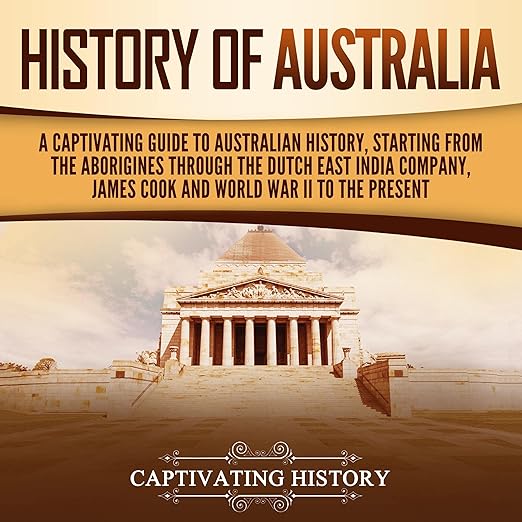
Captivating History publishes a lot of books. That’s not a criticism in itself. There’s genuine demand for accessible, affordable survey histories of countries and periods that most educational systems skip. I’ve encountered their format enough times to know what to expect before pressing play: a bulleted promise of what you’ll learn, a brisk chronological march through the major events, and prose that prioritizes clarity over color. The Australia entry delivers exactly that, at just over four hours, narrated by Jason Zenobia with professional competence.
What makes this worth reviewing honestly is the question of who it’s actually for and whether it earns the four-plus hours it asks of that person. The answer is mostly yes, with qualifications that matter depending on what you’re bringing to it.
The Format and What It Can Actually Hold
The book’s structure is essentially a timeline punctuated by thematic sections. You move from Australia’s first peoples, estimated to have arrived on the continent at least 50,000 years ago, through European contact and the period of Dutch non-colonization, the British decision to use Australia as a penal destination, the mechanics of convict transportation, the Gold Rush and its social consequences, federation, two world wars, and into modern Australia’s role in global affairs. The synopsis lists these topics in order, and that’s accurate: this is what you get, delivered at a pace that doesn’t linger on any single period.
One reviewer described it as “a great and thorough walkthrough” and praised the coverage of the Gold Rush and the ANZAC commitment. Another appreciated the timeline approach to explaining colonization and cultural roots. The reviewer who flagged that it “reads like a cleaned-up article from an encyclopedia” is not wrong, but that framing assumes depth and narrative richness are equivalent to informational quality. They aren’t always, and for a listener who needs an orientation, the encyclopedia mode may be exactly what’s required.
What Zenobia Brings to Survey History
Zenobia is a competent narrator for this kind of material. The register is neutral and clear, appropriate for a book that isn’t trying to construct intimacy or emotional investment. He moves through proper nouns and place names with confidence, which matters in Australian history, where unfamiliar geography can trip up narrators who haven’t prepared. The pacing is steady rather than propulsive, which suits a survey format but wouldn’t sustain a longer work. For four hours, it holds without becoming monotonous.
At least one reviewer has raised the question of AI authorship based on the prose style, noting that it lacks individual voice. Captivating History is a prolific publisher of survey histories, and the writing is consistent with their house style: factual, accessible, and thin on personality. The historical information is broadly accurate for mainstream events, which limits the practical risk even if the suspicion about the writing process is correct. Listeners who prefer identifiable human authorship should know the concern has been raised publicly.
Where This Sits Against Competing Titles
At least two other short-form Australian history audiobooks occupy the same category, including Billy Wellman’s History of Australia in the Uncovering the Australian Past series, which runs just under three hours with Virtual Voice narration. The Captivating History entry has a meaningful advantage there: a human narrator. The Wellman title covers similar ground in less time, but the AI narration actively works against the material. For listeners choosing between comparable primers, Zenobia’s delivery is the practical reason to pick this version. The rating differential, 3.9 here versus 4.3 for Wellman, reflects different audience expectations rather than a clear quality difference in the content itself.
This is an entry-level audiobook for entry-level listeners, and that’s exactly what it should be. The audience who will get the most from it is someone arriving at Australian history with genuine curiosity and no existing framework. It will give them that framework in four hours. What it won’t give them is the feeling of being told a story by someone who loves the subject. For that experience, David Hunt’s Girt does something entirely different and belongs in every Australian history listener’s collection.
A final practical observation: the references that one reviewer noted at the end of the book are more useful than they might initially seem. Captivating History’s survey format necessarily simplifies, and knowing which topics have substantial additional literature is worth something even if the overview doesn’t go deep. Listeners who find themselves wanting to know more about the Gold Rush specifically, or about the federation debates of the 1890s, or about Australia’s WWII home front, will find the references give them a starting point rather than leaving them stranded after four hours of context without a direction forward. That generosity of citation is genuinely useful and distinguishes this from some comparable survey titles that simply end without pointing anywhere, leaving you with context and no direction to take it.
Frequently Asked Questions
Is this book written by a human author or AI-generated?
At least one reviewer has raised the question of AI authorship based on the prose style. Captivating History is a prolific publisher of survey histories and the writing is consistent with that house style, which is factual and accessible but thin on individual voice. The historical information is broadly accurate for mainstream events, so the practical impact is limited, but listeners who prefer identifiable human authorship should know the concern has been raised.
How does the treatment of Aboriginal Australians compare to dedicated works on the subject?
It covers the broad outlines, including the duration of Aboriginal presence on the continent and the impact of European contact, but at a level of generality that a dedicated work like Bruce Pascoe’s Dark Emu or a specialist anthropological text would treat very differently. This is an orientation, not an investigation.
Is this part of a series and do I need previous volumes?
It’s listed under the Australasia series by Captivating History, but functions as a standalone. No prior volumes are required. Captivating History publishes similar surveys for most countries and regions, and each is designed to be read independently.
Does the audiobook include references or further reading suggestions?
One reviewer noted that the book provides references for listeners who want to go deeper, which is a meaningful addition for a survey text. Specific names and works are cited at points in the text, allowing listeners to identify directions for further reading beyond the four-hour overview.