Quick Take
- Narration: Virtual Voice AI narration strips the warmth and pacing that oral history of this kind requires, and the human element of Indigenous and colonial stories is noticeably flattened throughout.
- Themes: Indigenous origins, British colonization, national identity formation
- Mood: Informational and brisk, like a well-organized encyclopedia entry read aloud
- Verdict: A serviceable two-hour primer on Australian history that works better as a text than an audio experience, given the Virtual Voice delivery.
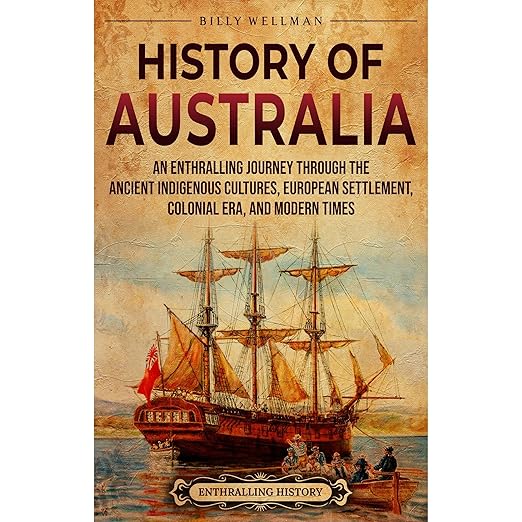
I keep a mental shelf for what I call orientation audiobooks: titles that exist not to add to what a listener already knows, but to build a foundation before they read deeper. Billy Wellman’s History of Australia belongs squarely on that shelf. It runs at two hours and fifty-five minutes, which tells you immediately what kind of book this is. You are not getting Blainey or Manning Clark. You are getting a structured walk through the main chapters of Australian history, from the first inhabitants to federation to the country’s role in two world wars and into the present.
For what it aims to be, it largely succeeds. The arc from Indigenous origins through convict settlement, the Gold Rush, independence, and into modern times is competently organized. Reviewers note that the book covers the Goldfields of Ballarat, the commitment of Australian soldiers in both world wars, and the development of the major cities. The reader who described it as “a quick way to learn the history and culture of Australia” is identifying the book’s real function accurately. It is a primer, and primers have genuine value when the listener needs them.
The Limitation Nobody Can Ignore
The problem is the narration. This title uses Virtual Voice, Amazon’s AI text-to-speech system, and for a book covering Indigenous culture, colonial violence, and the formation of national identity, that’s a significant structural mismatch. One reviewer specifically flagged that the book “lacks soul,” attributing it to suspected AI authorship, but the more immediate culprit for an audio listener is the AI delivery itself. History this layered, covering people who were dispossessed and communities that were destroyed, benefits from a narrator who brings genuine weight to the material. Virtual Voice doesn’t do that. It processes the text correctly, but it cannot inflect the difference between a date and a tragedy. The loss is not hypothetical: at several points in the convict transportation sections and in the coverage of Aboriginal dispossession, the flat delivery makes the human cost of these events feel like logistical detail rather than catastrophe.
At under three hours, the problem is at least contained. This is not a thirty-hour slog with Virtual Voice. It’s a short course, and the format limits the damage. But listeners should know what they’re getting into before they start, particularly if the narration style disrupts their ability to absorb the content.
Where the Content Actually Holds Up
The book’s structure is its genuine strength. Moving chronologically, it allocates roughly proportional time to each period. The deep Indigenous pre-history gets its own section rather than being treated as prologue to European arrival, which is the right choice and a better structural decision than many comparable primers make. The convict settlement chapters cover the mechanics of the transportation system, the conditions of early Sydney, and the transition from penal colony to civic settlement with reasonable clarity. The Gold Rush section connects the discovery of gold to demographic transformation, political agitation, and the slow construction of Australian self-image. The World War I chapters include Gallipoli but also make space for the Home Front and the political fractures that conscription debates caused, which is more than the bare minimum.
The series is called Uncovering the Australian Past, and the name is appropriately modest. This is the beginning of that process, not its completion. The reviewer who received a free copy and noted their own prior familiarity with the Goldfields confirms that the book covers established mainstream history without significant error or controversy, which at least tells us the content is reliable if not revelatory.
Who This Is Actually For
A listener who knows nothing about Australia and needs a rapid orientation before a trip, a longer book, or a documentary will find this useful. Australian listeners who grew up with the Goldfields, the ANZAC tradition, and the colonial history as lived cultural knowledge will find little here that surprises them. For them, a book like Geoffrey Blainey’s Cook account or Bruce Pascoe’s Dark Emu will be more rewarding. This title’s true audience is outside Australia, approaching the country’s past for the first time.
Skip it if you want genuine narrative immersion or if Virtual Voice narration disrupts your listening experience. Both are legitimate reasons to look elsewhere. But if you need a competent structural overview in under three hours and you’re starting from zero, it does that job without wasting your time.
One additional practical note: this audiobook functions well as a refresher for listeners who studied Australian history years ago and want a quick reorientation before tackling a more substantial work. The structured chronological approach makes it easy to locate where your existing knowledge becomes thin, and the short runtime means you can revisit specific sections without significant time investment. That use case, supplementary orientation rather than primary learning, is where it works best.
Frequently Asked Questions
Does the audiobook cover Aboriginal and Torres Strait Islander history respectfully?
It gives Indigenous pre-history its own section and doesn’t treat it purely as a prelude to European arrival, which is a meaningful structural choice. However, the Virtual Voice narration cannot deliver the cultural sensitivity that this material ideally deserves, and the coverage is necessarily brief given the total runtime of under three hours.
Is this part of a series, and does it need to be listened to in order?
It’s listed under the Uncovering the Australian Past series, but functions as a standalone overview. You don’t need any prior titles to follow the content. It’s designed as an entry point, not a continuation.
How does this compare to the Captivating History audiobook also titled History of Australia?
Both are short primers in a similar format. The Captivating History version runs just over four hours compared to this one’s under three, and is narrated by Jason Zenobia rather than Virtual Voice. If narration quality matters to you, the Captivating History edition has a meaningful edge on delivery, though both cover similar ground at a survey level.
Is the content reliable, or is there a risk of factual errors?
No specific factual errors have been flagged in the reviews. The content covers well-documented mainstream historical events, which limits the risk of significant inaccuracies. It’s more likely to be thin on contested or nuanced areas than factually wrong about core dates and events.