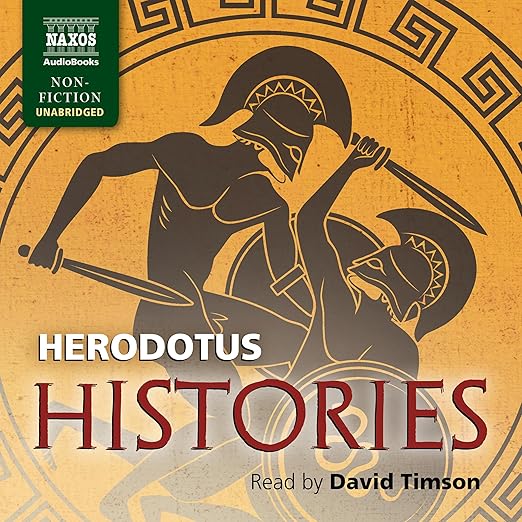
Quick Take
- Narration: David Timson brings genuine classical authority to Herodotus, his pacing honors the text’s mixture of epic scope and intimate anecdote, and his handling of the battle narratives is particularly strong.
- Themes: Persian imperialism versus Greek liberty, the role of custom and culture in shaping human destiny, the relationship between history and storytelling
- Mood: Epic and digressive, combining geopolitical drama with ethnographic curiosity and occasional myth
- Verdict: The foundational text of Western historical writing, given a narration that genuinely serves it, essential for any serious listener interested in the ancient world.
I remember the first time I read Herodotus in print, during a seminar on ancient historiography where the professor kept insisting we resist the temptation to evaluate him by later standards. That instruction makes more sense now than it did then. Herodotus was not trying to be Thucydides, who came after him, or Gibbon, who came two millennia later. He was doing something stranger and, in its own way, more ambitious: building a prose narrative large enough to contain the known world as he understood it, and honest enough to include the stories he could not verify alongside those he could.
The Histories is the first work of prose history in European civilization, the synopsis states this directly, and it is accurate. It is also, as reviewer Parrish MacDonald observed, an entertaining tale mixing fact with legend. Both of those things are true simultaneously and neither cancels the other. Listening to this work at twenty-seven hours and twenty-eight minutes is an experience that rewards patience and punishes the expectation of a single sustained narrative thread.
Timson’s Navigation of an Unusual Structure
The structural challenge of narrating Herodotus is real. The Histories is not organized the way a modern history book is organized. It builds outward from the question of why the Greeks and Persians came into conflict, accumulating context, custom, myth, and geography as it goes, often following a tangent for chapters at a time before returning to the main line of argument. For a reader navigating this on the page, the eye can jump. For an audio listener, the narrator’s tonal guidance is everything.
David Timson handles this with skill. His voice carries the authority of a scholar-reader without the dryness that can afflict academic narration, he is clearly engaged with the material, and the shifts between Herodotus’s registers (epic battle narrative, ethnographic description, personal anecdote, mythological reference) are tracked with appropriate tonal adjustment. The battle sections, Marathon, Thermopylae, Salamis, are given proper weight and pace. The digressive sections on Egyptian customs, Scythian burial rites, and the geography of the Persian empire are read with genuine curiosity rather than performed tolerance.
The PDF Companion as Navigational Infrastructure
The accompanying PDF is noted in the synopsis and worth taking seriously. At twenty-seven hours, the Histories is long enough that navigational support is useful. An introduction to the text is available and provides the kind of scholarly framing that helps listeners unfamiliar with Herodotus understand what they are hearing before they are fully into it. Reading the introduction before beginning the main text is strongly advised.
Herodotus as the Book That Contains Other Books
One of the pleasures of the Histories in audio is encountering the range of material that Herodotus assembled. This is not only the story of Thermopylae (though the account of the three hundred Spartans is here in its original telling). It is also a record of Egyptian religious practice, a taxonomy of nomadic cultures from the Scythians to the Ethiopians, an account of the political organization of the Greek city-states, a meditation on the relationship between divine will and human agency. The reviewer who noted that the best parts are the descriptions of people and their customs was identifying something essential: for all the epic scale of the Greek-Persian wars, it is Herodotus’s almost anthropological curiosity about how different people live that gives the book its distinctive quality.
This curiosity is what makes the Histories feel surprisingly modern to a reader coming to it cold. Herodotus does not assume that the Greek way of life is the only way, or even necessarily the best way. He describes practices that Greek culture would consider barbaric with the same level-headed interest he brings to Greek practices, a methodological neutrality that was unusual in its time and that reads as almost avant-garde now.
Who Should Listen and Who Should Skip
Listen to this if you have any interest at all in ancient history, Western civilization’s intellectual origins, or narrative nonfiction at the level of craft. This is where the tradition starts. Listen to it in combination with Tom Holland’s Persian Fire, which covers some of the same events from a modern popular-history perspective and illuminates the Herodotean text beautifully. Skip it if you need a tight, single-narrative structure, the digressions are real and they are long. But if you can sit with that, the Histories rewards it.
Frequently Asked Questions
Is the Timson narration the best available audio version of Herodotus, or are there strong alternatives?
Timson’s recording is widely considered among the best available unabridged versions. There are multiple audio editions of the Histories using different translations; the key variables are the translation quality and the narrator’s familiarity with ancient material. Timson, with a strong background in classical texts, brings more contextual authority than a generalist narrator would.
Which translation does this recording use, and does translation choice matter significantly for audio?
Translation choice matters considerably for Herodotus because the Histories was originally written in a storytelling register rather than formal historiographic prose, and some translations flatten that quality. A readable, narrative-leaning translation improves the listening experience substantially. Check the specific edition notes for translation credit before purchasing.
Does Herodotus’s mixing of fact and legend make this a difficult listen for someone who wants accurate history?
It requires a specific adjustment of expectations. Herodotus signals when he is reporting what he was told versus what he personally witnessed or verified, and he is more methodologically self-aware than his reputation for credulity suggests. Treating him as a primary source filtered through the available evidence of his time, rather than as a modern fact-checked reporter, makes the experience much richer.
How does the Histories relate to the film adaptations and popular accounts of events like Thermopylae?
This is the source text for Thermopylae, Marathon, and Salamis. The film 300 is a dramatization of an account that ultimately derives from these pages. Reading Herodotus’s version after seeing the film reveals both how close some details are and how much the popular versions have simplified and dramatized. The original account is considerably more nuanced about Spartan motivation and considerably more generous to the Persian perspective than most adaptations.