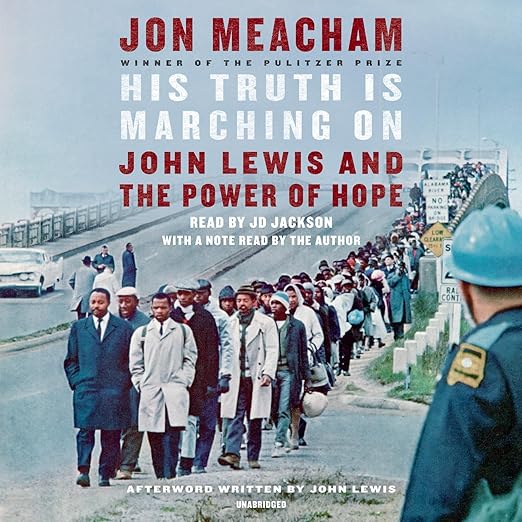
John Lewis was one of the most consequential moral figures in American public life, and his story deserves a biography equal to its scope. His Truth Is Marching On, Jon Meacham's intimate portrait of Lewis, delivers that and then some. This audiobook, narrated by JD Jackson, arrived on my radar during a period when I was rereading primary documents from the Selma campaign, and placing Meacham's narrative alongside those sources made the book's achievement clear: he has written a life of Lewis that is simultaneously a biography of American conscience.
Meacham draws on decades of direct interviews with Lewis, and that proximity to the primary source is the book's defining asset. The passages drawn from Lewis's own recollections, particularly around the Edmund Pettus Bridge, the early Nashville lunch counter sit-ins, and his relationship with Martin Luther King Jr., have the quality of testimony rather than reconstruction. JD Jackson's narration honors that quality. His voice carries the measured gravity the material demands, without projecting emotion onto passages that Lewis himself delivered with deliberate calm.
The Best Parts of His Truth Is Marching On
Meacham frames Lewis's life through two intersecting lenses: faith and nonviolence. He argues, persuasively, that Lewis did not treat nonviolence as a tactic but as a theological commitment, and that this distinction matters enormously for understanding both his personal courage and his political legacy. The story of the four-year-old Lewis preaching to his family's chickens, and then refusing to eat one after his mother cooked it, is the book's perfect opening emblem: the first act of nonviolent protest was not political but spiritual.
That framing allows Meacham to connect Lewis's work to the full arc of American democratic faith, linking him to Jefferson, Madison, and Lincoln not as flattery but as argument. The claim that Lewis was 'as important to the founding of a modern and multiethnic twentieth- and twenty-first-century America as Thomas Jefferson and James Madison and Samuel Adams were to the initial creation of the Republic' is a bold one, but Meacham earns it through the accumulated evidence of the book rather than simply asserting it.
Reviewers with strong prior knowledge of the civil rights movement have described the book as adding real depth to their understanding. One reader wrote that it gave 'a deeper understanding and appreciation for the civil rights warriors' and their faith, describing it as a meaningful expansion of a story they thought they already knew. That is the sign of a successful biography: it changes the reader's understanding rather than confirming what they already believe.
Before You Commit to His Truth Is Marching On
Meacham's approach is admiring rather than critical. This is a portrait written with enormous respect for its subject, and readers looking for a full examination of Lewis's political contradictions, his complicated relationship with younger generations of Black activists after the 1960s, or the limitations of the nonviolent approach in different contexts will find the book weighted toward hagiography at points. That is not a disqualifying flaw; Lewis's moral stature is genuinely exceptional, and Meacham's admiration is earned. But it is worth knowing the register in advance.
The book includes a PDF appendix, noted in the original audiobook listing, which suggests additional documentary material not read in the audio version. Listeners particularly interested in primary sources may want to access that supplement separately.
At ten hours, the audiobook is substantial but not exhausting. Jackson paces the material well, and Meacham's prose is lucid and well-structured. The book does not drag despite covering Lewis's full life from the Alabama tenant farm through his final years in Congress.
One passage that stands out in this audiobook is Meacham's account of Lewis's early organizing in Nashville, specifically the workshops in nonviolent resistance led by Reverend James Lawson. Lawson's training sessions, which involved role-playing harassment and physical provocation so that participants could practice not responding with violence, produced a cohort of activists who were not simply ideologically committed to nonviolence but physiologically trained in it. That distinction matters, and Meacham gives it the attention it deserves. Jackson's narration during these sequences is particularly effective.
The audiobook also handles the generational tension within the civil rights movement with care. Lewis's relationship with King was not without friction; their approaches to tactics and their relationship to the federal government created real disagreements. Meacham contextualizes those tensions without flattening them, acknowledging that the movement was not a unified bloc but a coalition of people with different histories, different risk tolerances, and different visions for what success would look like. That complexity makes the historical account more accurate and more useful for listeners trying to understand how social change actually happens.
Should You Listen to His Truth Is Marching On?
This audiobook is essential listening for anyone interested in civil rights history, American political biography, or the intersection of faith and political action. It works for listeners new to John Lewis's story as well as those who followed his career closely and want the depth that a biography built on direct interviews can provide. Meacham is a Pulitzer Prize-winning author with a track record in this kind of political biography, and His Truth Is Marching On is among his most important works.
Listeners wanting a critical or revisionist take on Lewis or the civil rights movement should supplement this with other perspectives. But as an act of biographical witness to one of the twentieth century's great moral figures, narrated by JD Jackson with the gravity the material deserves, this audiobook sets a high standard.