Quick Take
- Narration: Sunny Patel brings natural fluency to Sanskrit terminology and proper nouns, which matters significantly for a text this steeped in Hindu vocabulary.
- Themes: Vedic tradition, Hinduism in modern and diasporic contexts, religion and politics in contemporary India
- Mood: Measured and scholarly, with genuine curiosity running beneath the academic structure
- Verdict: A compact, well-structured introduction to one of the world’s oldest living religious traditions, especially strong on contemporary challenges like Hindu nationalism.
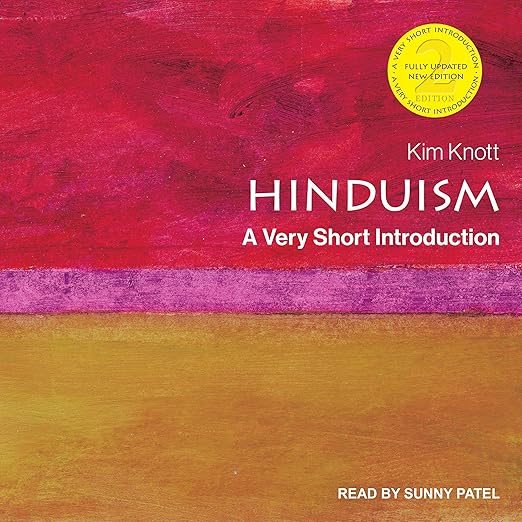
I’ve reviewed a fair number of Very Short Introduction titles over the years, and Kim Knott’s Hinduism sits near the top of that series for what it accomplishes within its constraints. At three hours and forty-four minutes, this is genuinely short. But it doesn’t feel abbreviated. Knott has the scholar’s gift for selecting the representative example over the exhaustive list, and listening to this on a Monday morning before a meeting reminded me why the best academic writing is also the most democratizing: it makes a vast subject accessible without making it shallow.
Hinduism is practiced by nearly 80 percent of India’s population and by some 70 million people outside India. It is also among the most internally diverse of the world’s major religions, encompassing vastly different regional traditions, philosophical schools, ritual practices, and social structures under a term that was itself largely a colonial organizational category. Knott navigates that complexity without either flattening it into a tidy summary or burying the listener in caveats.
Our Take on Hinduism
The first edition of this Oxford Very Short Introduction focused on the enduring dimensions of Hinduism: the centrality of the Veda as religious texts, the role of Brahmins, gurus, and storytellers in transmitting divine truth, and the cultural and moral weight carried by epics like the Ramayana. These pillars Knott handles with authority, drawing on her decades of work in religious studies to explain not just what these texts and traditions are but why they function as they do in the lives of practitioners.
The second edition, which this audiobook reflects, adds material on technology’s impact on Hindu practice, the flourishing of Hinduism in social media and popular culture (including an interesting discussion of Sita Sings the Blues), and what may be the most politically significant section of the book: an analysis of Hindu nationalism and the politicization of Hinduism in contemporary India. This is territory where a lot of introductory texts tiptoe, offering a note of caution without substantive engagement. Knott doesn’t tiptoe. She addresses the Hindutva movement and its global implications with the directness the subject deserves.
Why Listen to Hinduism
Sunny Patel’s narration is well-chosen for this material. Sanskrit terms, names from the Ramayana and Mahabharata, and the specific vocabulary of Hindu philosophy and ritual can be a genuine stumbling block for narrators without familiarity in the tradition. Patel handles them with fluency that doesn’t call attention to itself, the words land as words rather than as obstacles, which keeps the listener inside Knott’s argument rather than distracted by mispronunciation.
The audiobook format works particularly well for introductory scholarly texts like this one. Unlike a reference book you’d flip through, a linear listen forces you to sit with each topic sequentially, which often surfaces connections you’d miss in reading. The arc from Vedic tradition to contemporary Hindu nationalism lands differently as a progression when you’ve spent the preceding three hours building the conceptual framework that makes the final section meaningful.
What to Watch For in Hinduism
The reviews for the physical book, several of which focus on delivery speed and book condition rather than content, a common artifact of Amazon review ecosystems, tell you relatively little about the audiobook experience. What they do confirm is that this text has a stable readership in educational contexts, including college coursework, which speaks to its utility as a structured introduction rather than popular reading.
The brevity does create some gaps. Hinduism’s regional variations, the differences between Tamil Shaivism, Bengali Vaishnavism, and Maharashtra’s Warkari tradition, to name just three, are acknowledged but not deeply explored. The devotional traditions, the visual and material culture of Hinduism, the philosophical schools of Vedanta and their internal disagreements: all present but compressed. For listeners who come to this without prior knowledge, those compressions are appropriate. For those who already know the basics, the second-edition additions on contemporary issues are where the real value lies.
Who Should Listen to Hinduism
This is an excellent starting point for anyone who wants to understand Hinduism as both a living religious tradition and a contemporary political force, without committing to a full academic text. It works well for students taking introductory religious studies courses, travelers preparing to spend time in India, and anyone who wants a reliable frame for understanding news about Indian politics and culture. Listeners looking for devotional content, spiritual practice guidance, or deep philosophical exploration should look to more specialized sources, Knott’s project is analytical rather than participatory.
Frequently Asked Questions
Is Kim Knott’s Hinduism suitable for someone with no background in religion or Indian culture?
Yes. The Very Short Introduction series is specifically designed for general readers without prior specialist knowledge. Knott explains key terms, provides context for historical references, and builds concepts sequentially. No background in religious studies or South Asian history is required.
Does this audiobook cover contemporary Hinduism, or is it focused on ancient traditions?
Both. The second edition specifically adds material on Hinduism in social media and popular culture, Hindu nationalism in contemporary India, and the global diaspora community. About a third of the content addresses modern and contemporary dimensions of the religion.
How does Sunny Patel handle the pronunciation of Sanskrit and Hindu religious terminology?
With notable fluency. This is one of the genuine advantages of this particular recording, proper nouns and Sanskrit terms land correctly rather than stumbling, which keeps the listener inside the scholarly argument rather than distracted by mispronunciation.
Does the audiobook address the political dimensions of Hinduism in modern India?
Yes, and with more directness than many introductory texts. Knott engages with the Hindutva movement, Hindu nationalism, and the politicization of religious identity in contemporary India as serious topics that require genuine analysis, not just a cautionary footnote.