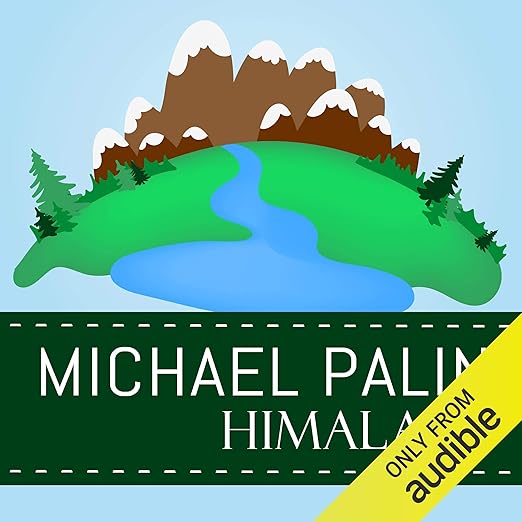
Quick Take
- Narration: Palin reading his own travel journal is exactly as good as it sounds, wry, self-deprecating, and full of the timing of a natural storyteller.
- Themes: geography as history, human connection across borders, the comedy of extreme travel
- Mood: Warm and curious, with an undercurrent of genuine awe
- Verdict: One of the best travel audiobooks in the format, made better by the fact that Palin is simply a pleasure to listen to for six hours.
There’s a particular kind of winter afternoon that feels designed for armchair travel: gray outside, tea going cold, nowhere to be. I spent one of those afternoons with Michael Palin’s Himalaya, and by the time it ended I had been to Pakistan’s northwest frontier, crossed into Tibet, navigated the politics of Kashmir, and arrived at the Brahmaputra delta in Bangladesh, all without leaving my chair. The audiobook clocks in at just under six hours, which is generous for a journey that covers 1,800 miles of the most difficult terrain on earth.
Palin is, of course, the former Monty Python performer who reinvented himself as one of travel writing’s most beloved voices through his BBC documentary series. Himalaya was his most ambitious journey to that point, traversing the full length of the mountain range in six months of hard travel. The audiobook is his own narration of the companion book, which means you are getting the author’s voice, cadence, and comic sensibility directly rather than through an intermediary. The difference is audible from the first chapter: this isn’t a professional narrator doing their best with someone else’s material, it’s a storyteller with the material inside him, reading it from memory as much as from the page.
From Khyber Pass to Brahmaputra Delta
The scale of what Palin attempts is genuinely staggering when you map it out. He passes through Pakistan’s remote northwest frontier, through terrorist-torn Kashmir, across the bleak plateau of Tibet, along the gorges of the Yangtze, and into the tribal lands of the Indo-Burmese border. These are not tourist routes. They are politically complex, physically demanding, and historically layered, and Palin treats them with the kind of informed curiosity that makes you want to follow up everything he mentions with a history book.
Reviewer Rachel identified precisely what makes Palin work as a travel writer: he has a light touch that never tips into condescension, he stays well away from assuming he knows what’s good or bad about a place, and most of the humor is directed at himself rather than the people he meets. That self-directed comedy, the slightly baffled Englishman confronting the world’s most extreme geography, gives the book its warmth without sacrificing its seriousness about the places and people it describes. He is curious rather than judgmental, and that orientation shapes every encounter he recounts.
Geography as Living Politics
What separates Himalaya from lighter travel writing is Palin’s willingness to let the political complexity of the region sit uncomfortably without resolving it neatly. Kashmir’s violence, the situation in Tibet, Pakistan’s northwest frontier, these are not backdrop. He engages with them through conversations with ordinary people, through what he observes at borders and checkpoints, through the way geography shapes both history and daily life. Reviewer Jim Moore noted that the book teaches you about history and people and religion through the lens of landscape, which is an accurate description of its method: this is political geography made intimate through individual encounters rather than through lectures.
The narrative moves briskly across enormous distances, which can occasionally feel like a cost, you want more time in some locations before Palin has to move on. But the journey’s logic requires that forward momentum, and Palin manages to leave you with a genuine sense of each place even when the stop is brief. The Khyber Pass gets different treatment than Kathmandu, which gets different treatment than the Brahmaputra delta, and that tonal variation keeps the listening experience from becoming uniform. K2, Annapurna, Everest, he passes through or near all of them, and each encounter has its own specific texture.
Why Palin’s Own Voice Is the Point
Reviewer Hermit Prone has bought this book three times because people keep borrowing it and not returning it, which tells you something about its staying power and the specific pull of Palin’s voice. The audiobook adds a dimension the physical book cannot: the dry observations land better spoken, the moments of genuine awe carry more weight when delivered by the voice that originally experienced them, and the comedy, which is genuinely funny rather than politely amusing, benefits from Palin’s decades of performance experience guiding his timing.
At a 4.5 rating across 463 reviews spanning more than a decade, this is a book that has held up across many readings and many contexts. Reviewer Mary Milner described it as informative but fun, which is perhaps the simplest accurate summary. It is both of those things, and in a format that lets Palin’s voice do the work, it is also genuinely transporting. For anyone who has wondered what the Himalayan range actually means as a lived geography rather than a scenic abstraction, this six-hour listen is one of the most efficient and pleasurable ways to find out.
Right Listener, Wrong Listener
If you are interested in South and Central Asia, the history, the politics, the landscape, this is essential listening. If you enjoy travel writing that takes its subjects seriously without becoming academic, Palin is one of the genre’s best practitioners. If you prefer destination-specific depth over the breadth of a 1,800-mile traverse, you may find the pace too sweeping for the kind of immersion you’re after. But for anyone who wants beautifully observed, wryly delivered travel writing from one of the great storytellers of his generation, Himalaya delivers on every front. The audiobook format, more than any other, honors what makes Palin’s work distinctive: it is essentially a spoken form, and hearing him tell it is as close as most of us will ever get to traveling alongside him.
Frequently Asked Questions
Is it necessary to watch the BBC documentary series before listening to the Himalaya audiobook?
Not at all. The audiobook stands completely on its own as a travel narrative. The documentary series covers much of the same journey, but the book has its own texture and the two complement rather than require each other.
How does Palin handle the politically sensitive regions like Kashmir and Tibet, does he take sides?
Palin is deliberately observational rather than polemical. He presents what he sees and hears without imposing a political conclusion. The result is nuanced rather than evasive, you understand the complexity of each situation without feeling lectured.
Is the Himalaya audiobook accessible for listeners who know very little about Asian geography or history?
Yes. Palin’s approach is to embed context naturally in the narrative. You don’t need prior knowledge of the region, the listening experience builds your understanding of the geography and its history as you travel through it with him.
Is Himalaya available as a free audiobook on Audible?
Yes, this free audiobook is available to Audible members through their subscription catalog. Availability can change, so check the current listing on Audible to confirm access.