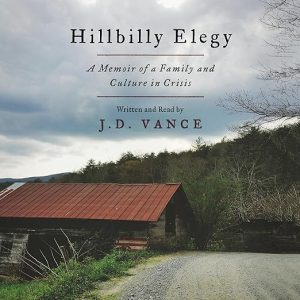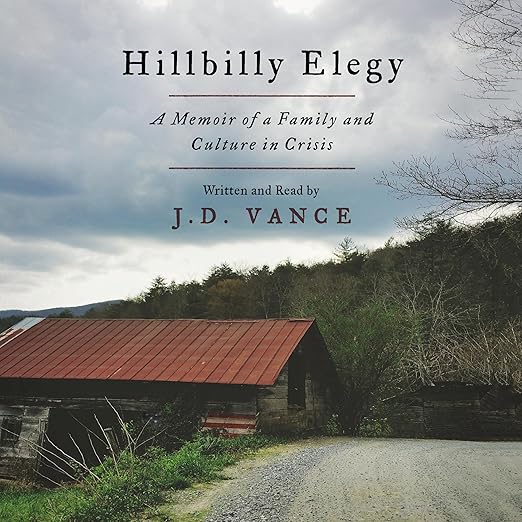
Kentucky's Appalachian hills produced the family J.D. Vance writes about in this audiobook, and Ohio's Rust Belt is where he actually grew up watching that family's early promise curdle into addiction and instability. Can a memoir this personal also function as honest sociology of a broader regional culture? Vance clearly believes it can, and across six hours and forty-nine minutes of his own narration, he mostly makes the case, moving between his grandparents' hopeful postwar move north and his own unlikely path to a Yale Law degree.
Vance Reads His Mother's Addiction Himself
Vance has since become a far more prominent and more polarizing public figure than he was when this memoir was first published, now serving in national office, but the audiobook itself predates all of that. It is worth approaching as the document it originally was: a specific memoir about one extended family's particular history, not a preview of anything that came later. Judged on those terms, what stands out is how deliberately unsentimental the narration is. Reviewer 相原大介 describes the tone well, noting that from opening to close, the author calmly and objectively relived his own history, and that even when the facts are not merry, the overall tone stays somehow positive rather than bitter.
That restraint is the book's central narrative choice. Vance could easily have written a book that either indicts or excuses the people who raised him; he mostly does neither, letting contradictory details about the same relatives sit next to each other without resolving them into a tidy verdict.
The title itself does real work. An elegy is traditionally a lament for the dead, and Vance is applying that form to a culture and a family that are very much still alive, which is a deliberately uncomfortable choice. It suggests something has already been lost even before the book's specific stories confirm it, and that framing colors every scene that follows, including the more hopeful ones.
A specific kind of vulnerability comes from an author reading his own account of his mother's addiction and his grandmother's temper aloud, in his own voice, rather than handing that material to a hired narrator performing emotional distance from it. Vance does not lean into that vulnerability for effect; if anything, the steadiness of his delivery works against easy sentimentality, letting the material's weight come through specific details rather than vocal performance.
A rating of 4.4 stars from 124 reviews looks modest next to the book's enormous print sales figures, which is a common pattern for audiobooks generally; print bestseller numbers and audiobook review counts rarely track closely, since many readers of a cultural-phenomenon book like this one first experienced it in text rather than audio. The reviews that do exist here skew toward the same personal-recognition angle PRNLM's review captures, listeners measuring the book against their own experience of similar communities.
Restraint Sets This Apart from Misery Memoirs
The blurbs attached to this book are unusually strong for a memoir, and they point toward why it broke out the way it did. The Economist called it a book no one should skip reading about America that year, and David Brooks flatly labeled it 'essential reading'. Those aren't casual endorsements, and the book's sales history bears them out.
Reviewer J. Foster's summary captures the memoir's actual shape well, describing it, in his own words, as 'family ties, bad choices, cyclical dysfunction, and in some cases, redemption,' which is a more accurate description than the book's reputation as a single-issue political text might suggest. Reviewer PRNLM, writing from personal familiarity with a similar cultural background, notes that anyone who has genuinely seen white poverty in America's flyover states will recognize a great deal of what Vance describes, a strong claim for authenticity from someone positioned to actually judge it.
The memoir genre has no shortage of addiction-and-poverty narratives that lean into shock value, and Hillbilly Elegy notably does not follow that path. Vance's restraint, the same quality 相原大介's review credits with keeping the book's tone positive despite difficult material, sets it apart from more sensationalized entries in the same broad category, favoring specific remembered detail over dramatic escalation.
This is a relatively compact memoir given its cultural footprint, which speaks to Vance's own economical prose style. He does not pad the account with extraneous scene-setting or lengthy reflection; the book moves briskly between specific remembered incidents, letting the accumulation of detail do the persuasive work rather than extended analysis.
More Questions Than Answers, by Design
J. Foster titled their review 'More questions than answers,' and that framing is worth taking seriously going in. This is a personal narrative first, not a policy document, and listeners hoping for prescriptive solutions to the systemic issues the book touches on will find Vance mostly stays in the register of lived experience rather than argument. That is a legitimate creative choice, but it means the book raises more than it resolves.
The material itself is genuinely difficult in places: addiction, domestic instability, and generational trauma are all discussed directly and without much softening. Vance's own narration handles this steadily rather than dramatically, which keeps the difficult passages from tipping into misery-memoir excess, but sensitive listeners should know what they are walking into before pressing play.
The book's opening description of his grandparents, dirt poor and in love when they left Kentucky for Ohio, works almost as a thesis statement for the whole memoir: real affection and real hardship sitting right next to each other, refusing to cancel each other out. That same uneasy coexistence, tenderness alongside genuine dysfunction, repeats throughout the book in ways that resist any single, comfortable takeaway.
Crossover Appeal Across a Fractured Political Spectrum
This suits readers of family-dysfunction memoirs in the vein of Jeannette Walls's The Glass Castle, anyone interested in Rust Belt or Appalachian regional culture specifically, and listeners who value hearing an author narrate their own difficult material rather than having it performed by someone else. Self-narration adds real weight to the passages about his mother and grandmother in particular.
Whatever else can be said about the book's reception since publication, its critical reaction at the time was genuinely notable: a number one New York Times bestseller with blurbs from major outlets across a wide range of perspectives, which speaks to how widely the specific story resonated with readers who otherwise agree on very little else. That crossover appeal is worth knowing about going in, independent of anything that happened later in Vance's public life.
Listeners expecting the book to function as a comprehensive academic study of Appalachian poverty, complete with policy prescriptions and broader sociological framing, should adjust expectations going in, since Vance stays personal and specific throughout rather than programmatic.
- Read by: J.D. Vance narrates his own memoir with calm, unhurried restraint that keeps difficult material from tipping into melodrama.
- At its heart: Appalachian poverty, family dysfunction, upward mobility, generational trauma
- Vibe: Personal, unsentimental, occasionally humorous despite the weight
- Short version: A tightly told, self-narrated memoir that works best as a specific family's story rather than a policy argument, worth hearing in the author's own voice.
Does J.D. Vance's own narration of this audiobook add anything print readers would miss?
Yes. Hearing him narrate his mother's addiction and his grandmother's temper in his own voice, delivered with restraint rather than performance, gives the material a directness a hired narrator likely could not match.
Is Hillbilly Elegy meant to be read as a personal memoir or as a sociological argument about Appalachian poverty?
Primarily a personal memoir. One reviewer titled their review 'More questions than answers,' noting it stays in the register of lived experience rather than offering policy prescriptions.
How graphic is this audiobook's depiction of addiction and family dysfunction?
Direct and largely unsoftened. Addiction, instability, and generational trauma are discussed openly, though Vance's steady delivery keeps the material from becoming a misery memoir.
Do I need any background in Appalachian or Rust Belt history to follow this audiobook?
No prior background is needed. The book stays grounded in one family's specific, chronological story rather than assuming outside historical or sociological knowledge.