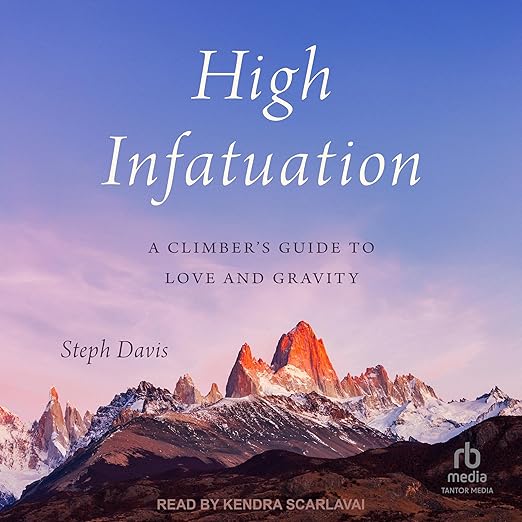
I was walking along a flat canal path when I started listening to High Infatuation, which felt almost comically incongruous. Steph Davis is describing Patagonia, the Torre Egger summit, weeks of rain and sleet waiting for a weather window, and I'm walking past barges and joggers. But that contrast clarified something for me about what makes this book work. Davis writes about the vertical world in a way that translates completely to horizontal existence. The book is genuinely about the terms on which you choose to live, and those stakes are legible from anywhere.
Davis's biography is striking: first ascents in Pakistan, Patagonia, Baffin Island, and Kyrgyzstan; the first woman to free climb the Salathe wall on El Capitan in Yosemite; the first woman to summit Torre Egger in Patagonia. She abandoned a concert pianist's education and university to live out of her grandmother's Oldsmobile with a Blue Heeler mix named Fletcher and pursue rock climbing full-time. The facts of her career are extraordinary. But High Infatuation isn't primarily a brag book or a climbing manual. It's something closer to an essay collection about identity, which is less common in athletic memoir than it should be.
The Verdict, Briefly
The book's format, a collection of essays and journal entries rather than a straight chronological memoir, was unexpected for at least one reviewer who came in expecting a conventional narrative arc. That expectation mismatch is worth addressing directly. High Infatuation doesn't follow the build-to-a-summit structure that most climbing books use. Davis circles around themes instead: the relationship between movement and self-knowledge, the specific difficulties of a romantic partnership when one person needs perpetual challenge and the other needs some form of stability, the question of what freedom actually means when you've organized your entire life around it.
This structural approach occasionally sacrifices the forward momentum that makes narrative memoir so addictive. One reviewer noted that the essays lack dates, which makes chronology difficult to reconstruct. That's a fair point, and in audio form it's more notable than in print, because you can't flip to contextual cues. Kendra Scarlavai's narration handles this gracefully: she doesn't try to impose a false continuity but reads each essay as its own complete thought. That's the right call.
Why High Infatuation Works as an Audiobook
The book's access point for non-climbers is Davis's writing about universals through specifics. The chapter on waiting in Patagonia is ostensibly about weather windows and expedition logistics. It's actually about patience as a form of faith: the willingness to sit with uncertainty long enough for conditions to clear. The sections about her relationship, about how a person who needs constant motion navigates love with someone who doesn't, are as honest as anything I've encountered in contemporary athletic memoir.
Kendra Scarlavai's narration deserves particular credit for the Patagonia sequences. Davis's prose has a lean, precise quality in those sections, almost like field notes pushed to the edge of poetry, and Scarlavai reads them without embellishment. She trusts the material. For a book that includes content about genuine technical climbing at elite levels, the narration remains consistently accessible. You don't need to know what free soloing means to understand what's at stake.
One reviewer compared Davis's approach to Lynn Hill's memoir, describing Hill's as more matter-of-fact and Davis's as more experiential and emotional. That's useful framing. High Infatuation is the more interior of the two books, more concerned with what climbing does to a person's inner life than with the technical achievements themselves. Those achievements are documented, but they aren't the point. The point is the question of what kind of life is worth having and whether you have the courage to insist on yours.
Points to Consider
The book's treatment of Davis's relationship, the man she eventually marries, tested by what she calls her need for movement and challenge, is handled with a care that avoids the usual memoir pitfall of making the partner either a saint or an obstacle. He is a real person in a complicated position, and Davis doesn't resolve that complexity neatly. Listeners who come for a tidy love story alongside the climbing will find something more honest and less comfortable.
There are moments in the Yosemite sections that even non-climbers will find viscerally legible. Davis describes the Salathe wall in a way that communicates both the technical reality and the emotional experience of committing to something that will either work or not. The audio format makes those passages more immediate than they might be on the page, partly because Scarlavai's voice doesn't give you anywhere to hide.
The book's ending is deliberately open. Davis doesn't offer a destination or a lesson. She offers the accumulation of choices, made and remade, that constitute a life organized around the question of what you're willing to risk. Whether that feels profound or unresolved will depend on what you want from memoir.
Who Should Pick Up High Infatuation
Non-climbers who come to this book will find it accessible and often moving, but the entry requirement is patience with the essay format and a willingness to follow thematic development rather than plot. If you want a conventional adventure memoir with a clear narrative arc from novice to summit, this book will frustrate you. If you want a literary account of what it means to choose an unconventional life and then actually live it, High Infatuation is one of the better examples of the form in audio.
Listeners who climb at any level will find material that speaks directly to their experience, and will likely find themselves underlining, metaphorically, more than they expect. Davis is a gifted writer in a field that produces many competent journalists but fewer genuine prose stylists. That's the book's real achievement, and Scarlavai's narration honors it appropriately.
Key Details
- Read by: Kendra Scarlavai reads with a directness that matches Davis's prose style, grounded and unsentimental even in the book's most emotionally exposed moments.
- At its heart: Choosing an unconventional life, the relationship between ambition and intimacy, what it costs a woman to be first
- Vibe: Quietly defiant and contemplative, with bursts of altitude and exposure that translate surprisingly well to audio
- Vibe: Quietly defiant and contemplative, with bursts of altitude and exposure that translate well to audio
- Short version: A rare climbing memoir that reads as literature about choosing how to live, accessible and genuinely moving for listeners who have never touched a rock face.