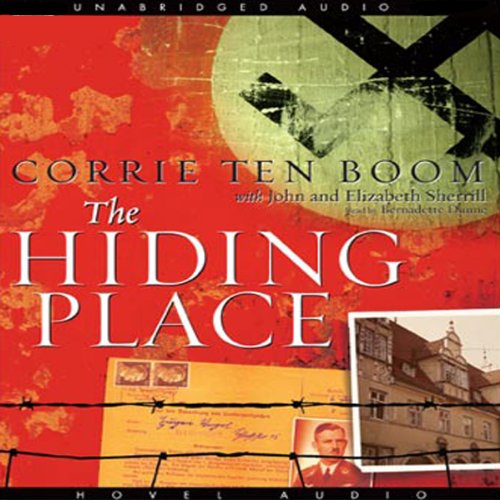
Psalm 119 supplies the title, as one response on this page takes the trouble to point out, and the line it comes from runs: thou art my hiding place and my shield. Two meanings sit inside that sentence, and this audiobook lives in the distance between them. Corrie ten Boom helped Jews escape the Nazis in occupied Holland, which required somewhere literal to put people, and she came out of the war as one of the most remarkable evangelists of the twentieth century, which required something else altogether. Nine hours and twenty-two minutes is the room the recording gives that whole transformation, and it does not feel rushed.
Collective Inspiration, Harder to Market
Corrie ten Boom's memoir arrives carrying a reputation that precedes it, and the reputation is only half of what the book actually is. Yes, it is a testimony of faith, and the response that credits the courage to nothing else reads it exactly that way: strength traced to faith in God, to obedience, to the Holy Spirit at work through a horrible stretch of history. That reading is honest and it is also incomplete, because the same pages are a Dutch Resistance account, with a household risking arrest to move people out from under an occupation. The two registers never compete here. The second is what gives the first its weight, and a listener who takes only one of them will get a smaller book than the one on offer.
Her family is the real subject, and it is the part that survives any retelling. A response from December 2025 states it plainly: what a war does to a family, how fast a life turns over, the camps, and the fact that only some of them came home to describe it. That makes this a memoir about a household rather than about a single heroine, which is unusual for a book sold as inspirational for the better part of a century. The inspiration on offer is collective rather than individual, and collective is a harder thing to market and a better thing to hear.
Two Layers of Distance in Dunne's Reading
Nine hours and change is a manageable commitment for a book carrying this much weight, and the length is one reason it still works as an entry point. Wartime memoirs run long, and this one declines to. What arrives instead is one household's experience of an occupation, told at a pace that never flattens into survey, and a story that does not stop at liberation, since the copy tells you the memoirist went on to spend decades as an evangelist heard around the world. Testimony that ends when the gates open is common. Testimony that has to account for the years afterward is rarer, and considerably more useful.
Dunne is credited with the reading, and that credit deserves a second look, because two separate layers of distance sit between the voice and the story. The memoir is written in the first person by a woman who lived through it, and it is read by a performer who did not. The copy also describes the text as retold for a new generation, which means what gets spoken aloud is an adaptation rather than the original as published. That combination can go badly. Handled properly it does something a recording by the memoirist could not: it lets the account be heard as a story that has been carried forward and handed on, which is precisely what this memoir became in the decades after the war.
A Shipping Time Folded Into the Rating
A five-star entry in this column reads, in its entirety: exactly as expected, came fast and in excellent condition. Its headline says it was great for school needs. That is a delivery note. It describes a parcel and a shipping time, and it is now folded into the number displayed beside the title on this page. A single entry does not distort a badge on its own, but it does tell you what kind of pool you are reading: one where a purchase experience and a reading experience get scored on the same five-point scale and averaged together. Weigh the written responses one at a time, because the figure above them is not filtering for relevance.
More than half the written responses read this story through faith, and the copy files the memoirist among the century's evangelists, so a listener arriving for a secular resistance narrative should know that the theology here is not decoration arranged around the history. It is the argument the book is making about why any of it happened at all. That is not a criticism, it is a fit question, and it is worth settling before you buy rather than three hours in. The story survives translation into other frameworks perfectly well. The book itself never attempts one, and it does not pretend otherwise for a paragraph.
Two More Groups Beyond the Faith Readers
Faith readers are the obvious audience and they will not need me to point them here. The more interesting question is whether anyone else should, and the answer is yes, for two groups in particular. Reach for it if you read wartime history and want the version told from inside a house rather than from above a map, where the decisions are small, immediate, and made by people with no strategic picture whatsoever. Reach for it too if you are assembling a shelf of accessible testimony for a younger reader, which is exactly the audience this retelling was prepared for, and where the October 2025 response is instructive: that listener came away holding lines from the book they expect to keep for good.
Holland under occupation is the setting, and the memoir never lets it soften into backdrop. Look elsewhere if you want a critical history of the Dutch Resistance, because this is testimony from one family and makes no claim to survey anybody else's. Look elsewhere as well when a book crediting its survival to divine guidance is a book you would spend the whole recording arguing with, since that reading is the spine of the thing rather than an interpretation you can lift out and discard. For everyone else the case is simple enough. Ten Boom's account has stayed in print across generations, and this is the version prepared to hand it to somebody who has never heard the name.
Before You Listen
What does 'retold for a new generation' mean for this audiobook?
It means the text being read is an adaptation rather than the memoir exactly as first published. The description says so directly and then leaves the details out: no reviser is named and no note explains what was condensed or simplified. If you want the original wording, confirm the edition first, because this listing does not identify one.
How long is the audiobook, and who published this recording?
Nine hours and twenty-two minutes, released by Christian Audio in July 2009. The shelf places it under biography, history and religion all at once, which is an accurate description of a book that genuinely is all three, and a useful warning if you came expecting it to be only one of them.