Quick Take
- Narration: Ethan Sawyer reads the survey material with scholarly composure, keeping the varied subject matter, Kabbalah, Sufism, alchemy, Gurdjieff, from collapsing into a homogeneous lecture.
- Themes: Western esoteric tradition as living practice, the gap between mainstream and mystery religion, Jung and Gurdjieff as modern inheritors
- Mood: Thoughtful and exploratory, like a guided tour of rooms most listeners have never entered
- Verdict: The most accessible introduction to the Western inner traditions available in audio, essential if this territory is new to you, and genuinely illuminating even with prior familiarity.
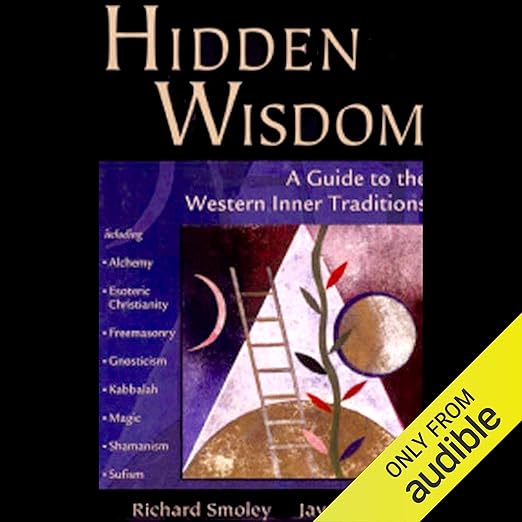
I spent a semester in graduate school studying the history of Western esotericism, a field that sits at the intersection of religious history, philosophy, and what most people would simply call the occult. The reading list for that course was dense and specialist. What I wished existed then was a single, fair-minded survey that could orient a curious person without requiring them to already know the difference between Hermeticism and Theosophy. Hidden Wisdom by Richard Smoley and Jay Kinney is essentially that book, and it has held up better than many more prestigious texts I read that semester.
Smoley and Kinney were co-editors of Gnosis magazine, which during its run was the most serious English-language publication dedicated to mystical spirituality. That background is reflected in the book’s approach: sympathetic but not credulous, scholarly but not inaccessible, and genuinely interested in what each tradition offers rather than in ranking them or debunking them. Published by Audible Studios in 2013 and running just under twelve hours at 11:56, it holds a 4.5 rating across 70 listeners. Narrated by Ethan Sawyer, the book covers Jung, Gurdjieff, the Kabbalah, neo-paganism, shamanism, alchemy, Sufism, and several additional traditions across twelve chapters.
Our Take on Hidden Wisdom
The book’s central argument is quietly significant: Western culture has its own esoteric traditions that are as rich and historically grounded as the Eastern practices that have entered mainstream vocabulary, Zen, karma, mantra, while remaining largely invisible to seekers who might benefit from them. This is not a polemical claim but an observational one, and Smoley and Kinney make it without dismissing Eastern traditions or exaggerating the accessibility of Western ones. They are writing for people who are genuinely searching and who have not found what they need in conventional religion, and they treat that search as legitimate rather than fashionable.
Reviewer Gerald Porter, describing the book as an excellent introductory overview, noted that the subjects are well-researched but not scholarly in the pejorative sense, meaning accessible without sacrificing depth. Reviewer Cindy Rhodes emphasized Smoley’s refusal to judge any of the traditions he covers: he presents them all as gifts, which is the right editorial stance for a survey text. Reviewer The Book Guy appreciated the suggested reading sections at the end of each chapter, which function as an honest bibliography for listeners who want to go deeper on any particular tradition.
Why Listen to Hidden Wisdom
Ethan Sawyer’s narration handles the tonal range the material requires. The Gurdjieff chapter reads differently from the Kabbalah chapter reads differently from the shamanism chapter, they have different histories, different vocabularies, and different emotional registers. Sawyer does not flatten these into a single scholarly tone but adjusts his pacing and delivery to match the character of each tradition. The alchemy chapter, which can easily become bewildering if presented without care, is particularly well read, he keeps the metaphorical language alive rather than draining it into abstraction.
The audio format suits a survey like this well because the listener can absorb one chapter at a time, pausing between traditions to reflect or to follow up on a suggested reading before continuing. The book does not require chapter-by-chapter continuity the way a narrative does; it accumulates rather than builds, which makes interrupted listening entirely workable.
What to Watch For in Hidden Wisdom
Reviewer C. Richard’s observation that the book often leaves you wanting to know more is accurate, but this is partly a design feature. A twelve-chapter survey of twelve distinct traditions cannot go deep on any single one, and Smoley and Kinney are honest about this constraint. The suggested reading lists are the book’s solution, they acknowledge the limitation and point toward resolution. Listeners who come to the book expecting a comprehensive treatment of any particular tradition, a full course in the Kabbalah, a deep study of Gurdjieff’s system, will need to treat this as the first step rather than the whole journey. The Sufism chapter, in particular, feels compressed compared to the richness of the tradition it is introducing.
Who Should Listen to Hidden Wisdom
Essential for anyone curious about Western esoteric traditions who does not know where to begin. Also valuable for listeners who have some familiarity with Eastern spiritual practices and wonder whether Western culture has equivalent traditions, the answer, as Smoley and Kinney demonstrate, is yes, and they are both stranger and more sophisticated than their popular reputation suggests. Those already deeply versed in Gurdjieff, the Kabbalah, or Hermeticism will find the relevant chapters introductory rather than revelatory, but may find value in the survey’s treatment of adjacent traditions they know less well. Recommended without reservation as a starting point and a map.
Frequently Asked Questions
Does Hidden Wisdom cover all the major Western esoteric traditions or just a selection?
It covers twelve traditions across twelve chapters: Jung, Gurdjieff, the Kabbalah, neo-paganism, shamanism, alchemy, Sufism, and others. It is comprehensive as a survey but deliberately introductory, each chapter is a starting point rather than a complete treatment.
Is Smoley and Kinney’s approach to the traditions sympathetic, skeptical, or neutral?
Sympathetic and non-judgmental. The authors present each tradition’s history, practice, and important figures without ranking them or subjecting them to skeptical debunking. Reviewer Cindy Rhodes described it as presenting everything without judgment, which is the accurate description.
Are the suggested reading lists at the end of each chapter accessible to general listeners?
Yes, the lists are curated for interested non-specialists rather than academic researchers. They provide a genuine path for going deeper on any tradition that captures your interest during the survey chapters.
Does the book require any prior knowledge of mysticism or esotericism to follow?
No, this is explicitly an introduction for people without existing background. The vocabulary of each tradition is explained as it is introduced. The ideal reader or listener is curious but uninitiated, and the authors write with that audience consistently in mind.