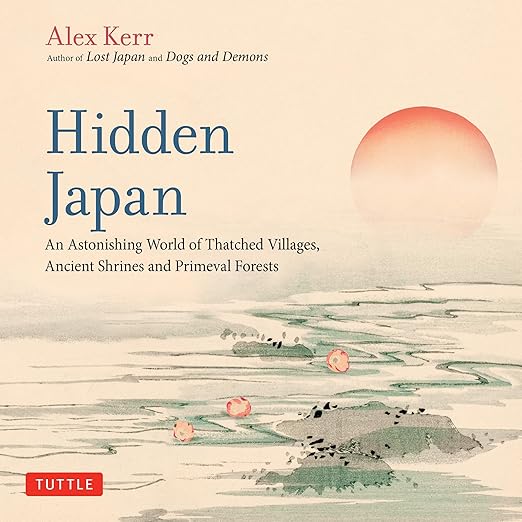
Quick Take
- Narration: Alex Kerr reading his own prose is an intimate and compelling experience, his decades-long immersion in Japanese culture gives every observation a weight that a hired narrator could not replicate.
- Themes: Cultural disappearance and preservation, the cost of modernity, finding beauty in what is being lost
- Mood: Lyrical and melancholic, the texture of a long farewell to places that deserve to be seen
- Verdict: An extraordinary piece of travel writing for readers who want depth over itinerary, not a guide to Japan but a meditation on what Japan is quietly losing.
I first encountered Alex Kerr’s name through Lost Japan, his 1993 account of cultural discovery and disillusionment that remains one of the most cited books in the genre of Japan writing. Hidden Japan arrives decades later from a writer who has spent his adult life watching the country he loves remake itself in ways he finds troubling. Listening to him narrate his own observations on a quiet weekday morning, with Japan’s mountain distances translated into sound, felt like sitting with someone who had been paying attention for a very long time.
The book is not a travel guide and should not be approached as one. A reviewer who was looking for off-the-beaten-path tourist recommendations found it too specialized and too hard-core. That is an honest response to an honest mismatch. Kerr is not mapping routes; he is asking what remains and why it matters that it remains, and the places he visits serve that argument rather than functioning as destinations to be checked off.
Our Take on Hidden Japan
Kerr’s project here is a kind of cultural archaeology in real time. He takes listeners to thatched-roof villages in misty mountains where traditional construction methods are still practiced, to the remote volcanic island of Aogashima where a volcano sits inside another volcano, to rural Tottori for a kaiseki meal made from wild herbs, to a northern village where Butoh dancers perform in snow. These are not famous places. Some of them are genuinely difficult to reach. And that inaccessibility is part of Kerr’s point, what survives in Japan survives in part because modernity has not found it profitable to pave it yet.
The prose Kerr narrates is lyrical without being self-indulgent. He has a scholar’s precision and a traveler’s eye for the telling detail. The austere beauty of kaiseki made from ingredients that cannot be bought in a supermarket is rendered with the specificity of someone who has eaten it many times and still finds it worth describing carefully. This is the advantage of the author-narrator: Kerr knows exactly which inflection each sentence requires because he wrote it.
Why Listen to Hidden Japan
A longtime Japan traveler who has been visiting since 1982 called the book an intense and effective tour that captured Kerr’s genuine concern for these secret places. Another reviewer situating it alongside Lost Japan and Dogs and Demons, Kerr’s earlier work on Japanese construction culture, noted his consistent position as a gadfly of the construction-crazed Japanese bureaucracy for over thirty years. That advocacy gives the book a moral urgency that separates it from pure aesthetic appreciation. Kerr is not just saying these places are beautiful; he is arguing that what is happening to them is wrong, and that argument makes the listening experience more charged than a conventional travel memoir.
For listeners preparing for a Japan trip and looking for depth beyond the standard Kyoto-Tokyo circuit, the book functions well as an orientation to what exists outside that frame. Not as a practical guide, Kerr occasionally has significant difficulty locating some of his destinations himself, but as an argument for why the effort might be worthwhile.
What to Watch For in Hidden Japan
The book’s greatest strength is also its limiting condition. Kerr writes from a position of deep expertise and decades of access that most listeners will not share, and he occasionally assumes a familiarity with Japanese cultural concepts, kaiseki, Butoh, the specific political history of certain conservation battles, that he does not always stop to explain. Listeners new to Japan travel will find the text richly evocative but sometimes obscure. Those with existing Japan knowledge will find exactly the depth they have been looking for.
The running time of just under six hours is modest for the ambition of the project. Some reviewers found the book rich and worth rereading; others found the rambling, personal-narrative structure less satisfying than Kerr’s more argumentative earlier work. This is a listener-temperament question as much as an assessment of quality.
Who Should Listen to Hidden Japan
Japan enthusiasts, cultural travelers interested in preservation and what modernization costs, and readers who already know Kerr’s earlier books will find Hidden Japan essential. Anyone who has visited Japan multiple times and wants language for what they half-noticed on the periphery of the tourist circuit will find Kerr articulates it with unusual precision.
Casual tourists planning a first Japan trip, or listeners who prefer travel writing that comes with practical recommendations and itineraries, will find this book addresses a different need than they have. The experience of listening to Kerr think about Japan is not the same as being told how to visit it.
Frequently Asked Questions
Is Hidden Japan suitable for someone planning their first trip to Japan, or does it assume prior familiarity?
It assumes some familiarity with Japanese culture and geography. Kerr writes for an audience that already has a frame of reference for terms like kaiseki and Butoh, and he does not always stop to define them. First-time visitors will find the book evocative and inspiring but may occasionally find themselves without enough context to fully follow a specific reference. Pairing it with a more introductory Japan title would help.
Does Alex Kerr’s self-narration add to the experience, or would a professional narrator have served the material better?
Reviewers who addressed this point found the self-narration a clear asset. Kerr’s decades of immersion in Japan give his delivery a specific gravity, he is not performing someone else’s observations, and that difference is audible. The narration is not technically polished in the way a studio-trained narrator would be, but the authority and intimacy more than compensate.
How does Hidden Japan compare to Kerr’s earlier book Lost Japan?
Lost Japan, written in the early 1990s, documented Kerr’s discovery of and falling in love with traditional Japan. Hidden Japan, written decades later, is more elegiac, the places it describes are further along the road of disappearance, and Kerr’s concern carries the weight of someone who has been watching the process for thirty years. Readers who responded to Lost Japan’s urgency will find Hidden Japan a darker and more mournful continuation of the same conversation.
Are the locations Kerr visits in Hidden Japan actually accessible to foreign tourists?
Some are accessible with effort; others are genuinely remote and require significant logistical planning. The island of Aogashima, for example, has limited transport access and unpredictable weather. Kerr himself describes considerable difficulty reaching some destinations. The book is better read as inspiration for the existence of these places than as a practical guide to visiting them.