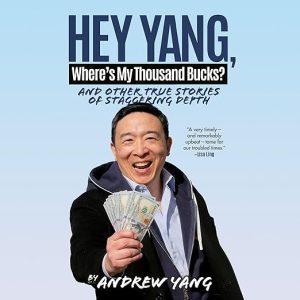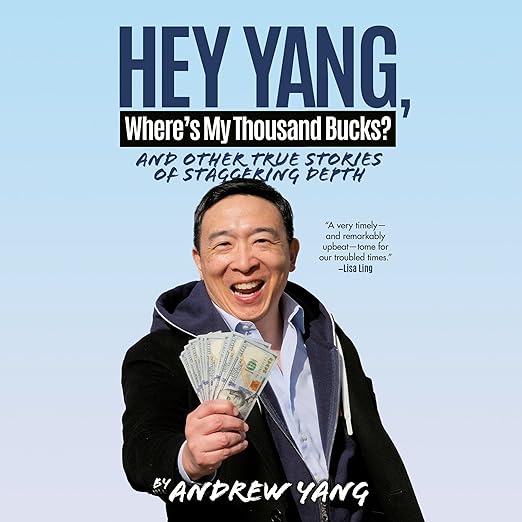
- Read by: Yang self-narrates with the comedic timing and genuine warmth of a practiced public communicator, and the result is one of his most accessible performances.
- At its heart: Universal Basic Income and political outsiders, optimism under systemic pressure, entrepreneurship and public service
- Vibe: Light and self-deprecating, with a warmth that makes even the frustrating parts of the campaign story enjoyable
- Short version: A sharp, quickly-paced audiobook for listeners wanting an insider's account of a heterodox presidential campaign without the usual bitterness.
Turning Mockery Into the Book's First Line
Andrew Yang's political autobiography is funnier than it has any right to be, and the audiobook version, narrated by Yang himself, makes the humor land in ways the printed page would struggle to replicate. I came to this audiobook with the general awareness of Yang's 2020 presidential campaign and his Universal Basic Income proposal, and I want to say that the book surprised me both in its candor and in the lightness it brings to material that is, underneath the jokes, genuinely concerned with some of the most serious structural problems in contemporary American life. At four hours and forty-three minutes, Hey Yang, Where's My Thousand Bucks? is efficient, and that efficiency suits Yang's sensibility exactly.
The title frames what the book is doing immediately: it converts the mockery that was directed at Yang's signature policy proposal and turns it into the first line of a longer conversation about why the idea matters, why it resonated, and what it cost to push it into the mainstream political debate. Yang is not writing from bitterness, which is notable for a political memoir. He is writing from something that looks more like bemusement and affection, including for the chaos of the campaign trail itself.
Yang's Timing Comes From Years of Live Audiences
Yang's self-narration is one of the audiobook's clearest assets. He has the timing of someone who has spent years translating complex economic ideas into accessible language in front of live audiences, and that skill translates directly to the audio experience. The book is described in the synopsis as 'part political memoir, part comedy, and part interior monologue,' and Yang's voice holds all three registers simultaneously. When he is joking, you feel the joke. When he pivots to something more serious, as he frequently does, the pivot is clean and the sincerity is evident.
One reviewer who describes themselves as a 'Yangster' from the launch of his first campaign noted that the book reads as a prelude to a future presidential run, particularly in its final chapters. That reading is plausible, and the audiobook rewards listening with that interpretive lens available. Whether you find Yang's optimism about American political possibility convincing or not, the consistency of his public persona and his on-record persona is striking. He writes and narrates as a man who is genuinely unbothered by the distance between where his ideas were received and where he thinks they deserved to land.
The Universal Basic Income content, what Yang calls the Freedom Dividend, receives thoughtful treatment as both policy argument and personal crusade. He explains how he came to the idea, how he pitched it, how it was received, and what he learned from the reception. For listeners interested in economic policy, this is one of the more accessible accounts of how a heterodox idea enters and moves through a political ecosystem. For listeners who already support UBI, it is a satisfying behind-the-scenes account. For skeptics, Yang makes his case with enough humor to hold attention even when the argument does not fully persuade.
Venture for America Grounds His Economic Argument
The book moves quickly, which is a strength and a mild limitation. At under five hours, it does not have space to be comprehensive about any of its subjects, and listeners wanting deep policy analysis of the Freedom Dividend, or extended treatment of Yang's entrepreneurial background, will find the coverage somewhat impressionistic. The book's mode is essayistic and anecdotal rather than argumentative in a sustained way, and that is clearly by design. Yang is after something different from a policy white paper or a conventional political biography.
The humor, described in the synopsis as 'laugh-out-loud,' is real but also notably gentle. This is not the comedic register of a political satirist. Yang's comedy is self-deprecating and warm, and it tends to defuse rather than escalate the tensions in the stories he tells. Some listeners will find that gentleness precisely what they want from a political book in a period of sustained outrage. Others may wish for a sharper edge.
The final chapters, which several reviewers have flagged as pointing toward future political ambitions, are worth listening to with some attention. Yang is not explicit about his plans, but the thematic arc of the book positions him as someone who has learned from one campaign cycle and is thinking carefully about the next.
Yang's background as an entrepreneur before entering politics gives the audiobook a layer of economic credibility that pure political memoirs often lack. He built Venture for America, a fellowship program designed to bring talented college graduates into entrepreneurship in cities outside the coasts, and that experience shapes how he talks about economic displacement, automation, and the limits of educational solutions to structural unemployment. The Universal Basic Income proposal, in this context, is not a utopian gesture but the conclusion of someone who spent years watching what happens to communities when the economic ground shifts beneath them and the policy response is inadequate.
Yang Gang Members Get the Most Satisfaction
Yang Gang members and supporters of Universal Basic Income will get the most direct satisfaction from this audiobook, but the book works well for anyone curious about the mechanics of unconventional political candidacy. Listeners fatigued by political content that leads with outrage will find Yang's determined optimism a useful tonal counterpoint.
Those seeking rigorous policy analysis, extensive economic argument, or a comprehensive account of the 2020 Democratic primary from an insider perspective should look elsewhere. This is a personality-driven memoir that works because of Yang's warmth and humor, not because of its analytical depth.
Good to Know
Do I need to know anything about Andrew Yang's 2020 campaign to enjoy this audiobook?
No background is required. Yang explains his journey from entrepreneur to presidential candidate clearly enough that newcomers can follow along, and the memoir format means context builds naturally as the stories unfold.
Does Yang's self-narration add to the audiobook experience?
Substantially. His comedic timing and self-deprecating warmth come through far more directly in audio than they would on the page, and his voice has the rhythm of someone who has delivered these ideas to live audiences many times.
Is this audiobook politically partisan?
Yang's politics are heterodox and deliberately cross-aisle in aspiration. The audiobook does not read as a partisan Democratic document, and Yang's stated goal is to 'break through the noise with humor, honesty, and heart' rather than to mobilize a specific political base.