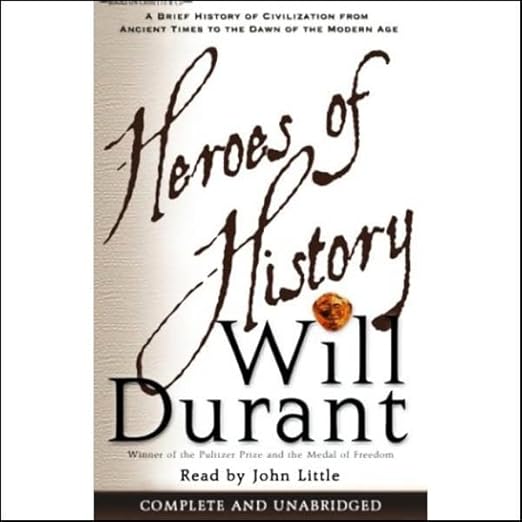
Quick Take
- Narration: Grover Gardner is among the best voices in historical nonfiction audio, and his measured, authoritative delivery gives Durant’s posthumous text the gravity it deserves.
- Themes: The individual as the engine of civilization, wisdom distilled from accumulated scholarship, the continuity of human aspiration across millennia
- Mood: Magisterial and quietly humane
- Verdict: A posthumous distillation of Durant’s life’s work that functions as both an introduction to his eleven-volume series and a genuinely moving statement about what history is for.
Will Durant died in 1981, ninety-six years old, having spent most of those years trying to make the accumulated wisdom of civilization accessible to ordinary readers. His eleven-volume Story of Civilization with Ariel Durant is one of the monuments of twentieth-century popular scholarship, the kind of project that requires both extraordinary intellectual range and a deep belief that the past is worth explaining to non-specialists. Heroes of History, discovered in a granddaughter's garage twenty years after his death, is his final attempt to distill that work into something smaller and more personal.
I first encountered Durant in my early twenties, reading The Story of Philosophy between other books, and the quality that stayed with me was his prose. He writes about ideas the way good literary critics write about novels: with genuine affection for the minds he's examining and an instinct for what is essential about them.
Our Take on Heroes of History
The twenty-one essays collected here span from Confucius and the Buddha through the Roman Empire, the Reformation, and into the Renaissance, tracing what Durant calls the individuals who helped define civilization. He is not writing a comprehensive survey but something more personal: a selection of the figures and movements that he found most formative, most worth carrying forward into whatever time a reader has left.
One reviewer describes it as the finest condensed history of philosophy they had ever read, and while that undersells the book's ambition, history and philosophy are inseparable for Durant, it captures the quality that makes this work distinctive. Durant does not just identify what Confucius or Shakespeare contributed to human thought. He situates each figure in their social, political, and economic environment and shows how those environments both produced and shaped the contribution. The history and the biography are always intertwined.
Why Listen to Heroes of History
Grover Gardner is one of the great voices in American audiobook narration, particularly in the nonfiction and history space. He brings to Durant's prose the quality it requires: gravity without pomposity, warmth without sentimentality. The twelve-and-a-quarter-hour runtime is long enough to develop real acquaintance with the figures Durant profiles without becoming encyclopedic. Gardner navigates the shifts between different civilizations and time periods without losing the thread that connects them all, which is Durant's faith that individual human beings have shaped history through the force of their ideas and their willingness to live by them.
One Spanish-language reviewer described Durant as the most engaging historian they had read, characterizing him as possibly less purely academic than some historians but enchanting in the way he describes the character and humanity of historical figures. That enchantment is precisely what Gardner's narration serves.
What to Watch For in Heroes of History
Some reviewers note that the work is a bit dated, reflecting the scholarship available to Durant in the decades before his death rather than current historiography. His interpretations of certain figures, particularly those outside the Western canon he was trained in, may feel like they need updating in light of subsequent scholarship. This is worth noting without suggesting it diminishes the book. Durant was working at the frontier of popular historical writing, and his limitations are those of his period rather than personal failures of insight.
The essays also operate at a level of generalization that specialists will find frustrating. Durant is always reaching for the essential principle, the lasting contribution, rather than the granular detail. For readers who want that distillation, it is a considerable virtue. For those who prefer their history dense with specificity, the essays may feel too summary in places.
Who Should Listen to Heroes of History
Essential for readers who have wanted to encounter Durant but found the eleven-volume Story of Civilization intimidating as a starting point. This works as both an introduction to his method and as a satisfying standalone work of popular intellectual history. Readers who enjoyed Paul Johnson's biographical approach to history, or who have found the broad sweeps of writers like Barbara Tuchman rewarding, will be comfortable in Durant's company. Those who need current scholarship or detailed primary-source engagement should supplement Durant with more recent historiography, but his prose and his framework remain genuinely valuable more than forty years after his death.
Frequently Asked Questions
Is Heroes of History a good entry point to Will Durant’s eleven-volume Story of Civilization?
Yes, it functions well as an introduction. The twenty-one essays cover the major figures and civilizations that Durant treated at greater length in the full series, and the condensed form gives readers a sense of his method, his prose, and his intellectual framework before committing to the larger work.
How does Grover Gardner’s narration handle the breadth of cultures and historical periods in Durant’s essays?
Gardner navigates the shifts between Confucius and Caesar, between the Roman Empire and the Reformation, with consistent authority and warmth. He does not over-differentiate between sections but trusts Durant's prose to carry the transitions. The result is a listening experience that feels unified despite covering thousands of years.
Is the scholarship in Heroes of History current, or does it reflect older historiography?
The book was written shortly before Durant's death in 1981 and published without significant scholarly updating. The interpretations reflect mid-twentieth-century scholarship rather than current historiography. Readers who need up-to-date historical consensus should treat this as an engaging popular synthesis rather than current academic history.
Does the book cover non-Western civilizations and figures, or is it primarily a Western canon survey?
Durant begins with Confucius and the Buddha and includes Egyptian and broader ancient civilizations in his scope. However, his training and the orientation of his work are primarily Western, and the coverage of non-Western traditions is less developed than his treatment of Greek, Roman, and European history. This is a known limitation of Durant's larger body of work.