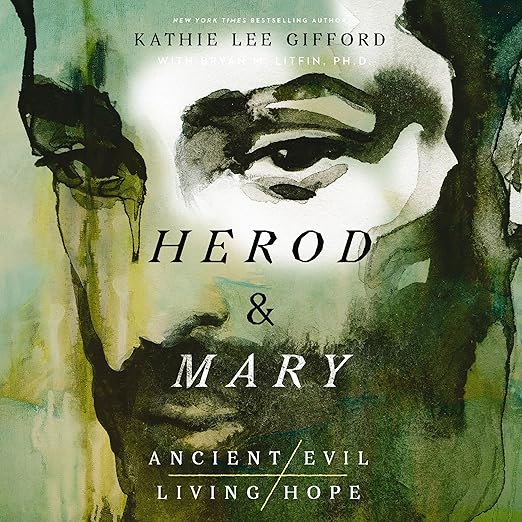
Herod and Mary works best understood as two character studies running in parallel, not one straightforward Bible story, and that structural choice is what makes this audiobook worth the eight hours and forty-nine minutes it asks for. Kathie Lee Gifford narrates, co-writing with Bryan M. Litfin, Ph.D., and the synopsis bills the whole production as 'read by the authors', tracking Herod the Great from an impressionable boy shaped by Roman power into what the book calls Christianity's first true persecutor, while following Mary of Nazareth's much quieter path toward becoming the mother of the Messiah under his rule. It is the first installment in a new series Gifford and Litfin call Ancient Evil, Living Hope.
A Coda After Every Chapter Adds Reflection
The book's most distinctive structural feature is a coda following each chapter, described in the synopsis as 'a coda between the authors,' where Gifford and Litfin discuss what was just covered, adding what the synopsis calls 'honest revelation and insightful meaning' beyond the main narrative. That is a genuinely useful device for material this historically dense: rather than leaving listeners to absorb Herod's court politics and Mary's circumstances cold, each chapter gets its own built-in reflection before moving forward, closer to a study-guide rhythm than a pure narrative history moving straight through.
Litfin's academic background clearly shapes the historical scaffolding, Jerusalem under Herod rendered as genuinely flourishing yet tumultuous, while Gifford's contribution leans into the emotional and spiritual stakes of Mary's side of the story specifically. Reviewer DebJoy highlights chapter five directly, where Herod's promotion to king coincides with Anna and her husband Joachim, traditionally identified as Mary's parents, crying out to God for a miracle, a moment DebJoy says 'gave me chills'. That kind of specific, chapter-level enthusiasm suggests the book earns its dual structure rather than just alternating perspectives for variety's sake alone.
The Series Title Previews Its Own Argument
Gifford's own credential as a New York Times bestselling author sits alongside Litfin's academic one, and the synopsis's own prose style reflects that pairing. A passage like 'the light of the world was born in a cave: not a king who maims and destroys, but the gentle King of the Jews' reads as consciously literary rather than dryly historical, a register choice that likely comes from Gifford's side of the collaboration specifically. That stylistic ambition is a real risk in narrative nonfiction, overwritten prose can undercut credibility, but the strength of reviewer response elsewhere in this listing suggests it lands as intended rather than as excess.
The series title itself, Ancient Evil, Living Hope, previews the book's structural argument in miniature: Herod supplies the ancient evil half, a study in how power corrupts across an entire lifetime, while Mary supplies the living hope half, a single ordinary young woman whose choice changes everything that follows. Naming the series this way upfront tells a listener exactly what kind of parallel to expect before the first chapter even starts, a clean, confident bit of framing for a debut series entry.
Gifford's Delivery Stays Warm, Never Performative
Gifford narrating her own material carries real weight for a book this personally invested in its subject matter. This is not a hired voice reading someone else's research; it is one of the two people who actually wrote the book, and the synopsis's 'read by the authors' framing suggests Litfin's presence is felt throughout as well, even though the narrator credit on this listing names Gifford alone. Reviewer Donna Olha mentions having her own copy signed, a small detail underlining how personally connected some of this audience already is to Gifford specifically, beyond just the subject matter itself.
Despite the serious historical and theological ground it covers, reviewers consistently describe the book as accessible rather than academic. DebJoy's review title declares it a 'MUST read' for 'Christian or non-Believer' alike, and the body backs that up, calling it an 'incredible read' that blends history, facts, and 'thrilling true events' into something that kept her 'on the edge of my seat', language usually reserved for narrative thrillers rather than biblical-era history.
Gifford's delivery throughout stays warm and conversational rather than performative, closer to the register of someone telling a family member a story she genuinely cares about than someone reading a manuscript aloud for the first time, which suits material this personally invested for her specifically. That register choice also keeps the heavier historical passages, Herod's court politics especially, from tipping into dry recitation, since her narration keeps circling back to why any of it should matter emotionally to the person listening.
A Coda Structure Some Call an Interruption
The synopsis notes that reference materials are available in a separate companion PDF download, which matters for listeners who want to verify sources or dig deeper into specific historical claims. The audio experience itself is complete as a listening experience on its own, but anyone planning to use this for serious study alongside a Bible study group should grab that companion document rather than expecting the audio alone to carry that function.
This is explicitly narrative nonfiction told from within a Christian theological framework, and listeners should know that going in rather than discovering it partway through. The book does not pretend at religious neutrality, Mary's story is framed around God's plan to bring a savior into the world, and Herod's is framed as active persecution of that plan. Readers approaching purely as secular ancient history rather than faith-inflected narrative should adjust expectations, even though DebJoy's review argues the history and storytelling still hold up for non-believers too.
The chapter-by-chapter coda structure, while valuable for reflection, does mean the book periodically steps outside its own narrative momentum to let Gifford and Litfin revisit what the chapter just covered, an interruption some listeners may find useful and others may find breaks the story's flow right when a chapter's tension has built. Listeners who prefer uninterrupted narrative nonfiction without built-in discussion breaks should know this structural choice recurs after every single chapter, not just occasionally.
The First Entry in a New Series
Christian listeners interested in biblical-era history, particularly anyone who wants Herod's political arc and Mary's spiritual one told side by side rather than separately, are the clearest audience, and this works fine as an entry point since it is the first book in the Ancient Evil, Living Hope series.
Listeners already drawn generally to biblical-era historical narrative in the tradition of faith-focused history-meets-storytelling nonfiction will find the dual-biography structure a genuinely distinctive angle worth the time, even setting the series framing aside entirely, since Herod and Mary's stories rarely get told as two halves of one deliberate argument elsewhere.
Those looking for a strictly secular, academic account of Herod's reign, without the accompanying theological framing around Mary and the Messiah, will find the balance tilted further toward faith narrative than straight ancient history.
Key Details
- Narration: Kathie Lee Gifford narrates her own material, and the synopsis bills the book as read by the authors, giving it a personally invested quality.
- Themes: King Herod's rise and fall, Mary of Nazareth, biblical-era Jerusalem
- Mood: Reflective and dramatic in turns, closer to narrative history than dry biography
- Verdict: A well-paced, faith-forward dual biography that earns its intensity through Gifford and Litfin's chapter-by-chapter reflections.