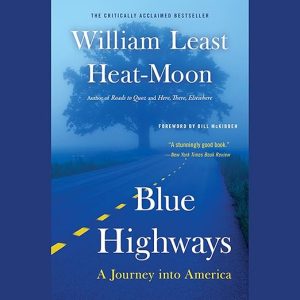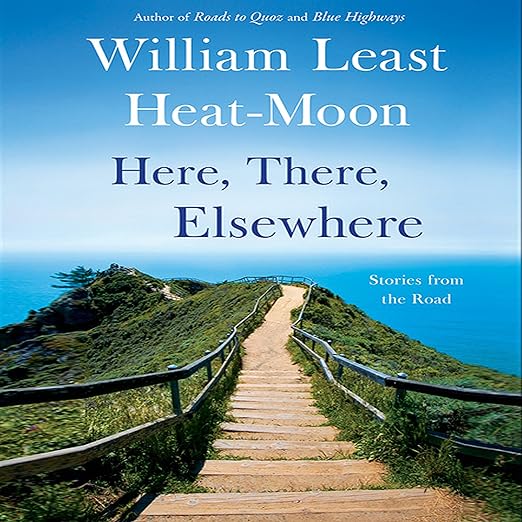
Heat-Moon roads tend to bend away from the obvious. William Least Heat-Moon built his reputation on Blue Highways, the 1982 account of traveling the back roads of America that became one of the defining texts of the American travel writing tradition. Here, There, Elsewhere, this audiobook gathering of his short-form travel writing, is not a sequel to that book but a complement to it, and in some ways a more revealing one. Where Blue Highways was a single sustained journey, this collection is plural and diverse, drawing together pieces written across decades for literary publications, and it shows the same sensibility at work across radically different scales and locations.
The pieces range geographically from Japan, England, Italy, and Mexico to Long Island, Oregon, and Arizona, from ocean shores to inland mysteries as the synopsis puts it. They were personally selected by Heat-Moon, which matters: this is not an authorized compilation assembled from a career archive but a writer in his later years choosing what he most wanted to stand for. The book also includes Heat-Moon's reflections on writing the individual pieces, a dimension that makes this audiobook something more than a travel anthology and closer to a meditation on how travel writing functions as a form.
Heat-Moon's prose has a particular quality that both his advocates and his critics tend to describe the same way: it is overly wordy. One reviewer used exactly that phrase while also noting the book is entertaining and contains fresh material. That is an accurate if compressed description of the trade-off at work in Heat-Moon's style. He does not reach for the efficient sentence when a richer, slower, more texturally dense one is available. That is a deliberate choice, not inattention, and listeners who have grown comfortable with compressed, rapid-fire travel writing in the contemporary vein should know they are entering a different kind of sensory pace here.
The short-form format is itself illuminating. Heat-Moon in Blue Highways had thousands of pages to develop observation slowly. Here, working in pieces often written for print magazines and literary journals, he has to compress his method into shorter spans. The result reveals how much his style depends on accumulation: on building a perception of a place not through a single defining image but through the layering of multiple small observations until the place feels inhabited rather than described. Some pieces in the collection achieve that compression successfully and feel complete in themselves. Others feel like portions of something larger, which is perhaps honest in a collection of short journalism and travel essays.
Highlights
Joe Barrett is a skilled audiobook narrator, and he is well-matched to Heat-Moon's prose. The challenge with this kind of writing in audio is that its rhythms are designed for the eye on the page: the sentence that turns back on itself to add a qualification, the paragraph that arrives at a destination only after establishing exactly why that destination matters. Barrett reads with the attention the writing requires, pausing where pause is earned rather than where convention suggests it, and sustaining the reflective pace that gives Heat-Moon's observations room to develop. Listeners who have experienced well-narrated literary travel writing will find the combination of Heat-Moon's prose and Barrett's delivery a natural fit.
One reviewer described the collection as a chronicle of the author's development and an opportunity to meet Heat-Moon personally through his experiences. That framing is apt. The reflections on writing that appear alongside the travel pieces do create a sense of Heat-Moon commenting on his own formation as a writer and traveler, a meta-narrative running beneath the surface of the individual essays. This dimension of the audiobook makes it something more than a greatest-hits compilation and more like a working document of a literary sensibility examined over time.
Things to Know Before Starting Here, There, Elsewhere
The collection's range of destinations and periods means that tonal consistency varies. Heat-Moon in Italy is a different kind of observer from Heat-Moon in small-town Oregon, and the adjustments in register are part of what makes the collection interesting rather than monotonous. Listeners who prefer sustained immersion in a single place or narrative will occasionally feel the collection's fragmentary nature as a limitation. But the best of the pieces, particularly those dealing with the Texas Intracoastal Waterway and the Italian Cinque Terre, demonstrate what Heat-Moon at full stretch can do with a specific place when given the space to inhabit it rather than merely describe it.
The audio format is genuinely good for this material. Travel writing, perhaps more than any other prose form, benefits from being heard rather than read. Heat-Moon's sentences were composed with attention to sound, and Barrett's narration recovers that sonic dimension from text that might otherwise be processed silently and efficiently. Listeners who have read Blue Highways or PrairyErth in print may find that encountering Heat-Moon in audio for the first time rewrites their sense of how his prose actually sounds.
Is This One for You?
Listeners who already know and love Blue Highways are the natural primary audience for this collection: it extends and deepens the Heat-Moon catalog in a different form and at a different scale, and the authorial reflections on the writing process give longtime readers new access to how the work was made. Listeners new to Heat-Moon who are interested in literary travel writing as a form will find this a strong entry point, though the episodic nature of the collection means it will occasionally feel like a sampler rather than a complete work. Joe Barrett's narration makes the audio edition worthwhile regardless of how you come to the book, and listeners who appreciate prose at the level of the sentence will find the combination satisfying across all ten hours.
Good to Know
Does the Here, There, Elsewhere audiobook require familiarity with Blue Highways or Heat-Moon's other work?
No. Each piece in the collection stands independently, and Heat-Moon's authorial reflections on writing provide context for readers encountering his work for the first time. That said, longtime readers of Blue Highways or PrairyErth will find additional layers of meaning in the collection's implicit commentary on his development as a writer.
Is the audiobook version of Here, There, Elsewhere enhanced by Joe Barrett's narration, or is print preferable for this kind of prose?
Barrett's narration genuinely suits Heat-Moon's style. Travel writing with strong sonic qualities in the prose, which Heat-Moon's certainly has, tends to benefit from an attentive reader, and Barrett provides that. Listeners who have read Heat-Moon in print may find the audio version reveals rhythms they processed silently before.
Does this audiobook work for listeners who are not typically travel writing readers but enjoy literary nonfiction?
Yes, with the caveat that Heat-Moon's pace and style are more contemplative and linguistically dense than contemporary narrative nonfiction. Listeners who enjoy literary essays, memoir, or nature writing that prioritizes perception over plot will likely find this collection rewarding. Those who prefer faster, propulsive narrative may find the pace demanding.