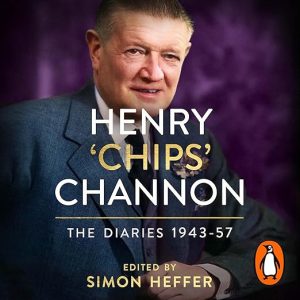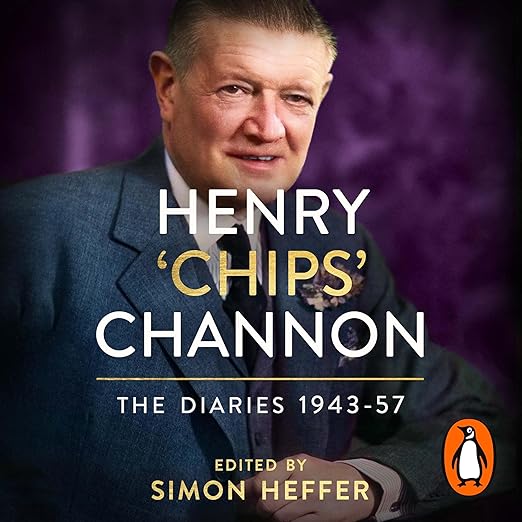
Henry Channon was born in Chicago and died a fixture of the British aristocracy he had spent his adult life auditioning for, and this final volume of his diaries covers the fourteen years, 1943 to 1957, when that transformation was essentially complete. I've been working through this three-volume unexpurgated audiobook slowly, an hour or two at a stretch over several weeks, because forty-eight hours of one man's unfiltered private observations is not something to rush, and Tom Ward's narration rewards exactly that unhurried approach. This closing volume opens as the war is finally turning toward the Allies and ends with Chips prematurely aged, still sharp-tongued but visibly declining.
Tom Ward's Careful Split Between Public and Private
Ward's central achievement across this marathon runtime is a tonal split that never announces itself as a technique. Chips's public voice, brittle, witty, endlessly gossiping about MPs' ambitions and indiscretions around Westminster, gets one register, while his private entries about his son Paul, his failed marriage to Honor, and his parallel relationships with a young officer on Wavell's staff and the playwright Terence Rattigan get a noticeably softer, quieter delivery. Ward never sentimentalizes those private passages, which would be the easy failure mode for material this emotionally exposed, and that restraint is arguably the hardest sustained trick in the whole recording.
The diaries move through some of the most consequential moments of mid-century British public life, VE Day, George VI's funeral, alongside an almost dizzying private social calendar that includes John Gielgud, Laurence Olivier, Vivien Leigh, Douglas Fairbanks Jr., Cecil Beaton, the Mountbattens, and a rotating cast of dethroned European monarchs. Ward keeps that enormous cast of real historical names legible without ever slowing into a recitation, which matters because Channon's prose style depends on momentum, one devastating aside about a dying acquaintance tumbling into the next piece of political gossip before a listener has time to fully absorb either.
Channon's set-piece chapters, his account of VE Day in the House of Commons and his description of George VI's funeral, show a different register than the daily gossip. The synopsis credits him with "rising powerfully to the occasion to capture the mood of the House" during these moments, and Ward's narration shifts accordingly, finding a more ceremonial pace for entries that function almost as historical reportage rather than private confession. Those chapters make a strong case that Channon, whatever his personal failings, understood exactly when a historical moment demanded he rise to meet it.
Calling Lloyd George a Wicked Rogue of Charm
Channon's real gift, and the reason this diary has outlived nearly every politician he wrote about, is a talent for the devastating one-line obituary. He calls the Archbishop of Canterbury a "fat fool of 63", dismisses Lloyd George as a "wicked unscrupulous rogue of charm", and writes that George Bernard Shaw "died as he lived, very selfishly". None of that cruelty reads as mean-spirited so much as compulsively honest, the diary of a man constitutionally unable to let a hypocrisy pass without commenting on it, even, especially, when the hypocrisy belongs to someone he had just been fawning over in person days earlier.
This unexpurgated three-volume edition restores material that earlier, more heavily cut editions of the diaries left out, and longtime readers of Channon consistently describe this fuller version as a real improvement over what came before. One reviewer, Nina Ritchie, put it simply: the three-volume edition is "much above the first version", and having sat with roughly two-thirds of this volume's fourteen years now, I understand why. The gossip lands with more context, the private material reads less redacted and more honest, and Channon's reputation as the "greatest British diarist of the 20th century" holds up better with the fuller record intact.
The cuts made to earlier editions weren't arbitrary. Homosexuality remained a criminal offense in Britain until 1967, which meant Channon's original editors had strong legal and social incentives to soften or remove his relationships with men entirely from any published version during his lifetime and for decades after. This unexpurgated edition restores that material specifically because enough time has passed for it to be published without endangering anyone, and hearing it read plainly by Ward, rather than encountering it as a scholarly footnote explaining an omission, changes how completely the private Channon comes through.
To Erase a Chicago Birth and Become English
Forty-eight hours and seventeen minutes is an enormous commitment for a single audiobook, longer than most people spend on an entire month of casual listening, and this volume assumes real familiarity with Channon's earlier two volumes and with mid-century British political figures generally. One reviewer, Craig, is candid that Channon's frankness about his own affairs takes some getting used to, but argues that his placement inside high society still makes the diary "a choice window on that world", and I'd agree that Channon's total lack of self-editing about his own conduct, unflattering as it sometimes is, is precisely what makes the diary trustworthy rather than a sanitized memoir written for posterity.
A second reviewer, Cbryce, notes that by this final volume it becomes clear how much Channon's Chicago birth shaped him: he seems to have spent decades trying to erase his American origins and any trace of not being born into British aristocracy. That self-invention runs through every entry here, the studied Englishness, the cultivated friendships with the actual titled and dethroned, and it sits in genuine tension with the one relationship in the book that reads as completely unguarded, his devotion to his son Paul, which never curdles into the performance the rest of his social life clearly is.
A Closing Volume for Readers Already Invested
This closing volume rewards readers of twentieth-century British political and social history, listeners who enjoyed diarists like James Lees-Milne or Harold Nicolson and want the same insider access with a sharper, crueler wit attached to it. Anyone who has already invested in the first two volumes should absolutely continue here; the payoff of watching Chips's health and social standing both erode across these final entries, while his tongue stays as sharp as ever, is the whole point of reading a diary through to its natural end.
Forty-eight hours of one aristocrat's private diary is a genuine time commitment, and listeners who have not heard the first two volumes should start there rather than jumping in at 1943, since Channon assumes deep familiarity with people and relationships established earlier in the series. Readers wanting a tidy political history with clear stakes and resolution, rather than the meandering, gossip-heavy accumulation of one very specific and very compromised man's daily observations, will likely find the density more exhausting than illuminating.
A Few Questions About Henry ‘Chips’ Channon: The Diaries (Volume 3): 1943-57
Do I need to listen to the first two volumes of the diaries before starting this audiobook?
Yes, strongly recommended. This third volume assumes deep familiarity with people, relationships, and events established across the first two, so starting here means missing significant context.
How long is the Henry 'Chips' Channon Volume 3 audiobook?
Forty-eight hours and seventeen minutes, one of the longest single titles in this category, covering the years 1943 to 1957.
Does Tom Ward use different voices for the many historical figures in the diaries?
Not distinct character voices exactly. Ward differentiates registers rather than doing impressions, shifting subtly between Chips's brittle public wit and his softer private tone rather than voicing dozens of individual historical figures separately.
Is this audiobook a reasonable starting point for listeners unfamiliar with mid-century British politics?
It's a difficult entry point for complete newcomers. Channon assumes real familiarity with Westminster figures and mid-century British social history, so some prior grounding makes the density considerably more rewarding.