Neville Chamberlain fighting for his political life in May 1940 is the kind of scene most history audiobooks only reconstruct secondhand, but Chips Channon was in the room, reassuring the prime minister directly before watching his fortunes collapse within days. This second volume of Channon's diaries picks up in the heady aftermath of the Munich agreement, when Chamberlain was still being credited with averting war, and carries listeners through the unraveling of appeasement and into the early, uncertain years of the Second World War. Can a socialite's eye for gossip really carry that much historical weight? Across more than forty-eight hours of audiobook, the answer turns out to be yes, more often than expected.
Pushed Slowly Out of the Rooms That Mattered
What separates this from a dry political record is Channon's proximity: he chats with Winston Churchill while the two men inspect the bombed-out chamber of the House of Commons, charts the war's progress from his desk at the Foreign Office, and records the exact moment his own influence starts to fade after his boss Rab Butler departs for the Ministry of Education. The diaries do not just describe the war from a distance; they document what it felt like to be pushed slowly out of the rooms where decisions were made.
Ward Lets the Marriage Passages Soften
Narrator Tom Ward carries this extraordinary runtime without ever sounding like he is coasting through it, which matters enormously across forty-eight hours and twenty-eight minutes of continuous diary entries. His real skill is tonal: Channon's brittle, witty social voice, the one deployed at dinners with Noel Coward or gossip about European royalty, gets a distinctly different treatment than the quieter passages about his collapsing marriage and his deepening friendship with a young officer on Wavell's staff. Ward lets that second register soften without ever tipping into sentimentality.
This is a bestselling series in its own right, marketed as the remarkable, widely read diaries of a single, singularly well-connected man, and that popularity is worth noting alongside the historical value: these are not obscure archival documents but a genuinely popular entry point into interwar and wartime British social history, one that has clearly found a dedicated audience across all three volumes.
Penguin's backing of this production, credited plainly at the start of the audiobook, is worth noting as its own signal: a major publisher committing to a forty-eight-hour-plus audio edition of a diary this dense represents real investment in the format, not a quick catalog filler, and it suggests genuine confidence that the audiobook audience for this material is substantial.
The War Must Be More Than Half Over
The name-dropping alone is remarkable: Prince Philip, General de Gaulle, and Lord Alfred Douglas, Oscar Wilde's former lover, all pass through these pages alongside dinners with European royal dynasties and running commentary on the gossip and scandal of London society. But reviewer Customer5 pushes back on the idea that this is mere gossip, calling the work 'a masterpiece of prose' and describing Channon's output across all three volumes as a genuine history of a vanished culture rather than tabloid material dressed up in a diary format.
The volume closes on an unexpectedly hopeful note: recording the fall of Mussolini in July 1943, Channon reflects, 'The war must be more than half over.' That line lands with real weight after forty-eight hours spent inside his daily anxieties and shifting alliances, and it is a good example of why these diaries work as audio specifically, the accumulation of small, dated entries builds a sense of lived time that a condensed history book cannot easily replicate.
Reviewer Customer5 offers a striking statistic worth sitting with: across all three volumes, Channon reportedly wrote more than two million words over the decades he kept these diaries. That scale helps explain why a single volume runs past forty-eight hours, and it reframes the whole project less as an occasional habit and more as a genuinely obsessive, lifelong act of documentation, one most listeners will never match in their own journaling.
Spectacularly Wrong About Almost Everything, Cbryce Says
Reviewer Charles Kovacs is blunt about the diarist himself, describing an American-born social climber who married into the Guinness family on his way to becoming a Member of Parliament, and reviewer Cbryce goes further, finding real satisfaction in the fact that Channon was, in that reviewer's words, 'spectacularly wrong about almost everything' he predicted politically. Listeners expecting a wise or admirable narrator should recalibrate; the pleasure here is closer to eavesdropping on a deeply flawed, endlessly vain man who happened to have extraordinary access.
Even the Penguin Edition Prefers Chips to Henry
This is the second entry in a three-volume set, and while the diary-entry format means a listener could plausibly start here without total confusion, doing so sacrifices the earlier social context that makes Channon's wartime anxieties land as sharply as they do. At more than forty-eight hours, this is also a genuinely enormous commitment, closer to a monthslong companion piece than a single audiobook to finish over a couple of weekends.
Tracking the sheer number of named figures, Chamberlain, Churchill, Rab Butler, Noel Coward, Prince Philip, General de Gaulle, Lord Alfred Douglas, across forty-eight hours of audio is a genuine challenge without a printed index to flip back to. Listeners unfamiliar with 1930s and 1940s British political and social circles may want to keep notes or a quick reference open nearby rather than trying to hold every name and relationship in memory.
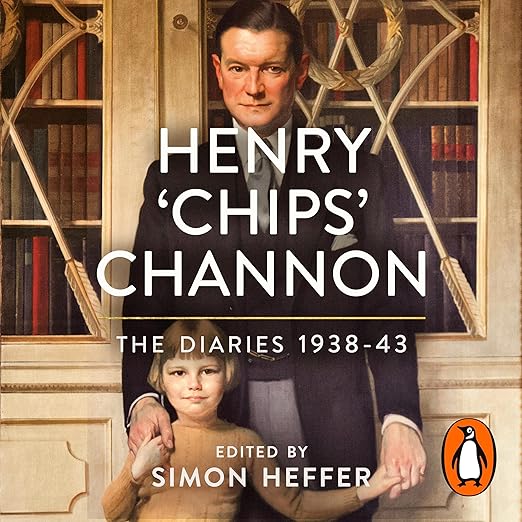
It is worth noting how completely the nickname has taken over even the formal packaging: this audiobook is titled Henry 'Chips' Channon, not simply Henry Channon, a small detail confirming just how thoroughly the social persona eclipsed the given name, even decades later in a scholarly Penguin edition.
A Guest List Taken as Seriously as a Cabinet
A real appetite for British political and social history of the appeasement and early war years is the main prerequisite here, especially for anyone drawn to primary-source material over secondhand historical narrative. Fans of gossipy, character-driven nonfiction, the kind that treats a dinner party guest list as seriously as a cabinet reshuffle, will find plenty to enjoy in Channon's eye for both.
The extreme length is also a real selling point for a specific kind of listener: anyone who treats a very long audiobook as a long-term companion for commutes, chores, or extended travel, rather than a discrete story to finish within a week, will get more out of forty-eight hours of Channon than someone looking for a tighter, more conventional listen.
Channon himself is, by nearly every reviewer's account, a genuinely unappealing narrator of his own life, vain about his appearance and weight, snobbish, and frequently wrong, so anyone who needs a sympathetic protagonist to stay engaged should look elsewhere. The sheer length is its own filter too; committing to forty-eight-plus hours only makes sense for listeners who already know they want this specific slice of history in this much detail.
At a Glance
- Voice: Tom Ward sustains this enormous diary across more than forty-eight hours without flagging, quietly separating Channon's brittle social wit from his softer private register.
- Big ideas: eyewitness political history, British high society, wartime diplomacy and gossip
- Atmosphere: gossipy yet historically weighty, brittle wit shading into real melancholy
- Worth it?: An essential primary source for WWII-era British political and social history, but only for listeners genuinely ready to commit to its enormous length.
Do I need to listen to Volume 1 before starting this audiobook?
Volume 1 establishes Channon's earlier diary voice and social standing, so starting there first helps Volume 2's political stakes land harder, though this entry can technically be followed on its own.
How does this audiobook's narrator handle such an enormous forty-eight-hour runtime?
Tom Ward sustains consistent energy throughout and separates Channon's public wit from his private emotional passages through subtle shifts in delivery rather than dramatic voice changes.
Does this audiobook cover the entire Second World War?
No, it runs from the aftermath of the Munich agreement through the fall of Mussolini in July 1943, with the diaries' third volume presumably continuing the story from there.