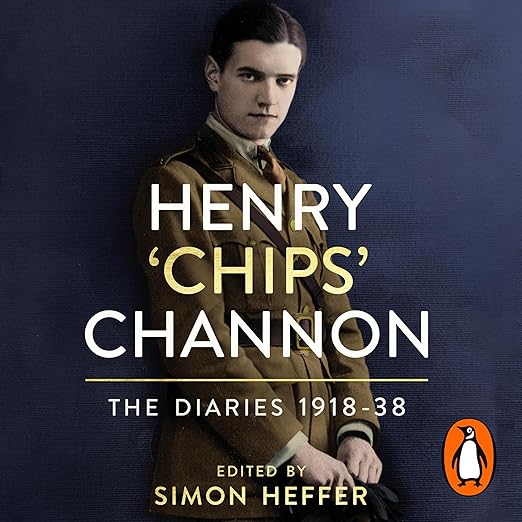
Edward VIII's abdication crisis unfolds through gossip, dinner parties, and society drama rather than official history in this audiobook, which is exactly the vantage point that makes Chips Channon's diaries so valuable. Born in Chicago in 1897, Channon settled in England after the Great War, married into the wealthy Guinness family, and served as Conservative MP for Southend-on-Sea from 1935 until his death in 1958. His actual political career was, by his own diaries' account, largely unremarkable. What he witnessed and recorded while attending everything and knowing everyone was anything but.
It's His View and Only His View
This volume covers the material that made a heavily abridged and censored 1967 edition famous even in its cut-down form: the antics of interwar London society, the growing scandal around Channon's close friends Edward VIII and Wallis Simpson, and the mood inside the House of Commons as the Munich crisis approached. What sets this release apart is that it presents the diaries in full for the first time, restoring material the earlier censored edition left out entirely.
Reviewer doggyfriend captures why that completeness matters: 'it's his view and only his view that makes it so wonderful,' praising the diaries precisely for their unfiltered subjectivity rather than treating that bias as a flaw to correct for. Channon's worldly connections, his private life, and his often unflattering judgments of the era's major figures are presented raw, exactly as he wrote them at the time rather than smoothed over decades later.
Channon's own biography reads like foreshadowing for the diaries' central tension: born in Chicago in 1897, he arrived in England after the Great War and effectively out-Britished the British, marrying into the Guinness fortune and eventually representing an English constituency in Parliament for over two decades. An American-born outsider becoming this thoroughly embedded in the exact social world he spent thousands of pages dissecting gives his observations a specific double vantage, fully inside the rooms he's gossiping about, while never entirely losing an immigrant's eye for what made that world strange.
Tom Ward Splits Brittle Wit From a Softer Register
Narrator Tom Ward sustains real energy across this volume's nearly forty-hour runtime, a genuine technical demand for diary-form nonfiction with no chapter breaks to reset a listener's attention. More impressively, he differentiates Channon's brittle, witty public social register from a softer, more private emotional one without ever tipping into sentimentality, letting the quieter passages land with their own weight rather than dramatizing them for effect.
Craig Calls It Foppish Gossip and Spoiled Excess
Reviewer Craig's account of working through the diaries, describing himself as unable to turn away despite calling the material 'foppish gossip and spoiled excess,' captures the addictive quality that makes this material work so well in audio specifically. Channon's eye for the telling social detail, whoever snubbed whom at which dinner, exactly how a scandal was discussed in private, translates naturally into the kind of listening that keeps pulling you into the next entry.
The synopsis's own description of the prose, 'elegant, gossipy and bitchy by turns,' names three genuinely distinct registers rather than one consistent voice, and that variety is a real part of the listening appeal: the same diary entry that delivers a cutting social putdown can turn genuinely moving, or quietly guarded, in the next paragraph, particularly around the private relationships and 'deep secret' reviewer doggyfriend references, material Channon kept carefully hidden from his public political life at the time.
Cbryce Clocks Zero War Work From Channon
This is Volume 1 of a multi-volume unabridged set, and reviewer Cbryce's account of already being 'on the second volume now, the WWII years' confirms this installment does not carry the story all the way through the war. Listeners expecting a complete cradle-to-grave account in one purchase should know upfront this is the opening chapter of a longer project, ending well before Channon's final years in Parliament.
Cbryce also flags a real tonal tension worth knowing about going in: despite two World Wars unfolding around him, Channon's diary remains fixated on society gossip almost to the point of parody, doing what the reviewer dryly calls 'zero war work' even once the fighting starts. Listeners hoping for a war memoir or serious political analysis will instead get a self-interested socialite's eye view, which is precisely the point but not what every history listener wants.
Reviewer Craig's own shorthand for the complete project, 'three volumes of one thousand pages' worth of material by his account, gives a sense of scale for how much exists beyond just this first volume, useful context for listeners deciding whether to commit to Channon's diaries as an ongoing multi-volume project rather than a single self-contained listen.
An Unremarkable Career Behind a Remarkable Record
Readers of political and social history, fans of gossipy primary-source diaries in the tradition of famous historical journal-keepers, and anyone fascinated by interwar British high society and the abdication crisis from a genuine insider's seat are the strongest audience for this one.
The specific irony reviewers keep circling back to, a genuinely unremarkable political career producing an anything-but-unremarkable private record, is itself part of the appeal: listeners get access to history's texture, who actually said what at which dinner party, precisely because Channon was never important enough on his own to have his candor filtered by the demands of a major public reputation.
Skip it if you want a sympathetic protagonist or a comprehensive account of Britain's wartime effort, since even admiring reviewers describe Channon as self-interested and largely disengaged from the era's larger crises, or if nearly forty hours of one man's social diary sounds like more commitment than the subject matter justifies for you personally.
At a Glance
- Voice: Tom Ward sustains real energy across nearly forty hours, subtly distinguishing Channon's public wit from his private emotional register.
- Big ideas: Interwar British high society, the abdication crisis, self-interested political diary-keeping.
- Atmosphere: Gossipy, immersive, historically rich.
- Worth it?: A genuinely addictive insider's account for social and political history fans, best started here rather than with a later volume.
Before You Listen
Do I need to listen to this audiobook in order, or can I start with a later volume?
Starting with Volume 1 makes the most sense, since it establishes Channon's world, his social circle, and the abdication and pre-Munich crisis periods that later volumes, including the WWII years, build directly on.
Does the Henry Chips Channon diaries audiobook cover World War II in detail?
Not this volume. Reviewer accounts confirm the WWII years arrive in the second volume, and even then, Channon's diary reportedly stays focused on society life rather than war work.